Get Full Government Meeting Transcripts, Videos, & Alerts Forever!
Get email alerts on the Veteran Reentry topic
No spam. Unsubscribe anytime.
Bill would require jails to identify veterans, connect them to VA services
Summary
Senate Bill 179 would require correctional institutions to incorporate the Veterans Reentry Search Service or similar veteran-identification tools into jail registries so incarcerated veterans can be verified and referred to VA and local veteran services. Senator Johnson sponsored the bill and said it passed unanimously in the Senate committee and
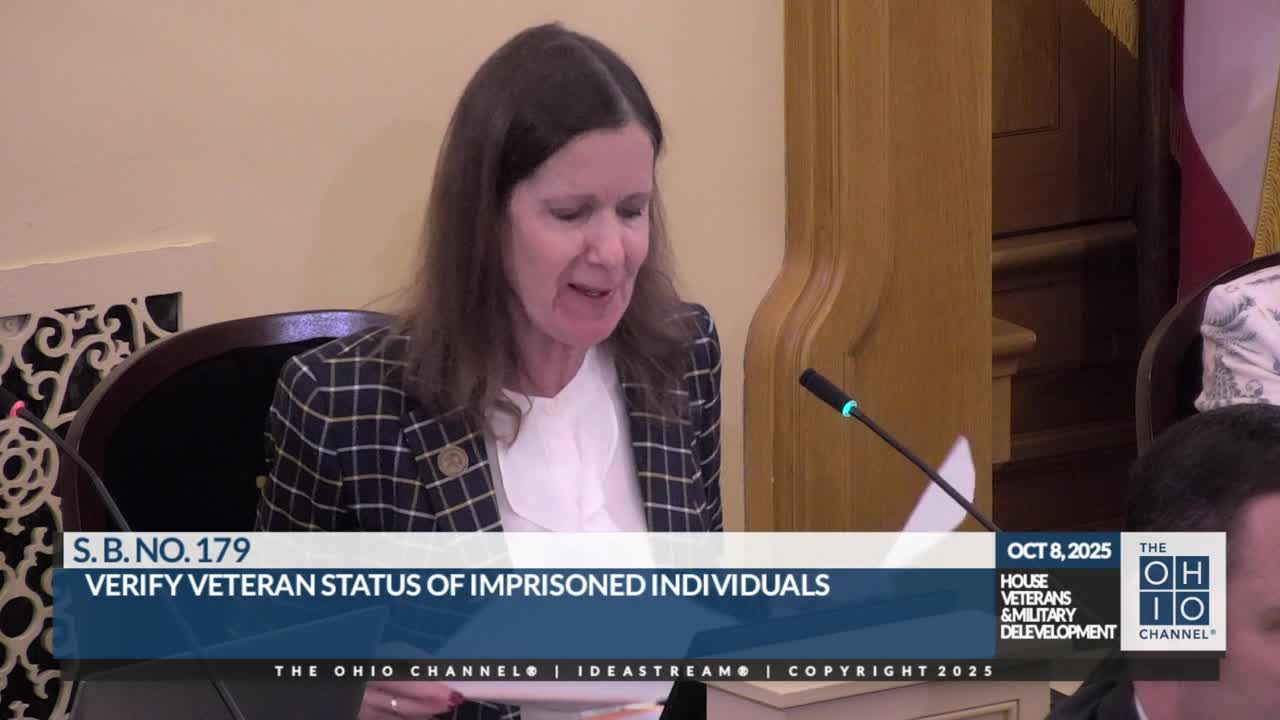
Senate Bill 179 would require correctional institutions to integrate the Veterans Reentry Search Service (VRSS) or comparable identification tools into jail registries to ensure incarcerated veterans are identified and connected with federal, state and local veteran services, the bill’s sponsor told the House Veterans and Military Development Committee during a first hearing.
"By tracking these individuals, we'll be better equipped to assist them when it comes time for their reentry to civilian life," Senator Johnson said, describing the VRSS tool maintained by the U.S. Department of Veterans Affairs and the bill’s verification and outreach steps. Johnson cited a 2021 Ohio Department of Rehabilitation and Correction report that identified about 2,582 veterans—roughly 6% of the state prison population—as the most recent public data point.
Under the sponsor’s description, correctional staff would use VRSS (or an approved alternate system) to identify individuals who served, verify veteran status and eligibility, and assist the person in contacting the VA, the County Veterans Service Commission, local veterans service organizations and Veterans Justice Outreach Program representatives. The bill would also require County Veterans Service Commissions to assist veteran treatment courts in setting up outreach programs.
Johnson told the committee his office is working with the Legislative Service Commission and the Ohio Judicial Conference to add language that allows other vet-identification systems that refresh more frequently than VRSS; he said that approach aims to avoid missing veterans served by alternate databases. "We certainly don't want to miss anyone that we otherwise would not," he said.
Committee members asked operational and coverage questions. Representative Thomas asked whether identification could shift certain health-care costs from counties or the state to the VA; the sponsor said identification is a prerequisite to connecting veterans to VA services but that in-jail access and transportation involve additional constraints and judicial discretion. Representative Gumbari asked whether the bill would catch veterans of all discharge statuses; the sponsor said VRSS may not capture everyone and acknowledged amendments to permit other identification programs could improve coverage.
Members suggested operational improvements, including a hotline sheriffs could use to verify veteran status quickly. The sponsor said the committee’s intent is to make identification and referral as simple as possible, while also refining the bill to account for VRSS’s lag time in smaller jails. SB 179 passed unanimously out of the Senate Armed Services, Veterans Affairs and Public Safety Committee and passed the Senate 33-0; the House committee conducted a first hearing and took no vote.