Get Full Government Meeting Transcripts, Videos, & Alerts Forever!
Get email alerts on the Ethics Legislation topic
No spam. Unsubscribe anytime.
Commission on Ethics seeks statutory fixes for whistleblowers, staff privacy, gift rules and first-time waiver for late filers
Summary
The Florida Commission on Ethics presented four legislative proposals to the Senate Committee on Ethics and Elections: broadened Whistleblowers Act coverage, a public-records exemption for commission staff and commissioners, expanded family definition for gift reporting to include foster relationships, and a first-time waiver for late filers of财dis
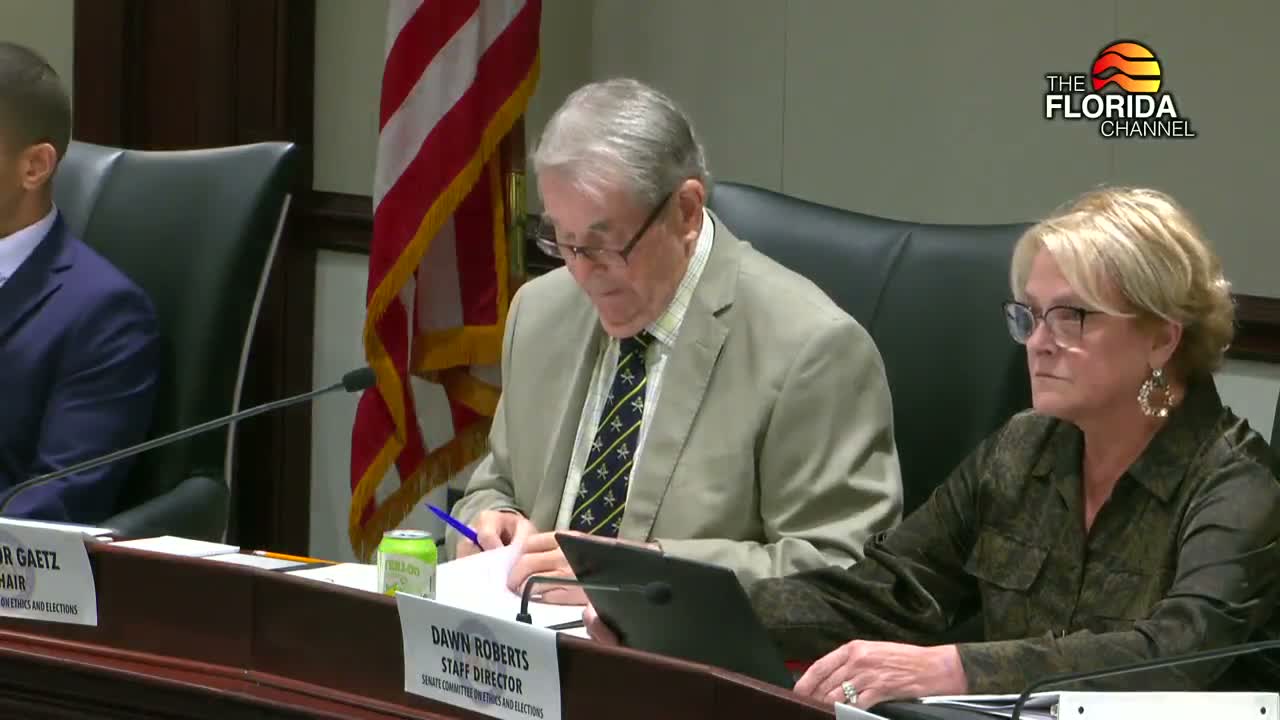
The Florida Commission on Ethics asked the Senate Committee on Ethics and Elections on Nov. 1, 2025, to sponsor four changes to state law and several technical fixes to improve transparency, safety and enforcement.
John Phillips, chairman of the Commission on Ethics, told the committee the commission has four major legislative proposals. "The first is the Whistleblowers Act," Phillips said, explaining that current protections do not always cover reports that come to the Commission on Ethics, including some conflict-of-interest complaints. He thanked Chairman Gates for sponsoring Senate Bill 92, which the commission believes addresses that gap.
Phillips also requested a public-records exemption for "sensitive personal information and addresses of the commission staff and its commissioners," citing repeated threatening calls and security incidents. "In this time where we're having more political violence, more strife," he said, the commission has increased security at meetings and offices.
The commission asked the Legislature to expand the statutory definition of "family" for gift-disclosure purposes so that foster parents and foster children are explicitly included, saying the change would better reflect modern family relationships.
Phillips described a fourth proposal to allow a first-time waiver of late-filing fines for financial disclosures. Under current law, fines start at $25 per day up to $1,500; the commission said individuals who reached the maximum fine would remain ineligible for the waiver and that the waiver would be limited to first-time late filers. Phillips said the proposal is modeled on an existing lobbyist-registration waiver that reduced repeat violations.
Carrie Stillman, executive director, presented technical clarifications and operational requests. She asked that appeals of fine assessments be considered timely if postmarked within the statutory 30-day appeal period, noting delays in mail can result in otherwise timely appeals being rejected. Stillman also asked the committee to clarify that individuals appointed to fill vacant elected seats must file Form 6, and to extend the statutory training requirement so that appointees who fill municipal elected terms must receive the mandatory annual ethics training now required of elected municipal officers.
Stillman recommended a statutory clean-up to clarify where Form 10 (annual gift disclosures) must be filed. She explained the shift to electronic filing for Forms 1 and 6 has reduced the number of physical filing locations and created confusion about where paper Form 10s should be submitted; repealing outdated filing-location language would make it clear that Form 10s are filed with the Commission on Ethics.
On administration and enforcement, Stillman reported wide adoption of electronic filing and new automated fines. The commission said 38,074 public officers and employees were required to file Form 1 or Form 6 in 2025 and that compliance had risen to 99.24% after outreach and a grace period. "This year as of September 2 ... we had an overall compliance rate of 98.1%" before late fines began, Stillman said, and automated fines are now assessed in real time.
Steven Ziolkowski, deputy executive director and general counsel, provided a litigation update on two federal constitutional challenges. He summarized Garcia v. Stillman, which involves the in-office lobbying ban adopted following Amendment 12; a district court found the ban unconstitutional and entered a permanent injunction that the Eleventh Circuit stayed pending appeal. He also described Loper v. Lucas, a challenge by municipal officers to the 2023 requirement that municipal elected officers file Form 6; cross-motions for summary judgment were filed and the district court has administratively stayed the case pending a ruling.
Committee members asked whether tougher disclosure rules had discouraged candidates from running; Stillman said the commission continued to receive questions during qualifying and that filings continued.
Why it matters: The proposals would affect reporting duties, public-records access, security for ethics staff and the fines and appeals processes that enforce disclosure compliance. The litigation updates could alter enforcement of key ethics rules if courts change current statutory requirements.
The commission requested sponsors for the outstanding proposals and offered technical language for the committee's consideration.