Get Full Government Meeting Transcripts, Videos, & Alerts Forever!
Get email alerts on the Water Conservation Landscape topic
No spam. Unsubscribe anytime.
Planning commission debates Waterwise Landscape ordinance; proposes $1,000 residential completion bond amid enforceability concerns
Summary
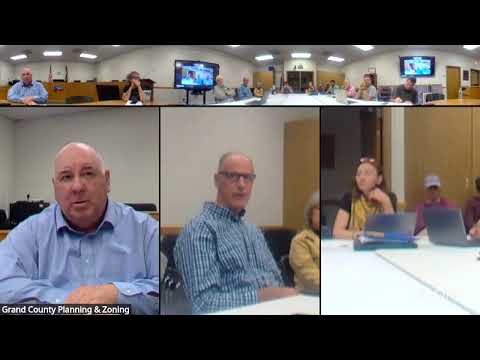
The Grand County Planning Commission held a public hearing on Oct. 27 on a Waterwise Landscape ordinance that would limit turf and require drought‑tolerant landscaping; commissioners debated enforceability and a proposed $1,000 residential completion bond.
The Grand County Planning Commission held an extended public hearing Oct. 27 on a proposed Waterwise Landscape ordinance that would restrict turf in narrow strips, cap residential front/side lawns at 50% (with exceptions for very small lots), limit common‑area lawn in nonresidential projects to 20%, and promote native and drought‑tolerant plantings and permanent underground irrigation.
Staff said the draft was intended to align county code with the state turf‑buyback program and to separate requirements for residential and nonresidential development. Katie, a community advocate, submitted a separate draft and an email from the Department of Natural Resources clarifying that the turf‑buyback program does not expire; she urged the commission to consider her work. Haley of the Division of Water Resources told the commission the DWR would like the county to adopt the measure and that landscaping requirements could be integrated into the county’s water element of the general plan.
Commission discussion focused on implementation and enforceability. Commissioners debated whether to include a sunset clause to make the ordinance temporary while the county completes a full land‑use code rewrite; staff advised the state prefers no sunset clause. Several members raised that current code contains landscape requirements that are infrequently enforced and that requiring full installation before a certificate of occupancy (CO) is impractical for builders. Commissioners proposed alternatives: require a backflow preventer before CO, allow up to one year for completion, enforce through code enforcement, or require a completion bond deposited at permit issuance and released upon completion.
Commissioner Jerry moved to amend the favorable recommendation to incorporate staff edits and specific changes: break out residential and nonresidential sections; add a $1,000 residential completion bond required at building‑permit issuance and released after one year if landscaping is completed within that period; change references from “planning commission” to “planning department” in section F(2)(a); and clarify that screening standards apply to nonresidential development. The motion was seconded. The transcript records debate, a roll call discussion and at the vote some members stated opposition and at least two members (identified in the record as Mary and Laurel) abstained. The transcript contains conflicting procedural comments about whether the amended motion passed; the final clear numerical tally is not explicitly stated in the hearing record provided.
Given the number of outstanding editorial and substantive questions, several commissioners recommended a continued review and a possible workshop to finalize language and enforcement mechanisms. The public hearing record was closed for verbal testimony but the chair reminded attendees they have 10 days to submit written comments to the County Commission.