Get Full Government Meeting Transcripts, Videos, & Alerts Forever!
Get email alerts on the Urban Mobility topic
No spam. Unsubscribe anytime.
UDOT and Salt Lake City present mobility and environmental analysis of highway‑reduction strategies
Summary
UDOT presented a mobility and environmental impact analysis of Salt Lake City's highway‑reduction strategies (HRS) required under SB 195, using signal performance, continuous counts and private probe data with travel‑demand and microsimulation modeling. The study found mostly negligible cumulative environmental impacts but mixed localized effects;
Utah Department of Transportation staff presented a multi‑method mobility and environmental analysis of Salt Lake City highway‑reduction strategies (HRS), conducted under the requirements of Senate Bill 195. The study examined completed and planned HRS corridors, used large datasets (signal performance metrics, continuous counts and private cell‑phone probe data) and ran travel‑demand and microsimulation models to isolate corridor impacts.
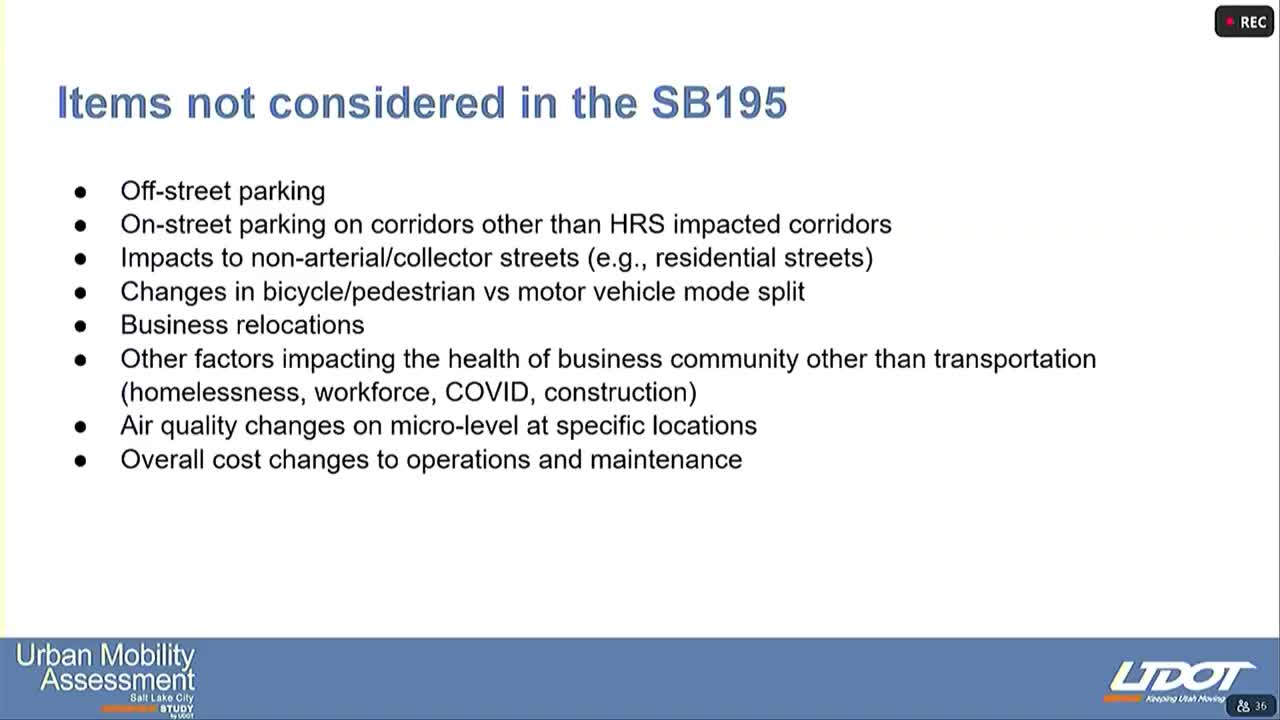
Carlos Perreira summarized the methods and caveats: the analysis relied on very large datasets (tens of millions of signal or probe records), but isolating HRS impacts is difficult because the study period included COVID‑era traffic changes, major construction projects, signal‑timing adjustments and substantial residential growth (the study area population rose about 30% over the last ten years). UDOT used a 3‑quarter‑mile influence band around corridors and used microsimulation for operational details such as lane tapers and driveway friction.
Perreira reported the principal findings: at the study‑area level the cumulative environmental impacts were negligible; localized results varied with some corridors showing modest vehicle‑mobility degradation while others showed improved safety, better transit or improved active‑transportation outcomes. On‑street parking changed locally (some corridors lost parking, others gained), and the report documented stakeholder concerns about construction disruptions, emergency‑response timing and business access during construction. The study recommended a tiered approach for future projects — identifying vehicle‑capacity routes to preserve, studying proposed reductions, and enhancing signal operations and community engagement.
Salt Lake City Mayor Erin Mendenhall told the committee the city is finalizing its mobility plan and will present it to the committee on Nov. 19. Committee members asked technical questions about probe data anomalies and about next steps for UDOT‑city cooperation; Perreira said operational signal improvements and improved engagement would be priorities.