Get Full Government Meeting Transcripts, Videos, & Alerts Forever!
Get email alerts on the Tourism Policy topic
No spam. Unsubscribe anytime.
Office of Tourism outlines HB456 transient room tax changes, warns of co‑op shortfall and touts new campaign
Summary
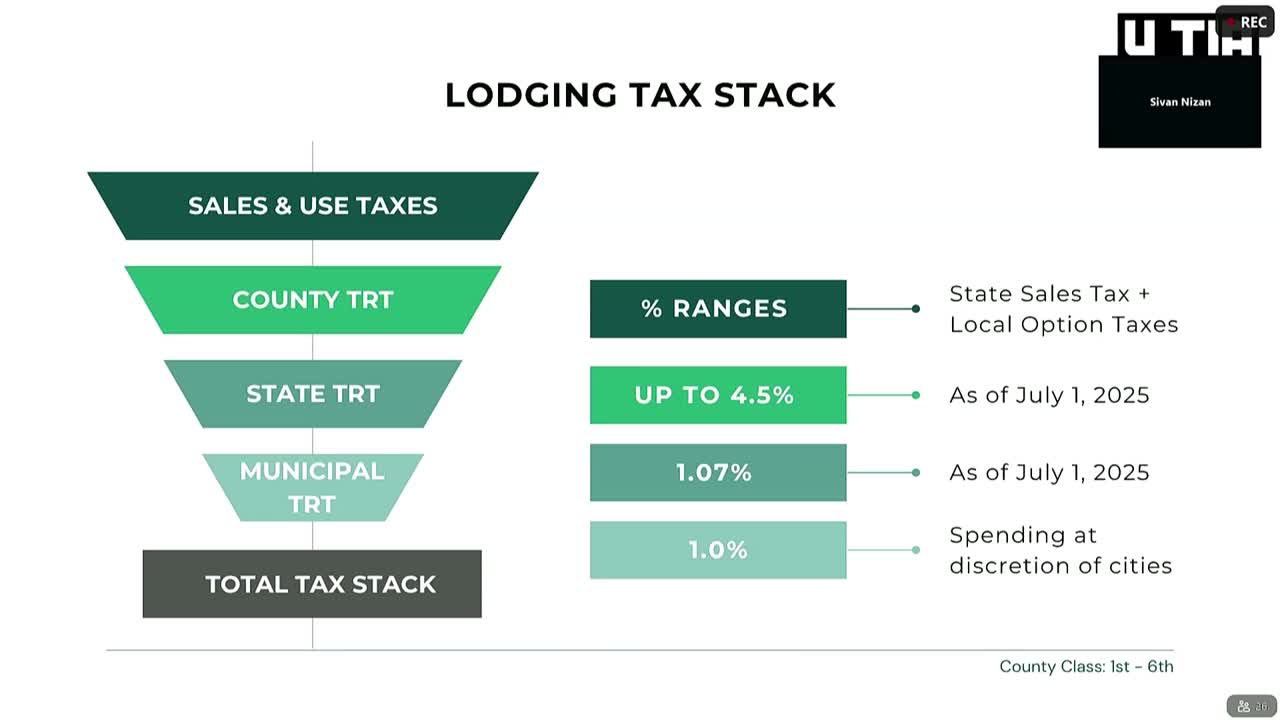
The Office of Tourism and industry partners briefed the committee on HB456 changes to the transient room tax, how revenue is allocated and the office’s marketing results. Staff said the bill raised the statewide transient‑room tax to 1.07% and created a 0.25% statewide allocation for an outdoor recreation mitigation grant for qualifying rural
State tourism officials and industry partners briefed the committee on changes to the transient room tax under HB456, the structure of the Tourism Marketing Performance Fund (TMPF), recent marketing outcomes and the office’s stewardship work.
Selena Sinclair, executive director of the Utah Tourism Industry Association, summarized HB456 major provisions. "Where HB456 came to was a total 1% increase to our lodging tax that is new for us starting July 1," she said, explaining the bill raised the statewide transient‑room tax and expanded a local county option to 4.5 percent in most counties. Sinclair said the statewide rate is now 1.07 percent and that 0.25 percent of the statewide levy is directed to a new outdoor recreation mitigation grant for qualifying third‑through‑sixth class counties that have implemented the full 4.5% county option.
Why it matters: Sinclair and Office of Tourism staff said the changes aim to keep Utah competitive for travel, provide a targeted mitigation grant to smaller counties with visitor safety costs, and protect funding for local destination marketing organizations.
TMPF and marketing: Office officials described TMPF allocations (10% to the Utah Sports Commission, 20% to the legacy cooperative marketing grant program, 70% to the office’s statewide marketing) and said the legacy co‑op awarded $4.1 million last year but faced a $1.8 million request shortfall. The office reported broad measures of visitor impact: $13.3 billion in direct visitor spending statewide, $2.5 billion in state and local tax revenue and 164,600 tourism‑supported jobs. Officials announced a new campaign, "Utah person," to succeed the "In Love in Utah" campaign, and said cooperative marketing helps rural and emerging destinations access statewide marketing.
Reservation systems, short‑term rentals and attribution: Committee members asked whether park reservation systems reduced total visitor counts and whether short‑term rentals affected hotel occupancy. Office staff said the reservation system contributed to some declines in visitation to specific national parks and that unregulated short‑term rentals can reduce taxable hotel room nights. Dave Williams, associate managing director, described the office’s attribution methods—web cookies, booking‑data matching, and advertising effectiveness surveys that compare travel rates for respondents aware and unaware of campaigns.
Discussion and next steps: Officials said they will finalize the outdoor recreation mitigation grant rules and the co‑op allocation process. The office emphasized stewardship work (visitor education, Utah Forever framework) and noted that the TMPF remains an important tool for attracting higher‑spending, planning visitors.