Get Full Government Meeting Transcripts, Videos, & Alerts Forever!
Get email alerts on the Film Incentive topic
No spam. Unsubscribe anytime.
Utah Film Commission says rural film incentive drove $200M in local spending; seeks continued appropriations
Summary
The Utah Film Commission reviewed four years of the rural film incentive, telling lawmakers it attracted 28 productions and more than $200 million in direct local spending across nearly every county. The commission said the program boosted hotel nights, jobs and local vendor revenue, and noted ongoing funding needs beyond a $1 million base appropr
The Utah Film Commission told the committee its rural film incentive, created in 2022 to encourage productions outside the Wasatch Front, has brought 28 projects to the state and generated more than $200 million in local spending.
"When productions choose rural Utah, the impact is real and immediate," Virginia Pierce, director of the Utah Film Commission, said. "They spend in hotels, restaurants, hardware stores, rental shops and paychecks across the state."
Pierce walked lawmakers through case studies the commission used to illustrate the program’s economic reach. She said a Marvel production stayed 11 days in Emery County and spent "over $4,000,000" and took more than 6,000 room nights, and that an HBO production filmed 22 days across multiple counties and spent about $8 million locally. She described larger multi‑part projects such as a Kevin Costner production that spent nearly $95 million across many counties and a Moab shoot for a Godzilla film that spent just under $4 million in ten days.
Why it matters: The commission argued the incentive helps diversify rural economies and builds local infrastructure and film‑readiness. Pierce noted the program’s role in generating "film tourism," citing a recent estimate that film‑related tourism contributed broadly to Utah’s tourism economy.
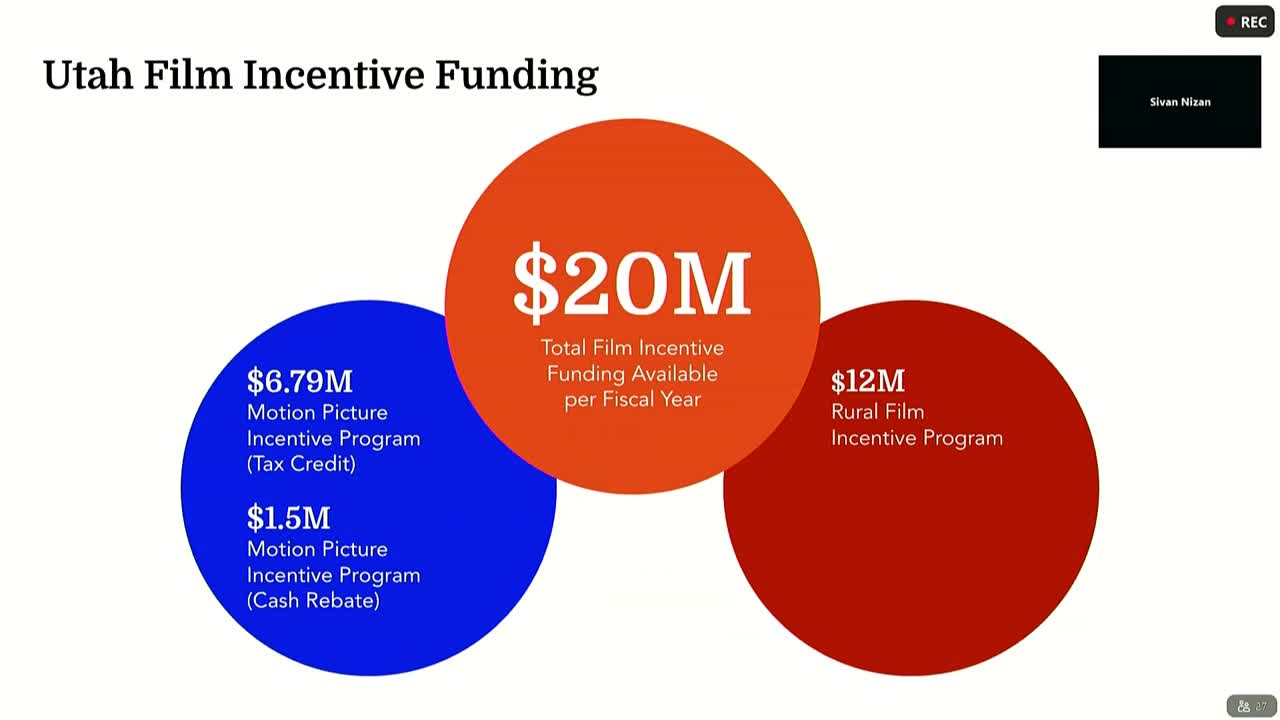
Program details and funding: Pierce described the state film incentive program as a roughly $20 million annual program overall and said the rural incentive was created by statute in 2022 (statute cited in testimony as "63‑8"). She said the commission currently has $1 million in ongoing program funding and that an approximately $11–12 million one‑time appropriation previously had significantly expanded production this past year. Pierce said continuing the program at levels that produce similar statewide impacts would require legislative appropriation; she did not present a formal dollar figure request during the hearing.
Local hiring and infrastructure: The commission said small‑budget film applications require producers to hire 85% Utah cast and crew; larger productions typically meet a 75% local hire threshold. Pierce said the commission and local staff work to prepare counties through a "film ready" network of county representatives and that productions frequently spend in multiple counties beyond the shooting location.
Committee response and next steps: Committee members asked whether the commission planned to seek ongoing appropriations and how the rural return compared with other incentive jurisdictions. Pierce said the program exists in statute and needs legislative appropriation to continue at the higher spending levels; she offered to provide county‑level spend data on request.