Get Full Government Meeting Transcripts, Videos, & Alerts Forever!
Get email alerts on the Human Trafficking topic
No spam. Unsubscribe anytime.
Sponsor previews wide‑ranging human‑trafficking bill; AG says prosecutors will keep working with drafters
Summary
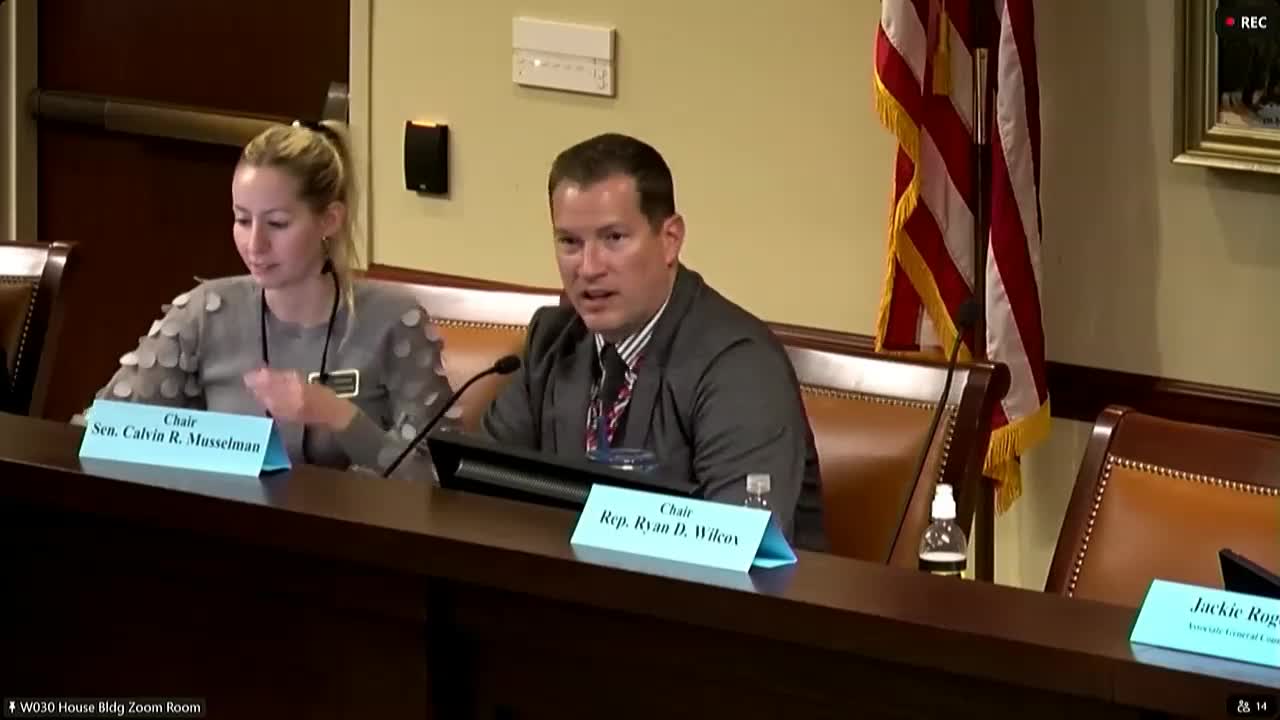
Sen. Cal Musselman presented a staff draft of human‑trafficking amendments to the Law Enforcement and Criminal Justice Interim Committee on Oct. 15, asking members to review a large restructuring that separates forced labor from commercial sexual exploitation and creates new patronizing offenses.
Sen. Cal Musselman presented a staff draft of human‑trafficking amendments to the Law Enforcement and Criminal Justice Interim Committee on Oct. 15, saying he was presenting the bill for review and not asking the committee to take action.
"This bill, it's quite large. It's it breaks apart some of the current human trafficking offenses," Jackie Rogers, associate general counsel for the Office of Legislative Research and General Counsel, told the committee during a staff overview. Rogers described several structural changes: separating offenses for forced labor and sexual exploitation, revising definitions, and creating a distinct set of "patronizing" offenses aimed at users of trafficked victims rather than traffickers.
Rogers said the draft raises the mens rea for many trafficking offenses from reckless to knowingly, narrows and specifies the list of conduct that establishes an offense, creates gradated penalties for different kinds of commercial exploitation, and repeals a standalone "benefiting from trafficking" offense. She also told members the draft broadens and then narrows certain definitions to improve data tracking and to reduce ambiguous cross‑references across the criminal code.
Musselman framed the legislation as an effort to align punishment with culpability. "I want the punishment to fit the crime," he told members, adding he was concerned the current code could sweep ordinary labor‑law violations into trafficking charges in ways that were not intended. He said the draft reduces some maximum penalties in the aggregate as a result of reclassifying and separating conduct, and asked committee members and stakeholders to review technical sections before he returns with a revised draft in November.
Craig Peterson, director of the Justice Division at the Utah Attorney General's Office, testified in public comment that the AG's office appreciated being consulted on the draft and supported separating labor and sex trafficking elements. "We like many of the changes that have been made to it," Peterson said, while noting prosecutors might seek a few technical changes in follow‑up drafting.
No committee action was taken; Musselman said he will present a revised draft next month after additional consultation with law enforcement and prosecutors.
Ending: The committee did not vote on the draft. Committee staff will incorporate feedback and return a revised bill for further consideration in November.