Get Full Government Meeting Transcripts, Videos, & Alerts Forever!
Get email alerts on the Fuel Tax topic
No spam. Unsubscribe anytime.
Tax Commission seeks legislative definition of 'statewide average rack price' after small new Cisco rack appeared
Summary
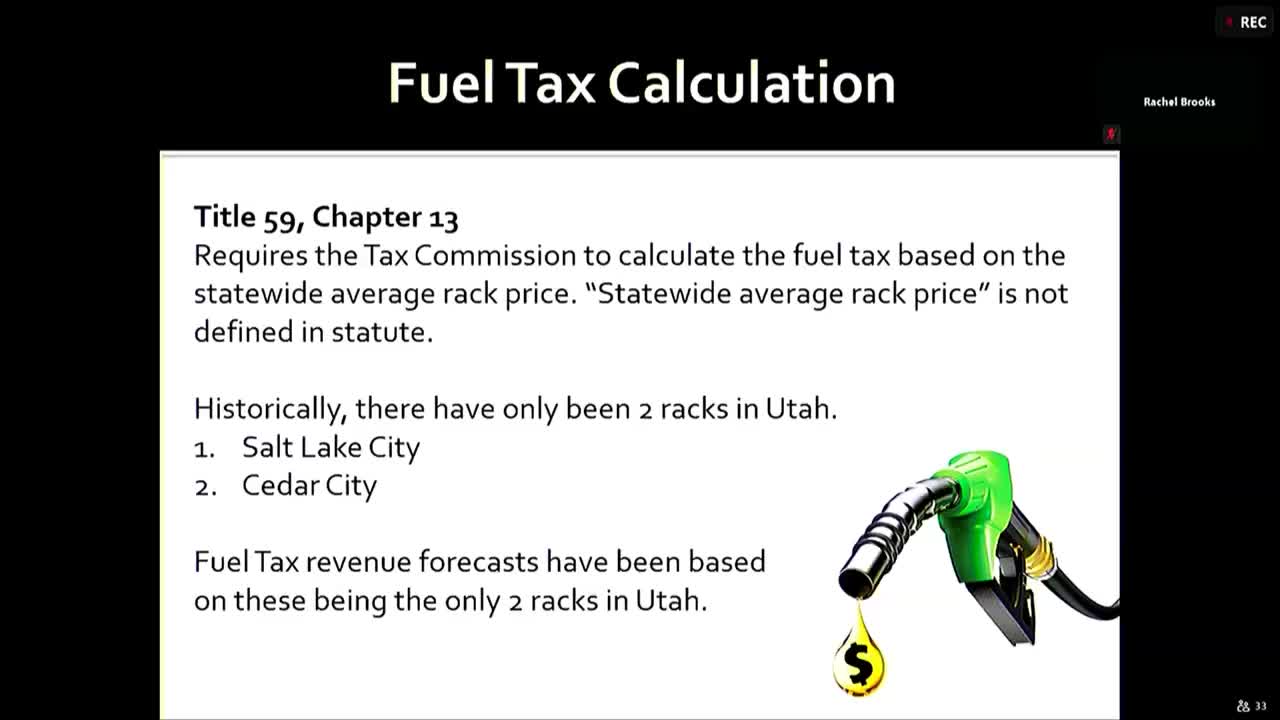
The Tax Commission asked lawmakers to define the statutory "statewide average rack price" used to calculate the fuel tax after a new small Cisco rack began operating and could distort long‑range revenue forecasts.
The Utah State Tax Commission told the Senate Transportation Interim Committee that the addition of a small new fuel rack in Cisco, Utah — a distribution point primarily supplying fuel exported to Colorado — can skew the statutory "statewide average rack price" used to compute fuel tax receipts and forecasts. The commission recommended the Legislature consider defining the statewide average rack price to include only the Salt Lake City and Cedar City racks.
Jason Gardner explained fuel is taxed at the rack — the commercial distribution point where tanker trucks fill before delivering to retail stations — and that historically Utah used two primary racks, in Salt Lake City and Cedar City. In 2024 a new Cisco rack began operating; Gardner said the Cisco rack is small, unbranded and serves exports, which would produce a distortion if included in statewide averages used for multi‑year revenue forecasts.
The commission suggested defining "statewide average rack price" in statute to preserve the comparability of forecasts and to avoid skewing that could produce unpredictable revenue estimates. Senator Reby asked the panel to explain the rack concept and the commission clarified the rack is the last commercial distribution point before retail and that different racks can report different prices.
No bill language was introduced during the meeting, but Gardner presented the issue for committee consideration and follow‑up during the interim.