Get Full Government Meeting Transcripts, Videos, & Alerts Forever!
Get email alerts on the Renewable Energy topic
No spam. Unsubscribe anytime.
Apex Clean Energy tells committee renewables are least-cost, fast-to-deploy option for near-term load growth
Summary
An industry representative from Apex Clean Energy told the committee that solar, wind and battery storage are currently the least-cost and fastest-to-deploy resources to serve near-term load growth, contrasted the multiyear lead times for new thermal plants and underscored renewables' role as a hedge against fuel-price-driven rate increases.
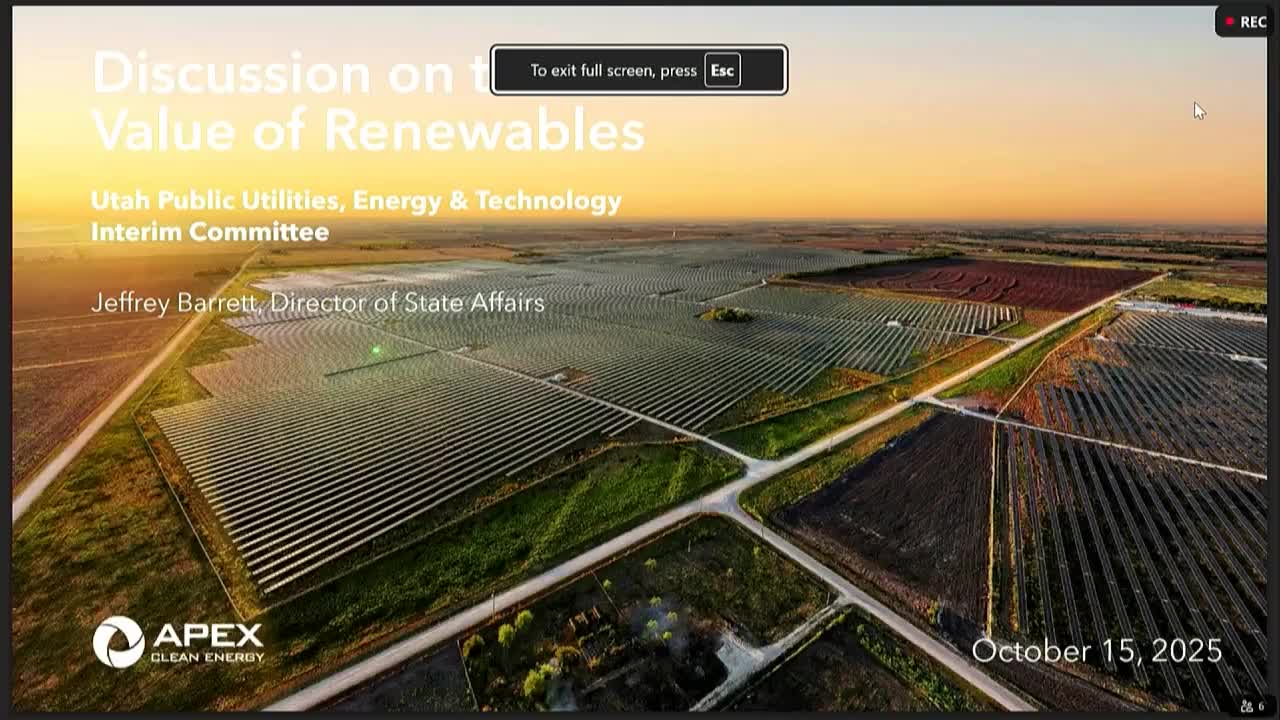
An Apex Clean Energy representative briefed the committee on the economics and deployment timelines of renewable resources, arguing that utility-scale solar, wind and storage are the least-cost resources available today and can be deployed quickly to meet rapid load growth and economic opportunities.
The presenter, who described previous roles in state and utility energy offices, cited Lazard levelized-cost-of-energy (LCOE) ranges showing solar and wind have lower lifetime costs than many thermal alternatives even before federal tax credits. He emphasized three policy-relevant points: renewables can provide a long-duration fixed-price hedge against future fuel-price volatility; wind and solar projects are available now and often can be built in 12—18 months while new large gas plants face 5—7-year-plus lead times; and modeling procured by utilities in other states frequently selects portfolios that are predominantly non-emitting (roughly 90—to 95 percent) with limited firm generation.
The presenter noted that renewables and storage do not provide the same effective load-carrying capability as thermal plants but argued that the energy value and near-term availability of renewables make them essential to meet fast timelines for large new loads. He also pointed to operational and community best practices (for example, aircraft-detection lighting systems at wind sites and vegetative management using sheep at solar projects) and highlighted Apex projects recently brought online.
Ending: The industry representative asked the committee to consider the deployment timelines and cost dynamics when evaluating energy policies and procurement options that seek to attract large loads to the state.