Get Full Government Meeting Transcripts, Videos, & Alerts Forever!
Get email alerts on the State Energy Planning topic
No spam. Unsubscribe anytime.
OED outlines IPP transfer work, San Rafael lab status and capacity-expansion modeling
Summary
The Office of Energy Development updated the committee on the Utah Energy Council's work to appraise IPP land and water and to issue an RFI, progress at the San Rafael Energy Lab and its research arm, and the state's strategic-energy planning using NREL's REEDS capacity-expansion model to inform future policy and procurement.
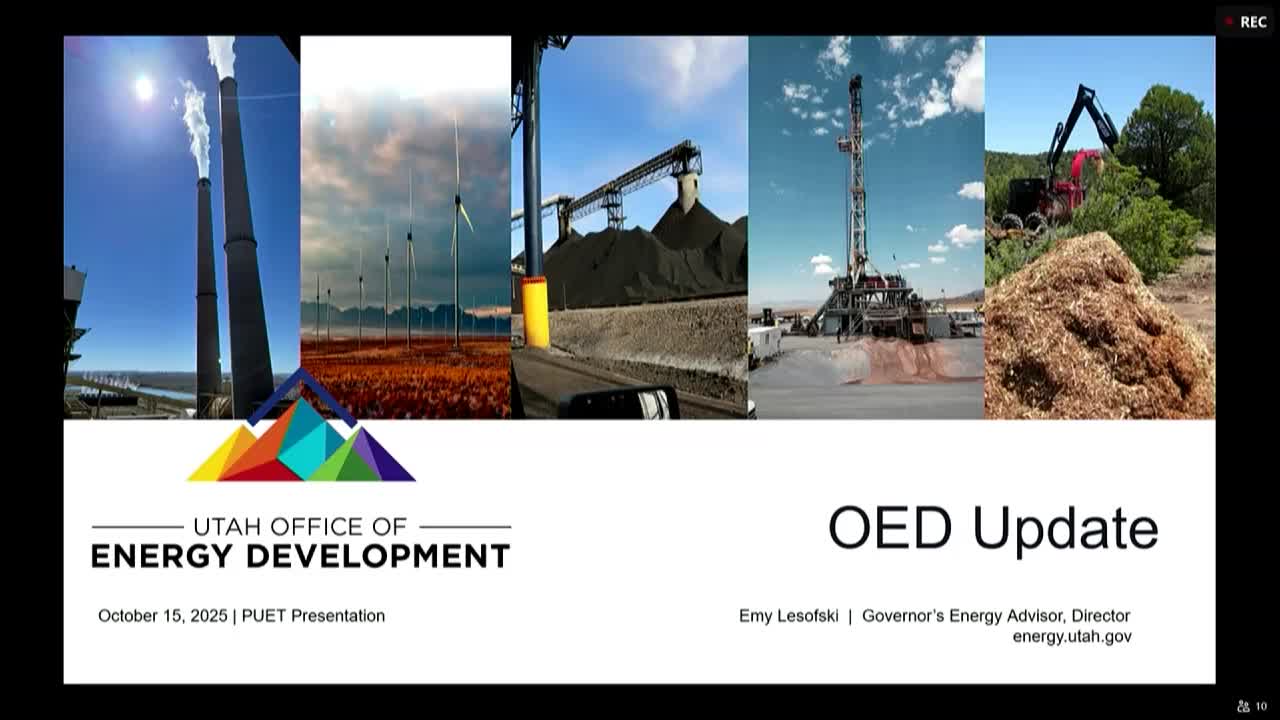
The Office of Energy Development told the Public Utilities, Energy & Technology Committee on Oct. 1 that it is moving forward on a set of legislatively required activities including the state's transfer of the Intermountain Power Plant (IPP), operation of the San Rafael Energy Lab and implementation of the strategic energy plan.
Director Emmy Lisovsky said the Utah Energy Council ' composed of the director as chair, Sen. Anne Milner, Rep. Karl Albrecht, Nate Walkingshaw and Curtis Wells ' is overseeing an appraisal of IPP land and water assets and preparing a request for information (RFI) for potential operators. Lisovsky said the RFI will be used to shape a later request for proposals (RFP) and that the office expects to issue the RFI in the coming days, subject to council comment and state purchasing rules. "We definitively feel an urgency as it relates to the IPP activities, and we're hoping we can get it out the door soon," she said.
The nut of the matter, Lisovsky told committee members, is to give respondents sufficient access to information so bidders can submit full responses; the RFI is expressly intended to inform a later RFP. She said the office is also obtaining appraisals so any transfer will reflect fair market value for land and water as required by statute.
Lisovsky also summarized work of the Utah Energy Research Board (UERB), which oversees the San Rafael Energy Lab and the Utah Advanced Nuclear Energy Institute. The office hosted a Sep. 11 groundbreaking for a nuclear test reactor at the lab and said Natura Resources (an advanced-nuclear company) has leased most of the lab space for research. The Utah Energy Research Grant Program was created in statute and initially received a general-fund appropriation to stand up program operations; Lisovsky said grant awards are currently on hold while lab operations and staff are funded from the new energy research fund.
Cindy Eckhart, OED data scientist, presented the office's strategic-energy planning work and capacity-expansion modeling. Eckhart said OED selected the National Renewable Energy Laboratory's Regional Energy Deployment System (REEDS) because it is open source, uses industry-standard data (including WECC and EIA datasets) and stacks with other models the state plans to use. The REEDS model combines seven-year hourly weather and demand data, plant and technology characteristics, policy inputs and transmission topology to answer "what/where/when/how" questions about future capacity and generation. Outputs include optimal capacity mixes by region, dispatch patterns, net-present-value system costs and emissions estimates.
Eckhart said the REEDS results will be used to inform production-cost modeling, workforce development analysis and a public dashboard tied into the state's energy-resources portal. The office said it is working with national labs, state agencies, research universities and neighboring states (Idaho and Wyoming via a Tri-State Compact activity) to tailor modeling scenarios (for example, different demand growth rates, nuclear cost assumptions and large-load siting) and to provide policymakers and utilities with comparative scenario analysis.
Lisovsky and Eckhart emphasized that models are tools to compare scenarios, not perfect predictions. Committee members asked about how modeling results will interface with policy decisions; Eckhart said the model is a decision-support tool and asked the legislature to provide questions and scenarios it wanted explored. Several legislators, including Sen. Owens and Rep. Albrecht, pressed for protections of Utah's baseload and for OED to collaborate closely with the Energy Council and nuclear consortium when refining procurement or siting assumptions.
The presentation also covered statutory updates including the formal end of the Alternative Energy Development Incentive program (AEDI) beginning Jan. 1, 2025, and revisions to the High Cost Infrastructure Tax Credit that allow taxpayers to elect the credit against severance tax for costs incurred in 2024. OED presented a fiscal estimate that, under standard well-cost and performance assumptions, a 50% increase in wells drilled could increase state severance-tax revenue by roughly $26.3 million; the office noted the estimate excludes induced economic benefits and job impacts.
The office said next steps include integrating production-cost modeling with REEDS outputs, publishing scenario results on an energy-resources dashboard, and following up with the committee on any focused working sessions requested by legislators.
Ending: OED asked the committee to identify specific scenarios and policy questions it wants the office to model; staff offered follow-up briefings and deeper technical sessions on request.