Get Full Government Meeting Transcripts, Videos, & Alerts Forever!
Get email alerts on the Housing Stability topic
No spam. Unsubscribe anytime.
Advocates press Judiciary Committee to codify access-to-counsel, strengthen eviction and foreclosure processes and protect people experiencing homelessness
Summary
Legal-aid groups, tenant organizers and people with lived experience urged the Joint Committee on the Judiciary to support several housing-stability measures: a statewide right-to-counsel framework (H.1952), codifying two-tier summary-process protections so defaults do not enter at initial eviction events (S.1184/H.1895), foreclosure-mediation proposals, and S.1120, a Bill of Rights for people experiencing homelessness.
Legal-aid groups, tenant organizers and people with lived experience urged the Joint Committee on the Judiciary to support several housing-stability measures: a statewide right-to-counsel framework (H.1952), codifying two-tier summary-process protections so defaults do not enter at initial eviction events (S.1184/H.1895), foreclosure-mediation proposals, and S.1120, a "Bill of Rights" for people experiencing homelessness modeled on Rhode Island's law.
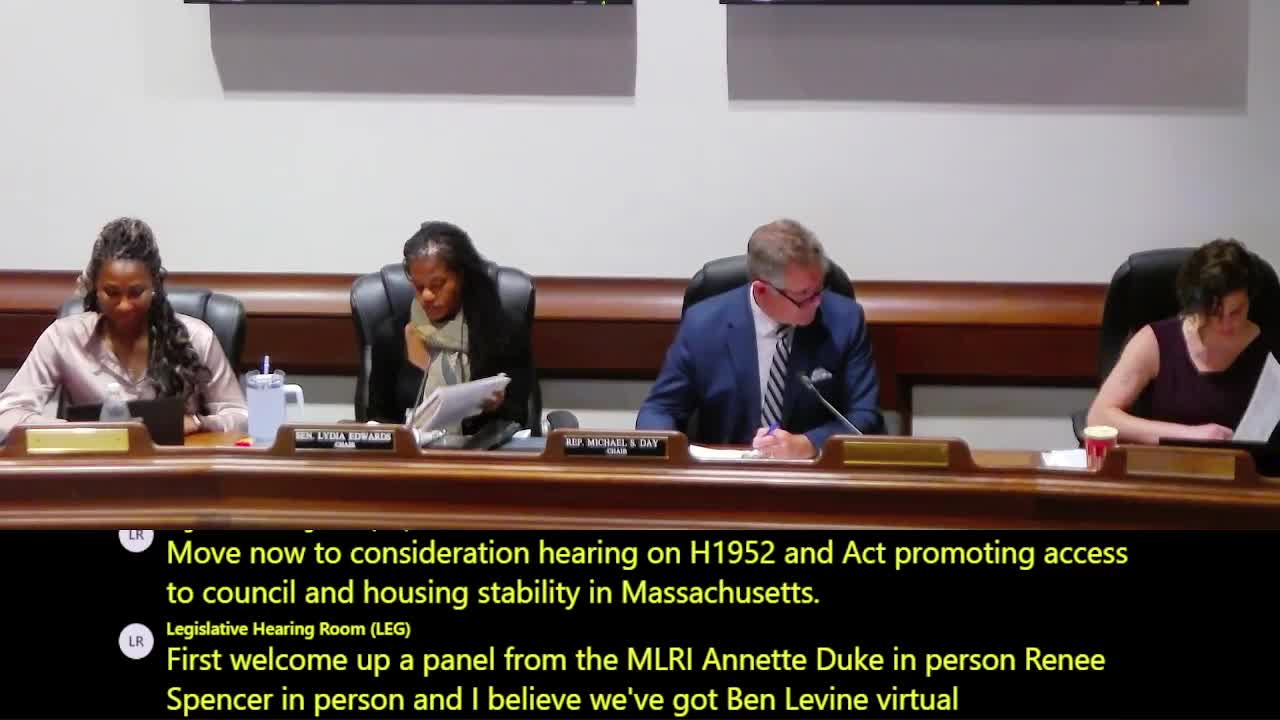
Annette Duke of the Massachusetts Law Reform Institute said the FY25 budget funded an Access to Counsel pilot and subsequent FY26 funding removed the word "pilot," but the program lacks a statutory framework that would ensure consistent quality, statewide administration and contracting standards. "We need a framework," Duke told the committee, adding that program data show strong early results: in the pilot's initial months, she said, 97% of closed cases produced positive outcomes for tenants (staying in housing or more time to move) and opposing parties were represented in 93% of opened cases.
Renee Spencer, a public-housing tenant who described a prolonged eviction and years of instability, urged lawmakers to make representation permanent: "No one should have to face eviction alone," she said.
Legal-services witnesses recommended codifying the eviction-court standing order implemented during COVID that made the first court event a case-management conference and prohibited defaults at that initial tier. Advocates argued that preventing default judgments at the first event helps pro se tenants — who comprise the majority of defendants in housing court — to access the process and to secure legal help or mediation.
Separately, advocates and homelessness-service organizations testified in favor of S.1120, which would extend anti-discrimination protections to people experiencing homelessness, protect their right to rest and seek shelter in public spaces, and repeal criminalizing statutes. Kelly Turley of the Massachusetts Coalition for the Homeless said the bill would "interrupt the rise in the criminalization of homelessness" across municipalities.
Organizations working on foreclosure mediation and "zombie" second mortgages (addressed in a separate panel) urged statutory mediation and stronger servicer disclosure obligations to prevent unlawful subordinate-mortgage foreclosures and reduce unnecessary displacement.
Ending: Advocates asked the committee to integrate successful pilot elements into statute, fund statewide implementation, and prioritize quality-control measures to ensure that legal representation, mediation and homelessness protections reach the people most at risk of displacement.