Get Full Government Meeting Transcripts, Videos, & Alerts Forever!
Get email alerts on the Postpartum Psychosis topic
No spam. Unsubscribe anytime.
Mass. hearing spotlights bill to require reproductive-psychiatric evaluation for mothers accused of crimes within 12 months postpartum
Summary
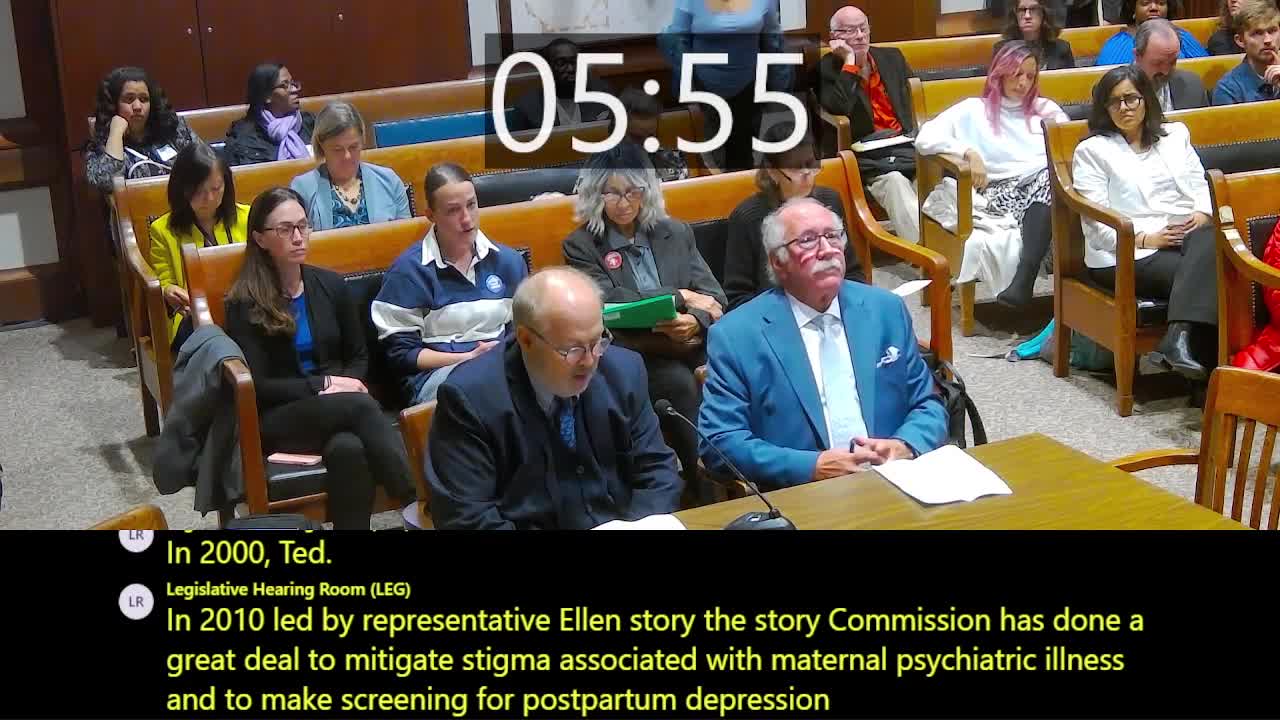
A bipartisan panel of clinicians, survivors and legislators urged the Joint Committee on the Judiciary to report favorably on H.1924/S.1171, a bill that would permit defendants who gave birth within the previous 12 months to be examined by an expert in reproductive psychiatry and to receive medically appropriate treatment when perinatal psychiatric illness is a factor in alleged criminal conduct.
A bipartisan panel of clinicians, survivors and legislators urged the Joint Committee on the Judiciary to report favorably on H.1924/S.1171, a bill that would permit defendants who gave birth within the previous 12 months to be examined by an expert in reproductive psychiatry and to receive medically appropriate treatment when perinatal psychiatric illness is a factor in alleged criminal conduct.
"Postpartum psychosis is not common, occurring 1 to 2 per 1,000 live births," said Dr. Lee Cohen, director of the Center for Women's Mental Health at Massachusetts General Hospital and a professor at Harvard Medical School. "But this serious perinatal psychiatric illness is treatable with readily available medications and appropriate therapy."
Supporters, including Representative Jim O'Day and clinicians from Massachusetts General Hospital and UMass, framed the bill as narrowly targeted: it would allow examination by a reproductive-psychiatric expert; permit judges to consider perinatal mood and anxiety disorders as mitigating factors at sentencing; and create a process for treatment and, in specified circumstances, resentencing reviews for past cases where perinatal psychiatric complications were not considered.
"This legislation will place Massachusetts as a lead champion in recognizing the complexities that arise when hormone-triggered mental health crises and crimes collide," Representative O'Day said, summarizing the bill's aims to fold evaluation and treatment into the criminal-justice process rather than defaulting to incarceration.
Clinical witnesses described the presentation and risks of perinatal psychiatric illness. "Postpartum psychosis is brain disconnected, resulting in psychotic symptoms including paranoia, delusional thinking, and hallucinations," Dr. Cohen testified. Multiple clinicians and researchers told the committee that the illness can appear rapidly, may occur in people without prior psychiatric histories, and carries elevated risks of maternal suicide and, in rare instances, harm to infants. Several witnesses cited figures presented during testimony: studies and clinicians' summaries discussed maternal suicide rates and that infanticide can occur in a small proportion of untreated cases (witnesses gave ranges such as 1–4% for the latter and 4–5% for maternal suicide in testimony).
Survivors and family members described personal experiences. "No mother should be jailed for an act she couldn't control," said Lisa Roth, a survivor who testified about symptoms she experienced in 2018 and the separation from her infant while she sought care. Crystal Jaramillo, founder of the CORD Foundation, emphasized racial disparities: "People like me who experienced postpartum psychiatric complications have for too long been stigmatized and criminalized," she said.
Experts told the committee that specialized assessment is often necessary because routine prenatal and psychiatric care providers may lack training in perinatal-onset psychosis. Dr. Nirmaljit Jamy, who runs a perinatal program in California, described integrated care models that include inpatient perinatal psychiatry units and said that timely, evidence-based treatment can restore patients to family life and community participation.
Several witnesses pointed to Illinois' 2018 statute as a model. "The Illinois law has played a pivotal role in increasing awareness for judges, prosecutors and defense attorneys," Dr. Feingold of Postpartum Support International testified, noting that the number of resentencing petitions to date is small but that the law has raised courtroom awareness and consistency.
The bill's supporters repeatedly said the proposal is not a "get-out-of-jail free" card. Instead, they described it as a mechanism to ensure accurate diagnosis and evidence-based treatment before a court imposes the most severe penalties.
Committee members asked whether retrospective diagnosis is practicable for people seeking resentencing after many years. Dr. Cohen responded that structured interviews used in research and clinical practice can identify episodes of postpartum psychosis years later in many cases.
No formal vote or motion was recorded during the hearing. Supporters asked for a favorable report from the committee so the bill could advance for consideration by the full legislature.
Ending: Advocates framed H.1924/S.1171 as a public-health and justice measure: it would require reproductive-psychiatric evaluation when relevant and create pathways to treatment, while leaving final legal determinations to courts.