Get Full Government Meeting Transcripts, Videos, & Alerts Forever!
Get email alerts on the Foster Care Insurance topic
No spam. Unsubscribe anytime.
Providers urge special commission as liability insurers exit foster care market
Summary
Nonprofit foster care providers told the joint committee that liability insurance carriers are abandoning or sharply raising rates for foster care coverage, threatening community-based placements and prompting calls for a special commission to study solutions.
Nonprofit foster care providers told the joint committee that a national liability insurance crisis is forcing carriers to reduce or end foster care coverage and pushing premiums to unsustainable levels for community-based providers.
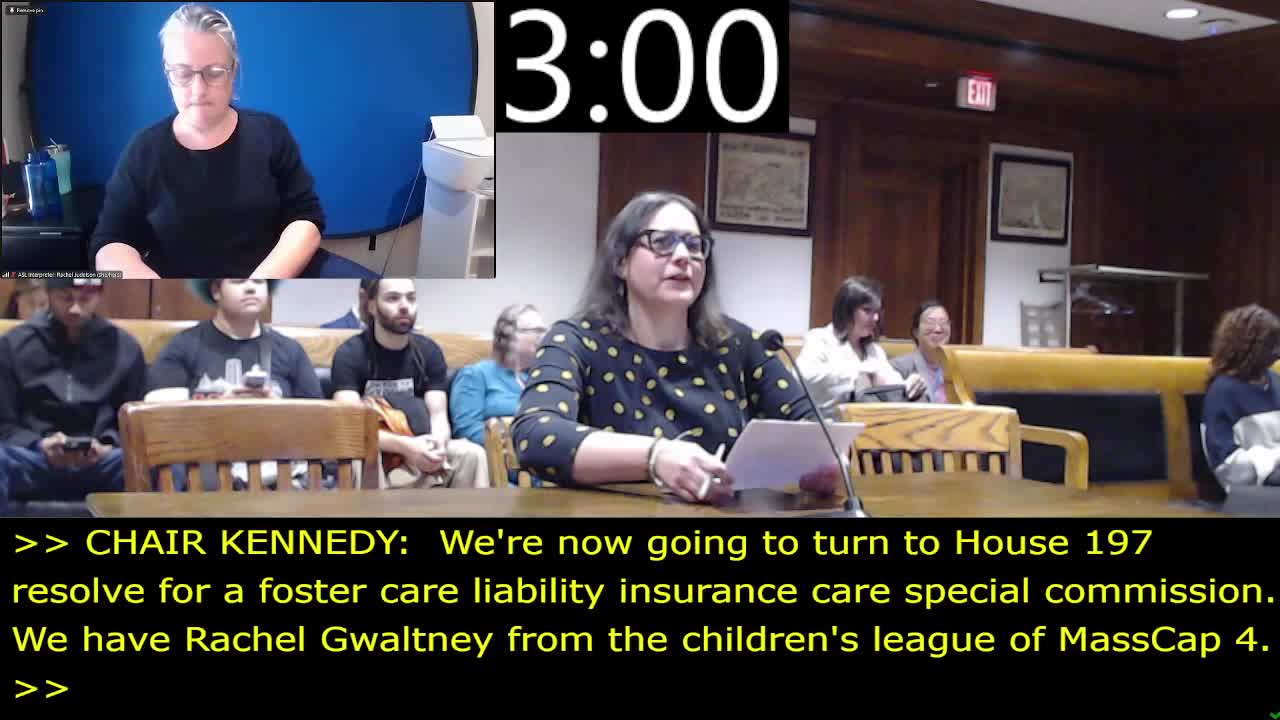
"A nationwide crisis has emerged specific to foster care liability insurance, severely shrinking the marketplace for this coverage," Rachel Guatney, executive director of the Children's League of Massachusetts, said in testimony supporting H.197, which would create a special commission to study the problem. She said the change threatens community foster care beds that serve youth with acute therapeutic needs.
Speakers from Justice Resource Institute and Hopewell described recent nonrenewals and premium increases. Robert Koster, director of foster care programs at JRI, said his program recently faced a 200 percent premium increase and a three-quarters reduction in coverage from a long-serving carrier. Hopewell, the largest community-based comprehensive foster care provider in the state, told the committee it received a notice of nonrenewal and was forced into a secondary market charging about five times prior premiums.
Witnesses said some carriers now require steps beyond state regulatory standards, such as more frequent site visits and additional vetting of prospective foster families. Those added conditions drive operational costs higher, the providers said, and reduce the number of providers willing or able to hold DCF contracts.
Testimony warned of cascading effects if community providers withdraw: the Department of Children and Families would have to absorb placements or direct children into more restrictive and costly settings, including group homes. Witnesses cited recent closures in other states as an illustrative risk.
Committee members asked about the mechanics of coverage. Robert Koster said foster parents hold homeowners policies and must notify their carriers that they provide foster care; agencies also carry a separate liability policy specific to their foster care programs. Speakers said the interplay among homeowners, agency liability, and brokers is complex and varies by carrier.
Guatney and others urged passage of H.197 to establish a special commission to study market causes and durable solutions, including potential state actions to stabilize coverage and preserve community-based placements.
The bill would initiate study only; no binding programmatic remedies were proposed during testimony. Providers said they will submit written testimony with additional details and endorsements and asked the committee to act with urgency to avoid disruptions for the roughly 1,000 children placed in contracted comprehensive foster homes each year.