Get Full Government Meeting Transcripts, Videos, & Alerts Forever!
Get email alerts on the Public Health Budget topic
No spam. Unsubscribe anytime.
St. Louis County health director outlines FQHC revenue hopes, requests follow‑up on clinic receipts and corrections medicine costs
Summary
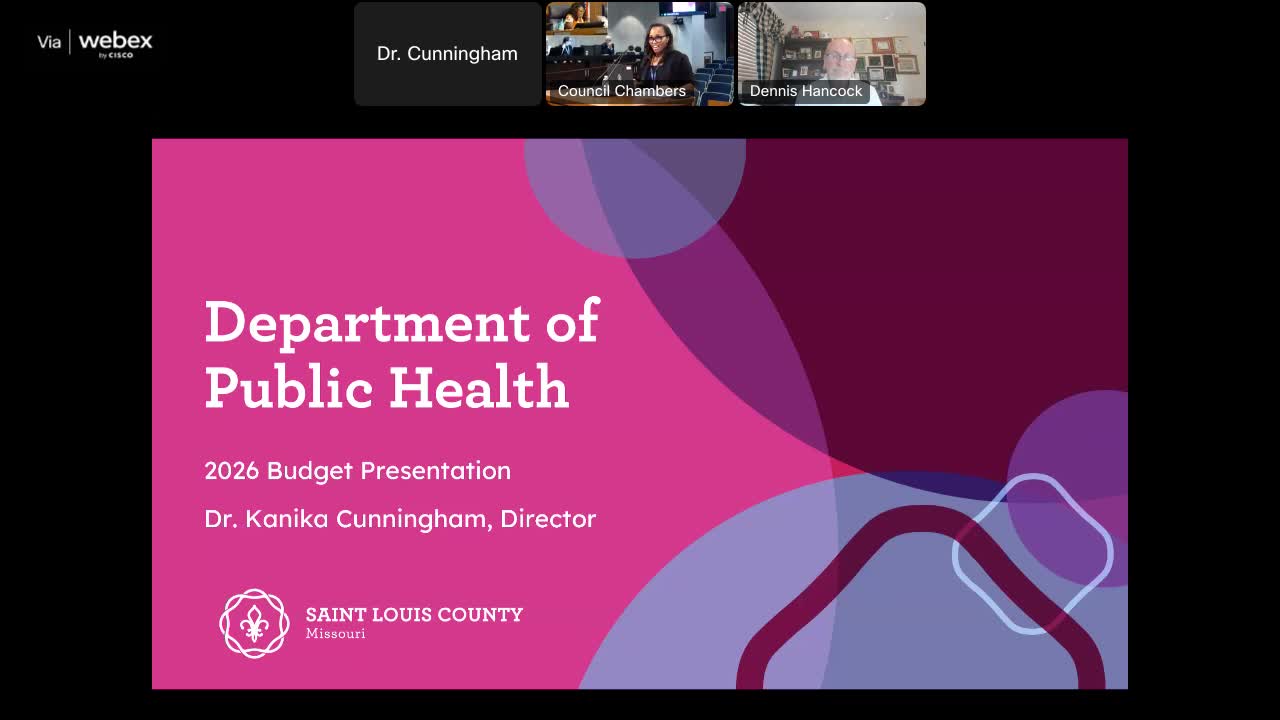
Dr. Cunningham, director of the St. Louis County Department of Public Health, told the county’s Budget Committee on Oct. 16 that the department is counting on an FQHC look‑alike designation, a new electronic medical record and improved billing to increase clinic reimbursements and reduce the county subsidy.
Dr. Cunningham, director of the St. Louis County Department of Public Health, told the county’s Budget Committee on Oct. 16 that the department is counting on an FQHC (federally qualified health center) look‑alike designation, a new electronic medical record system and improved billing to increase clinic reimbursements and reduce the county subsidy.
The department’s FY2026 request covers the health fund and the solid‑waste management fund and seeks opioid‑remediation dollars to support the MAT program in corrections medicine. “The DPH budget is made up of the health fund and a solid waste management fund,” Dr. Cunningham said. She described the budget as aligned with the region’s community health improvement priorities and the county’s STL Co 2050 plan.
Why this matters: the county’s clinical services account for a substantial share of DPH spending and corrections medicine alone was identified in the presentation as roughly 20% of the department’s budget. Council members said they need clearer, line‑by‑line revenue and fund‑balance detail before acting on the broader budget request.
What officials presented: Dr. Cunningham said the public health clinics improved billing and coding and, combined with the FQHC look‑alike designation, the department projects higher reimbursement levels — a figure presented to council members as roughly $5 million in additional clinic revenue in 2026 compared with current year receipts. Michael Ladovich, a public health administrator who described himself as the department’s CFO for reimbursement work, explained the cost‑report process that produces lagged additional Medicaid/Medicare settlements: “We’re gonna submit a cost report for ’25 … We’ll probably get the Medicaid … in ’27,” he said, summarizing the 18‑ to 24‑month timing for some settlements.
Council scrutiny and outstanding data requests: Council members repeatedly questioned the Munis year‑to‑date revenue figures shown in staff reports and the report’s “total revenue” line, because property tax receipts and other large items inflate a year‑to‑date picture. The committee asked for an itemized reconciliation that separates clinic revenues (FQHC billing, Medicaid/Medicare, managed care and private pay), public‑health program fees, property tax receipts and grants. Committee members also asked for: (a) a clinic‑level breakdown of patient counts and visits for the last five years; (b) the department’s current payroll and vacancy detail, including contractors; (c) the amount already spent to obtain the FQHC look‑alike designation; (d) the expected timing and size of cost‑report settlements; and (e) a clearer explanation of the assumptions underlying the $5 million projection.
Corrections medicine and drug cost strategies: committee members pressed on corrections medicine — a major driver of costs. Dr. Cunningham said the department is exploring several steps to reduce net costs, including billing Medicaid for eligible juveniles in custody, pursuing discounted drug pricing available to FQHC look‑alikes and asking local municipalities to share some medical costs for residents they bring to the county jail. “Corrections medicine is 20% of our budget,” Dr. Cunningham said; the presentation showed corrections medicine as one of the largest single budget lines.
EMR, staffing and audits: the department plans to replace its aging electronic medical record (EMR) to improve coding and provider capacity — Dr. Cunningham said the new EMR should allow clinicians to see more patients per day (changing a provider template from about one patient per 30 minutes to one per 20 minutes). Committee members also pressed for outside audit/accounting support to prepare complex FQHC cost reports and to verify revenue projections; the department said prior council action had withheld funding for outside contracts and asked the council to release or restore those dollars to support revenue‑cycle improvement work.
Requests and next steps: committee members asked that DPH return with the requested data in writing and offered to schedule a dedicated follow‑up session on the FQHC look‑alike program and on corrections medicine. Dr. Cunningham offered either small‑group briefings or a full committee hearing and agreed to supply the cash‑flow and revenue detail, staffing and contractor lists, and the EMS/EMR encumbrance information. The committee did not take any formal vote on DPH budget lines during the meeting.
Bottom line: DPH leaders described concrete steps intended to boost clinical revenue and reduce county subsidy, but council members said the department’s projected revenue increases are not yet supported by sufficiently detailed, auditable figures and asked for follow‑up analysis before the committee takes further budget action.