Get Full Government Meeting Transcripts, Videos, & Alerts Forever!
Get email alerts on the Online Raffles topic
No spam. Unsubscribe anytime.
Ohio House Finance Committee hears bill to allow nonprofits to sell raffle tickets online
Summary
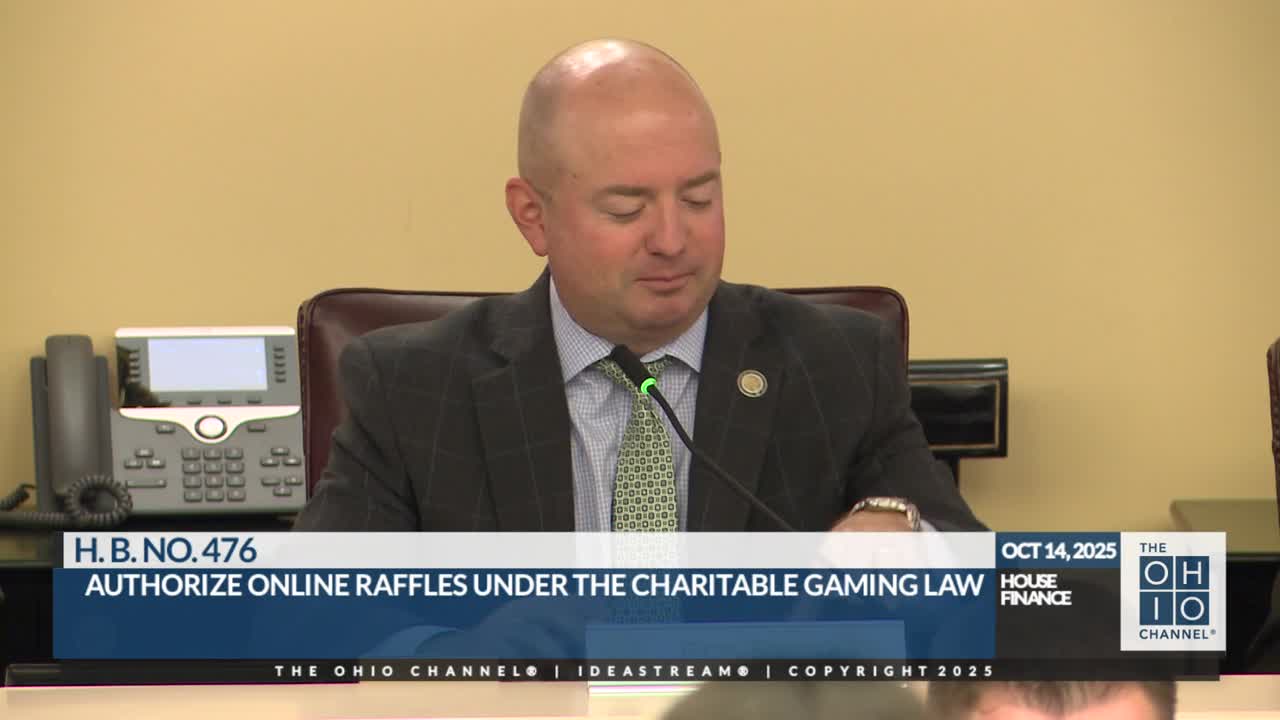
House Bill 476 would allow nonprofit organizations across Ohio to sell raffle tickets online, sponsors told the Ohio House Finance Committee at a first hearing on the bill.
House Bill 476 would allow nonprofit organizations across Ohio to sell raffle tickets online, sponsors told the Ohio House Finance Committee at a first hearing on the bill.
Representative Thomas, one of the bill sponsors, told the committee the measure was a “practical and much needed modernization of Ohio law” after the Ohio Attorney General issued cease-and-desist letters to some groups conducting online raffles. “These groups were not acting in bad faith. They were simply adapting to a new fundraising landscape,” Thomas said during sponsor testimony.
The bill would add an explicit online option to the existing charitable raffle statute and — sponsors emphasized — would not expand legal gaming to online poker, card games, or other forms of internet gambling. Thomas said the legislation is written to require nonprofits to remain “in good standing” and to comply with the same oversight and reporting requirements that apply to in-person raffles; the sponsors included an emergency clause because some organizations said enforcement actions had already halted vital fundraising.
Committee members’ questions focused on three recurring issues: the Attorney General’s legal rationale, how online platforms preserve the same auditing and reporting safeguards as in-person raffles, and consumer protections (including age verification and the risk of opportunistic or “shady” operators). Ranking Member Sweeney asked why the Attorney General concluded the practice was unlawful; sponsors answered that the AG’s office views current statute as requiring a physical paper ticket and an in-person drawing, and that enforcement has generally been complaint-driven.
Witnesses who testified in support of the bill included volunteer and local public-safety officials and nonprofit leaders. Brandon Johnson, identified to the committee as president of the North Lawrence Fire Department, said his department typically raised $3,000–$5,000 at in-person raffles and that online sales had the potential to greatly increase revenue used for turnout gear and rescue equipment. “Online raffle sales are essential as they expand the reach and increase revenue,” Johnson said.
Chief Rob Harrington of the Wintersville Volunteer Fire Department told the committee his department used online raffles before receiving a cease-and-desist order and that the resulting loss of income had prompted staffing and budgeting pressures. Harrington described steep increases in equipment costs — citing examples in committee testimony such as a ladder truck that cost roughly $685,000 in 2012 and one model priced at about $1.3 million in 2024 (and reportedly higher since) — and said his department had relied on raffle proceeds for equipment and building payments. “Without the raffle income, we will at the very least reduce our staffing levels by the end of the year,” Harrington said.
Other proponents included small nonprofit leaders (Brock Yoder, who said his county dog shelter was planning a series of online raffles to raise funds for a climate-controlled mobile adoption trailer estimated at about $270,000) and public-safety chiefs who described rising costs and long delivery waits for apparatus and ambulances.
Members pressed proponents on how online platforms would satisfy auditing requests from state offices. Sponsors and witnesses said online sales typically produce digital purchase records (names, contact information, payment trails) that can be exported for review and that reporting requirements under the charitable-gaming statute would remain unchanged. Representatives also asked about age verification for prizes such as firearms or alcohol; sponsors said existing laws (for example, Federal Firearms License transfers for guns) and platform tools could be used to ensure legal transfers, and that in-person checks would still occur at the point of prize delivery where required.
Several members raised concerns about market effects and fraud. Some asked whether a proliferation of large, frequently run online raffles could “cannibalize” charitable giving or make it easier for disreputable operators to solicit statewide. Sponsors answered that the bill preserves current enforcement mechanisms — the AG’s complaint-driven process and existing reporting rules — and that making the practice legal would allow enforcement and transparency to function more effectively rather than pushing activity underground.
No formal motion or vote was taken during the hearing. Chair Stewart told members the committee expects follow-up hearings “likely within the next two weeks.”
The committee record includes written testimony from additional proponents and offers the committee an opportunity to consider amendments addressing specific safeguards discussed at the hearing (reporting clarity, age-verification methods, and limits or definitions for platform operators).