Get Full Government Meeting Transcripts, Videos, & Alerts Forever!
Get email alerts on the Student Epinephrine Policy topic
No spam. Unsubscribe anytime.
Sponsor seeks to add intranasal epinephrine to Ohio law for students
Summary
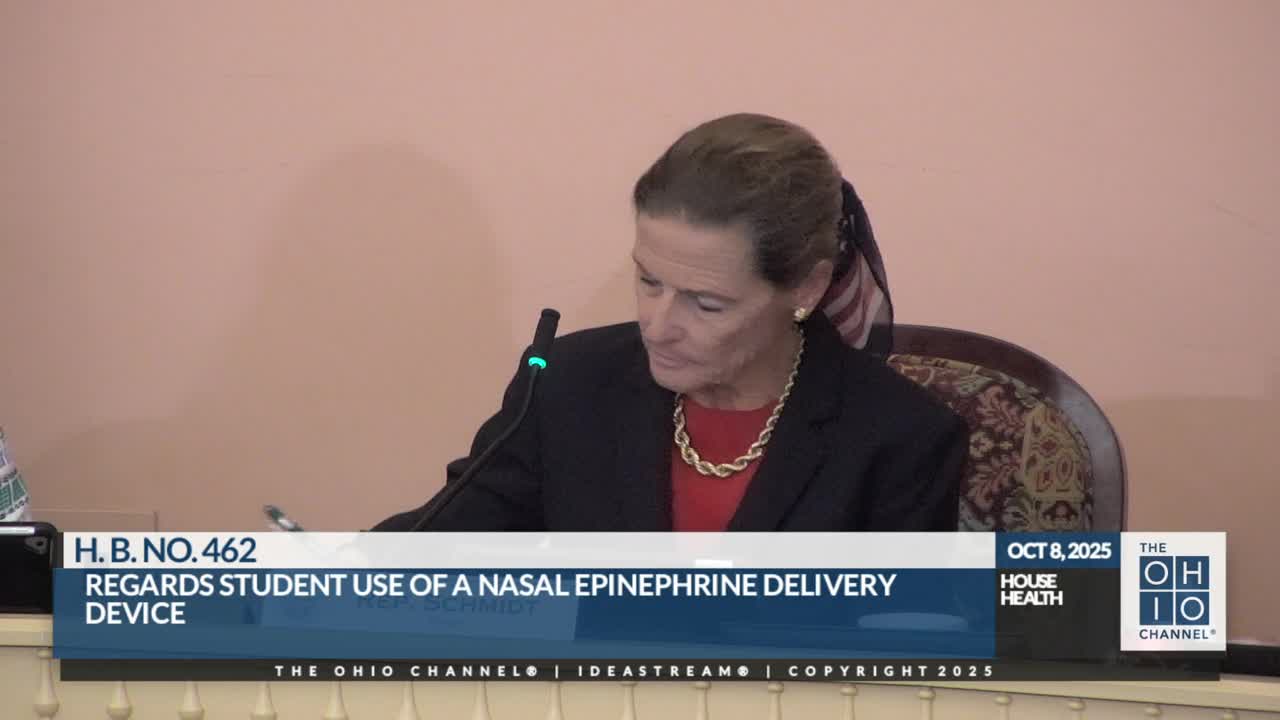
Representative Richardson told the House Health Committee that House Bill 462 would add intranasal epinephrine as an authorized delivery method for students to carry and use at school following FDA approval of a nasal spray epinephrine device.
Representative Melissa Richardson told the House Health Committee during the bill’s first hearing that House Bill 462 would update Ohio law to allow students to possess and use intranasal epinephrine for treatment of anaphylaxis at school and at school‑sponsored activities.
"HB 462 simply adds nasal epinephrine devices as an additional option for students to carry at school and school sponsored activities," Richardson said, noting the FDA approved an intranasal epinephrine spray in August 2024 and that school nurses are already receiving written approvals for nasal spray prescriptions but are constrained by existing statutory language.
Richardson said the request originated from a constituent and that the change would provide parents with an additional delivery option. She cited CDC data in testimony noting that approximately 8 percent of children have severe allergies ("1 in 13 children") and argued the nasal device may reduce anxiety and hesitation when staff or teachers must administer epinephrine.
Committee members asked technical drafting questions. Representative Baker asked whether the statute should be framed to allow any currently available delivery methods rather than naming nasal specifically; Richardson replied the bill’s drafters considered a broader drafting approach but limited the change to the nasal device because other delivery methods may be less suitable for children.
Representative Gross asked whether the bill makes parents and providers the decision makers regarding delivery method; Richardson replied, "Through the chair, that is correct. And really what it does, it just gives them an additional choice. It’s fully up to the parents whether they want their children to carry it along with their prescriber." A question was raised about possible emergency‑clause language to speed implementation; Richardson said she would recommend it to leadership.
The chair closed HB462’s first hearing and scheduled the next committee agenda placement.
This article is based on sponsor testimony and committee questions recorded in the public hearing transcript; no committee vote on HB462 was held during this meeting.