Get Full Government Meeting Transcripts, Videos, & Alerts Forever!
Get email alerts on the Resilience topic
No spam. Unsubscribe anytime.
Resilient Hampton staff highlight completed projects, $56M in leveraged grants and pipeline of shoreline and flood-control work
Summary
Resilient Hampton staff reviewed completed and in-progress projects, highlighted $56 million in leveraged grant funding over five years, $12 million awarded in 2025 from $72 million requested, and described near-term construction for Big Bethel Blueway, North Armistead raising, Millpointe living shoreline and Lake Hampton work.
Resilient Hampton staff on Tuesday briefed council on accomplishments under the city’s Living with Water strategic priority, outlining recent projects, grant performance and future work to reduce flood risk while delivering community amenities.
Scott Smith, the city’s coastal resilience engineer, said the resilience team delivered three major projects last year — Lake Hampton Resilience Park, the Aberdeen Gardens Community Resilience implementation strategy, and the Bluebird Gap living shoreline — and advanced studies that will form the project pipeline, including the Aberdeen Gardens drainage study, a Natural Infrastructure Resilience Plan and a Billy Woods Canal feasibility study.
Smith said the city has leveraged more than $56 million in grant funding over the last five years. In 2025 alone the city submitted $72 million in grant requests and received $12 million in awards. He described near-term construction and design milestones: the Big Bethel Blueway shared-use path (phase nearing completion), the North Armistead Road raising (advertised for construction), the Millpointe living shoreline (advertising expected in coming weeks) and the Honor Park Resilience Park design outside City Hall.
Smith described project benefits beyond flood mitigation, noting boardwalks, trails and new habitat areas. He said Lake Hampton improvements include a berm expansion, wetlands bench and tidal gate work to disconnect the lake from tidal flows during high-water events while providing storage during storms. The North Armistead project will elevate sections of a major arterial three to four feet where needed and add a multiuse path connecting neighborhoods to Lake Hampton and the Water Walk trail.
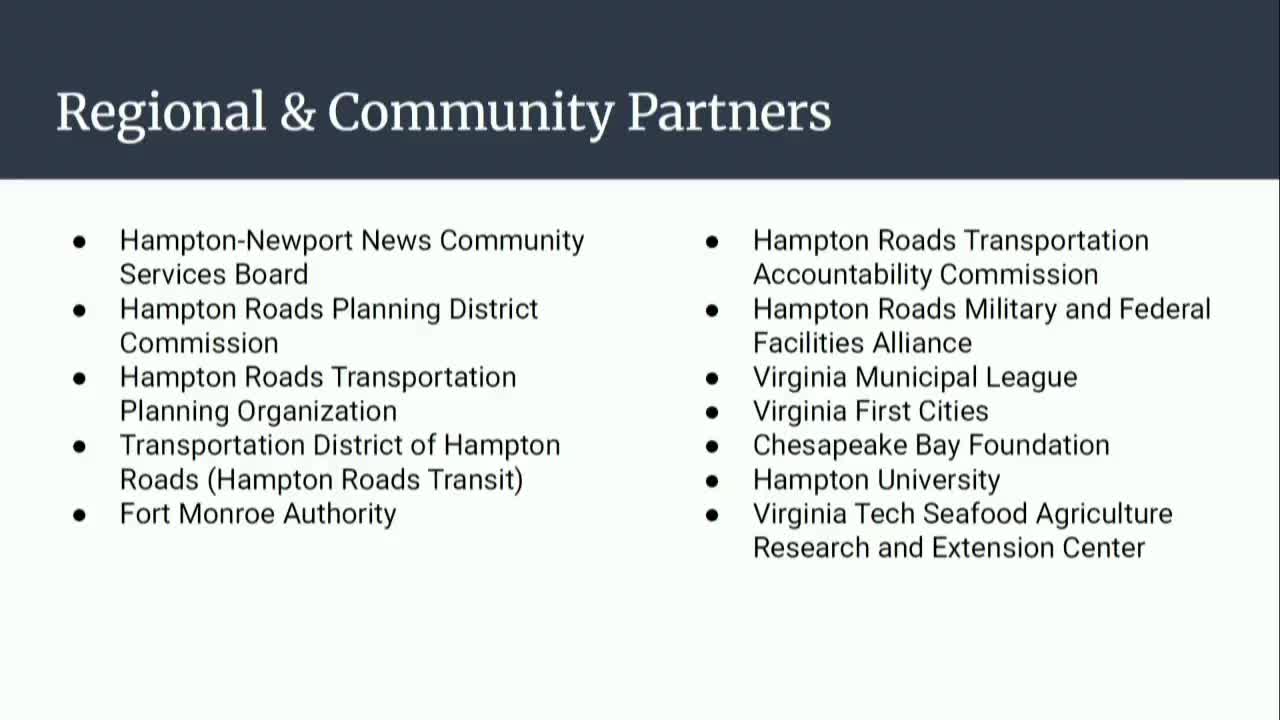
Resilience staff said the program is small but has partnered with federal and state agencies, universities and non-profits, engaged 30 community groups in the last year and is finalizing an energy-assurance plan, an energy-efficiency audit program and a climate-action plan to complement flood-resilience efforts.