Get Full Government Meeting Transcripts, Videos, & Alerts Forever!
Get email alerts on the Billing Transparency topic
No spam. Unsubscribe anytime.
Consumer advocates and groups back HB 158 to require itemized, plain-language utility bills
Summary
Proponents told the committee that House Bill 158 would require utilities to itemize charges on residential bills, improve customer understanding, and recommend low-cost tools such as QR codes linking to plain-language glossaries and assistance program information.
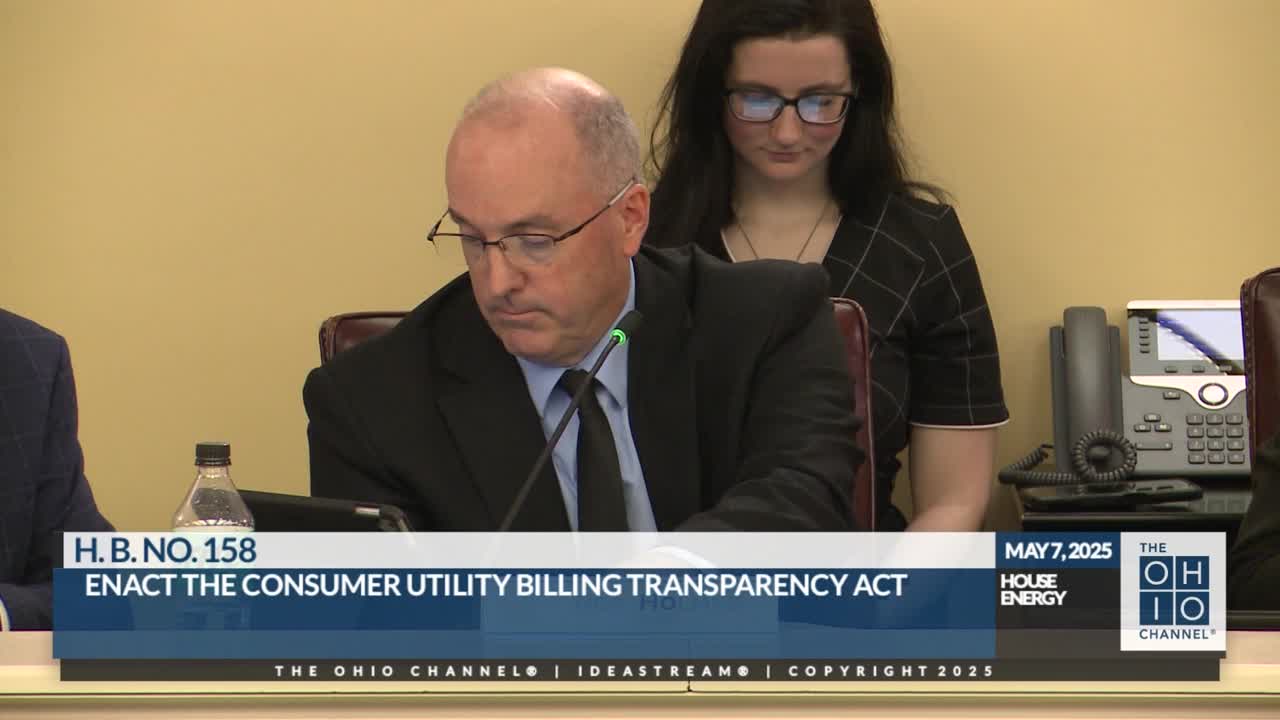
House Bill 158, the Consumer Utility Billing Transparency Act, drew unanimous proponent testimony at a second hearing before the House Energy Committee, with witnesses saying clearer, itemized residential bills would help consumers understand charges, check for errors, and engage in energy choices.
Jesse Velasquez, climate justice manager at the Ohio Environmental Council Action Fund, said itemization of major charges and riders would 22provide people with the tools they need to make informed decisions, seek accountability, and plan for the future.22 He told the committee the bill does not create new costs for utilities because the underlying information already exists.
Hannah Cubbins, legislative director for Americans for Prosperity Ohio, said HB158 promotes 22transparency and competition22 by requiring utilities to break out distribution, generation, transmission, supply costs, riders and taxes, enabling customers to compare services and costs without changing pricing rules.
Maureen Willis, director of the Ohio Consumers27 Council, representing residential consumers, urged support and recommended that utilities place QR codes on bills linking to a plain-language glossary and to assistance-program information. Willis noted many consumers cannot readily decode tariff terms and said a simple electronic link could improve understanding at low cost.
Committee discussion: Representative Brennan and other members said clearer bill language could spur civic engagement by enabling constituents to ask legislators about specific charges. Committee members discussed implementation details such as whether QR codes would be sufficient for consumers without digital access; OCC said QR codes could be supplemented with annual printed materials if needed and that the cost for QR-code implementation is likely low.
Outcome: HB158 received a second hearing with proponent testimony; no vote was taken. Witnesses and sponsors discussed collaborating on glossary terms, presentation format and low-cost approaches to ensuring broad consumer access to explanatory materials.