Get Full Government Meeting Transcripts, Videos, & Alerts Forever!
Get email alerts on the Submetering Consumer Protection topic
No spam. Unsubscribe anytime.
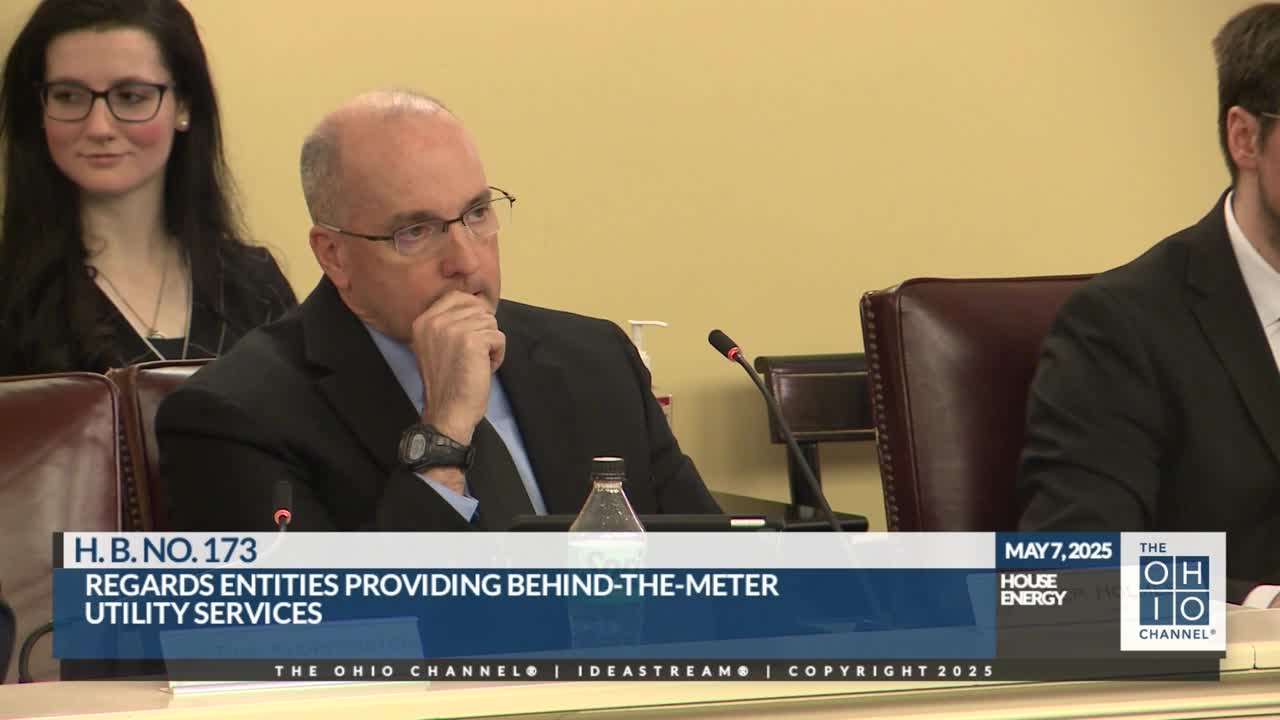
Rep. Thomas presents HB 173 to codify submetering rules, cap tenant charges
Summary
Representative Thomas told the House Energy Committee that House Bill 173 would clarify that submetering behind-the-meter does not make a company a public utility, give PUCO clear jurisdiction to hear complaints, and cap landlord charges so tenants never pay more than the local residential rate.
House Bill 173 seeks to clarify the legal status of submetering and add consumer protections for tenants in multi-unit dwellings, Representative Thomas told the House Energy Committee during a first hearing.
Thomas explained that submetering occurs when a landlord or submetering company installs meters behind the host utility27s meter and bills tenants based on unit usage. He said prior PUCO and Ohio Supreme Court decisions have treated submetering companies as not operating as public utilities because the host utility continues to serve the building, but litigation has nonetheless imposed significant delay and cost on developers and providers.
The bill would codify that a monopoly public utility 22ends at the meter22 and that behind-the-meter services provided under contract with private property owners do not constitute a public utility. Thomas said the bill would also give PUCO clear jurisdiction to hear complaints and include explicit language to cap the total amount a landlord may bill a residential tenant so the tenant would not be charged more than the residential rate the local host utility would charge.
Committee concerns and discussion: Members pressed on consumer implications. Representative Fisher asked whether tenants could access competitive suppliers under the proposed structure; Thomas said disclosure at move-in and contract terms would determine the arrangement and that the private property owner generally controls the supplier choice for the single building meter. Representative Hall asked whether volume discounts obtained through a commercial account would be required to be passed through to tenants; Thomas said the bill would not automatically require landlords to pass through such discounts, but the contract and disclosure process would identify how savings are used.
Members also raised program eligibility and consumer protections, including access to assistance programs (HEAP), representation by the Ohio Consumers27 Counsel, and shut-off protections. Thomas acknowledged that some programs are tied to a customer27s utility account type and that the bill aims to increase oversight and consumer protections through PUCO jurisdiction and clearer landlord-tenant disclosure requirements.
Outcome: The committee held a first hearing; no final action was taken. Sponsors indicated follow-up and potential clarifying language to address program eligibility and enforcement mechanisms.