Get Full Government Meeting Transcripts, Videos, & Alerts Forever!
Get email alerts on the Utility Policy topic
No spam. Unsubscribe anytime.
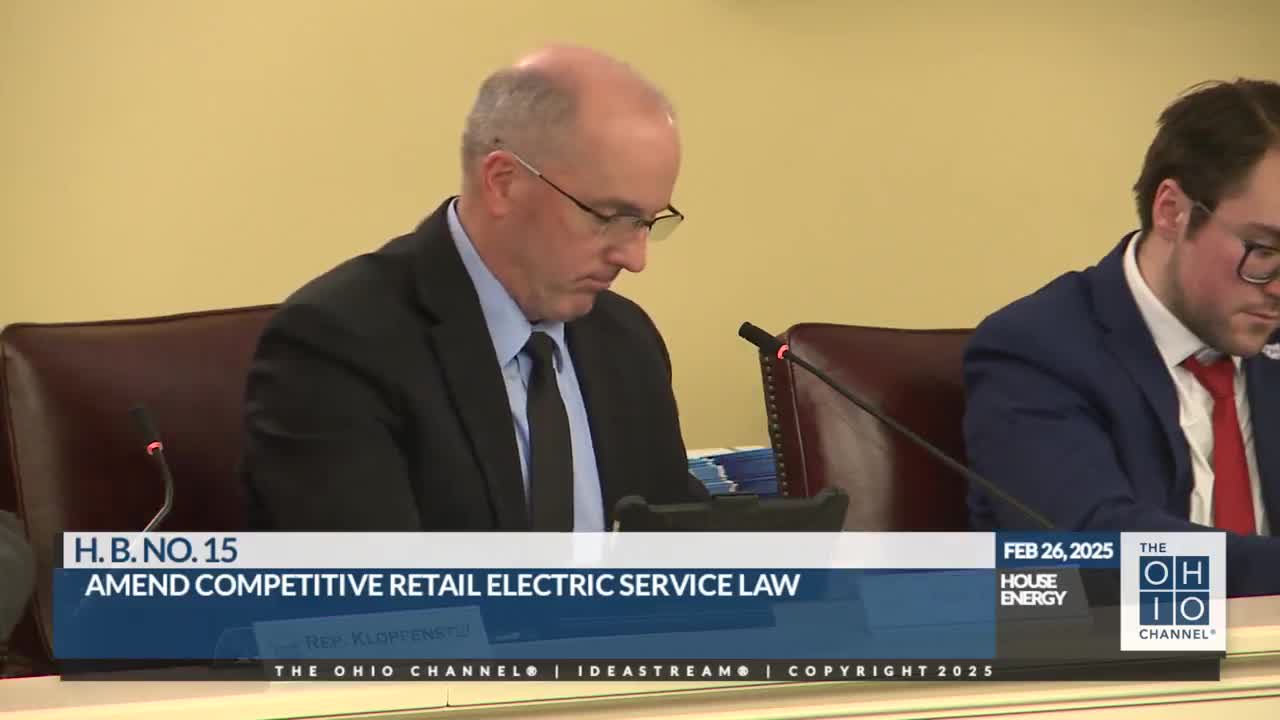
AEP and Buckeye Power tell committee rollback of ESPs and legacy rider risks reliability, investment
Summary
AEP Ohio and Buckeye Power opposed provisions of House Bill 15 that would repeal Electric Security Plans and end statutory recovery for OVEC, saying the changes could weaken utilities' balance sheets, impair planned investments and raise costs to consumers.
AEP Ohio and Ohio's electric cooperatives told the House Energy Committee that elements of House Bill 15, as drafted, risk harming utilities' ability to finance grid improvements and could expose customers to higher costs.
Craig Grooms, president and CEO of Buckeye Power and Ohio's Electric Cooperatives, said his members "support the legislature's goal of incentivizing new generation resources in Ohio" but warned the HB 15 language would not just incentivize new resources; it would transfer cash to existing merchant generators and raise taxes on transmission — a change that would translate into higher costs for electric cooperative members. He urged the committee to consider the tangible personal property provisions included in Senate Bill 2 instead, which the co-ops view as more narrowly targeted to new generation.
Mark Reiter, president and chief operating officer of AEP Ohio, said repeal of Electric Security Plans would "significantly limit a utility's ability to adequately invest in the grid" and urged the committee to adopt alternatives that modernize base-rate law (including forward-looking forecasted test years and clearer procedures for recovering investments). Reiter said AEP Ohio plans about $5 billion in investments over the next five years to meet growing demand and improve reliability, and that removing statutory recovery mechanisms would impair the company's balance sheet and borrowing costs.
Both witnesses urged a measured approach to the Ohio Valley Electric Corporation (OVEC) legacy generation rider. AEP asked that, if the statutory recovery is repealed, the committee provide a transition tied to current ESP expirations rather than an immediate cut-off. Buckeye Power described OVEC capacity as an existing hedge against market volatility and said eliminating recovery could expose customers to higher wholesale-market price risk.
Utility witnesses also cautioned against unintended distributional effects of shifting taxes from generation to transmission, echoing county auditors' concerns that the change would move revenues from generation-hosting rural counties to more urban transmission-heavy counties while failing to reduce the kilowatt price for Ohio consumers because generation costs are set within the larger PJM region.
Committee members followed with technical questions about customer consolidated billing pilots, the share of riders in distribution revenue, and the mechanics of supplemental transmission projects and PJM processes. AEP and Buckeye said they were willing to discuss alternatives, including transition periods and reforms that preserve timely cost recovery while providing accountability and prudence review.