Get Full Government Meeting Transcripts, Videos, & Alerts Forever!
Get email alerts on the Land Use topic
No spam. Unsubscribe anytime.
Escalon planning panel recommends approval of Murphy Ranch subdivision, urges traffic mitigations at Brennan/Highway 120
Summary
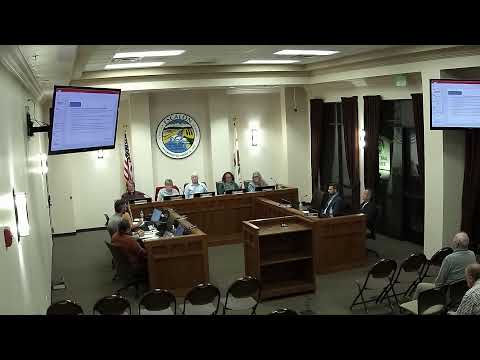
The Escalon Planning Commission voted 3–2 on Oct. 14 to recommend that the City Council approve Florsheim Homes’ application to annex nearly 18 acres and subdivide them into 72 single-family lots, with a condition directing city staff to explore interim traffic mitigation at the Brennan/Highway 120 intersection.
The Escalon Planning Commission voted 3–2 on Oct. 14 to recommend that the City Council approve Florsheim Homes’ application to annex two parcels totaling about 17.98 acres and subdivide them into 72 single-family lots, contingent on standard entitlements and mitigation measures.
Staff said the project — called the Murphy Ranch proposal in the staff packet — would create a specific plan and Plan Development (PD-4) overlay, a tentative subdivision map, a development agreement and an inclusionary housing agreement. The developer proposes eight moderate-income affordable units (out of 72 lots) and expansion of Shadowwood Park by about 1.095 acres, including a single-stall restroom, a half-court that can be striped for pickleball, a gazebo and looped sidewalks. The city adopted an Initial Study and a Mitigated Negative Declaration for the project; noise and cultural/archaeological resources were among the categories with mitigation measures.
The staff report, presented by city planner Jalen French, said the proposal is consistent with the city general plan designation of low-density residential, meets municipal-code requirements for planned developments and specific plans for parcels of this size, and triggers a development agreement as a condition of annexation. French also summarized municipal-code provisions and the city’s inclusionary housing requirement, and noted the city would adopt a mitigation monitoring and reporting program if the Council approves the project.
Traffic and circulation drew the sharpest public comment. Multiple residents and nearby homeowners urged the commission to delay recommendation until the Brennan/Highway 120 safety improvements that Caltrans has proposed were more advanced. Residents and commenters told the commission they were concerned about crash history, heavy truck traffic along 120, and queuing and sight-line problems at the intersection. Several speakers, including residents who live on California Street and in adjacent subdivisions, said they fear additional congestion and more dangerous conditions at the intersection if development proceeds before major intersection improvements are constructed.
Caltrans deputy district traffic operations director Arvinda Bajwa told the commission the agency has approved the project for further study and has initiated the Project Initiation Document (PID) process; typical PID and PA&ED phases can take 12–18 months each, and right-of-way acquisition and railroad coordination could be on the critical path, so a full delivery timeline for major construction may be three to four years (and sometimes longer). Bajwa also said interim measures — including additional striping and signage and left-turn restrictions ("pork-chop" treatments) — are feasible and can be considered while long-term work proceeds.
The applicant’s team, represented at the hearing by attorney Dave Romano and Florsheim Homes executives, said the developer has modified plans in response to neighborhood concerns: homes adjacent to existing residences along the southern and eastern edges of the site will be one story, and the developer committed to placing park maintenance in a separate Community Facilities District or Landscape and Lighting District to avoid increasing assessments on existing neighborhoods.
Planning commissioners debated the balance between the city’s long-standing land-use designation for the site, the housing and park benefits of the proposal, and the safety and timing concerns raised by residents and Caltrans. The motion forwarded to City Council recommended adoption of the Initial Study and Mitigated Negative Declaration, approval of the rezoning/prezone, specific plan, tentative map, inclusionary housing agreement and development agreement, and directed city staff to explore traffic mitigation measures for the Brennan/Highway 120 intersection. The motion passed 3–2.
Next steps: the Planning Commission’s recommendation will go to the Escalon City Council; the annexation also requires proceedings with the San Joaquin County Local Agency Formation Commission (LAFCO). The Planning Commission record and staff report note that any final annexation and entitlements remain subject to the Council’s decision and to LAFCO approval.
Sources: City staff presentation and staff report; public testimony at the Oct. 14 Planning Commission hearing; remarks by Caltrans deputy district traffic operations director Arvinda Bajwa.