Get Full Government Meeting Transcripts, Videos, & Alerts Forever!
Get email alerts on the Wastewater topic
No spam. Unsubscribe anytime.
City committee approves engineering contract for Hillier Fletcher Phase 3 wastewater upgrades
Summary
A Tuscaloosa City committee on an unspecified date approved a professional services agreement with Garber LLC to design Phase 3 improvements at the Hillier Fletcher wastewater treatment facility.
A Tuscaloosa City committee on an unspecified date approved a professional services agreement with Garber LLC to design Phase 3 improvements at the Hillier Fletcher wastewater treatment facility.
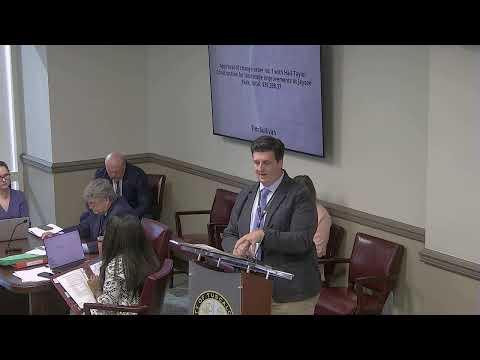
Mr. Gurney, the project presenter, told the committee the design effort will cover three components: replacement of five return activated sludge (RAS) pumps that move sludge from the secondary clarifiers to the aeration basin; replacement of four 600-horsepower aeration blowers with variable-frequency drives; and rehabilitation of the septage-receiving station, including valves, actuators and level transmitters. "The design is expected to take 7 months," Mr. Gurney said. "Conceptually, our rough order of magnitude cost is $11,000,000 for construction."
The presenter said the city will not likely fund the entire construction cost immediately. Staff described a two-part approach: complete a comprehensive design, pursue a short-term construction package to address the highest priorities, then phase the remainder of construction into future budgets. Mr. Gurney said the city expects to spend about $1,000,000 for design and that the current budget includes about $1.5 million anticipated for near-term RAS pump work and short-term septage improvements. "We'll have an additional 1 and a half million dollars in budget," he said when asked what might be available for initial construction.
Committee members asked questions about financing and sequencing. One member asked whether the project would be financed incrementally; staff replied that the specific financing plan for long-term work has not been finalized and that design will be used to prioritize which pieces proceed first. "Depending on how — if you want to get the design, we'll continue to kinda understand the priorities," Mr. Gurney said, adding that the design will make priorities more granular and allow staff to identify what can be funded and when.
The committee voted to approve the professional services agreement by voice vote.