Get Full Government Meeting Transcripts, Videos, & Alerts Forever!
Get email alerts on the Fentanyl Controlled Substances topic
No spam. Unsubscribe anytime.
Committee backs enhanced penalty for adults who distribute fentanyl to minors
Summary
The committee voted to sponsor 26LSO171, which would make distribution of fentanyl by a person 18 or older to someone under 18 a felony with penalties up to a $10,000 fine and up to 20 years in prison. The draft extends the higher penalty to any adult distribution to anyone under 18 and defines fentanyl to include isomers and certain analogs.
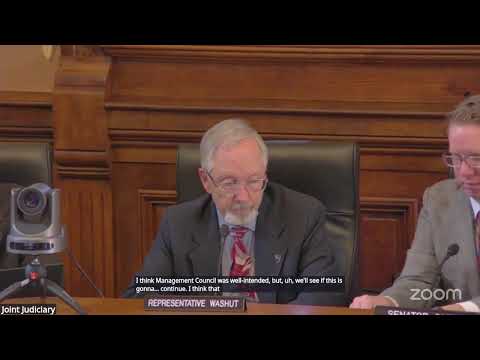
The committee voted to sponsor 26LSO171, a Legislative Service Office draft that would enhance penalties when an adult distributes fentanyl to a person under age 18.
Brian Fuller (LSO) summarized the proposal: the draft adds a subsection making it a felony for "any person who is at least age 18 who violates [the Controlled Substances Act] by distributing fentanyl to a person under age 18," and the enhanced penalty doubles the statutory maximum in the underlying delivery statute (up to 20 years of imprisonment and a fine as high as $10,000). Fuller noted the draft also defines "fentanyl" to include isomers and related esters/ethers used by chemists to evade scheduling.
Alan Thompson of the Wyoming Association of Sheriffs and Chiefs of Police said the sheriffs' offices that provided input support the concept, describing fentanyl as a particularly lethal drug that warrants enhanced penalties. Committee members discussed the deterrence value of heightened penalties and practical enforcement questions; Representative Lean raised concerns about removing a three‑year age gap for certain juvenile‑to‑juvenile sales, and sponsors confirmed existing prosecution channels (including juvenile procedures) remain available even if the double‑penalty enhancement applies only to adults.
The committee recorded a roll call vote to sponsor the bill; staff reported the result as 13 ayes and 1 excused. Sponsors and staff said any technical questions about analogs (for example, carfentanil) could be resolved in session drafting or with agency input prior to introduction.