Get Full Government Meeting Transcripts, Videos, & Alerts Forever!
Get email alerts on the Town Center topic
No spam. Unsubscribe anytime.
Sumner updates Town Center Plan: IDEA overlay, street typologies and HB 1491 walk‑shed rule drive revisions
Summary
City planners presented proposed updates to Sumner’s Town Center Plan to add an IDEA overlay for small makers and live‑work uses, refine form‑based development standards and street typologies, and ensure consistency with House Bill 1491’s transit‑oriented development (3.5 FAR) requirement within the station walk shed.
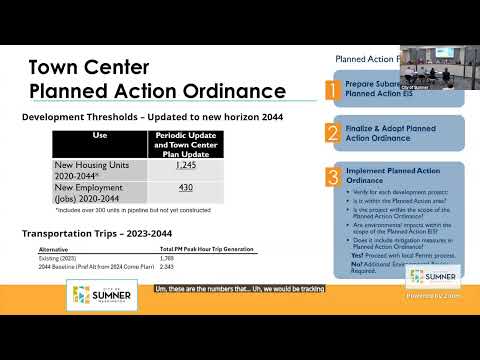
Sumner staff presented proposed updates to the Town Center Plan, form‑based code and related ordinances (Ord. Nos. 2939, 2940, 2941) at the Oct. 13 study session. The 2025 package includes: an IDEA (Innovative District Enterprise Area) overlay to encourage small‑scale makers, live‑work and flexible business spaces; refinements to allowed building heights and transition zones; clarifications to the form‑based code and development standards; new Exhibit language and updated planned action ordinance thresholds; and revisions to street typologies and when frontage improvements are required.
House Bill 1491 and FAR obligations: staff said House Bill 1491 requires jurisdictions with qualifying transit stations to allow, on average, a 3.5 floor‑area ratio (FAR) within a quarter mile walk shed of the train station for jurisdictions under 15,000 population (a half‑mile buffer applies when a jurisdiction exceeds 15,000). Krishanda Walker explained how the quarter‑mile walk shed requirement affects allowed heights and how the 3.5 FAR must be demonstrated across the walk shed. She told council the city is “barely meeting the 3.5 requirement with our current heights” and that HB1491 is a key driver of the town center capacity conversation.
IDEA overlay and transition objectives: staff proposed applying the IDEA overlay to parcels south of Zender Street and near the post office to provide a lower‑height, small‑scale light‑industrial/maker transition between heavier industrial uses north of the tracks and the historic downtown. The overlay would allow one‑ to two‑story maker and live‑work spaces (units as small as ~600–1,000 sq ft, shared makerspaces up to 10,000 sq ft) and would not require a standalone application for parcels in the overlay.
Streets, parking and right‑of‑way: staff recommended clarifying street typologies. Earlier plans showed angled (diagonal) parking on several town streets; staff scaled back angled parking in some places to parallel parking to reduce the right‑of‑way width requirement (parallel collector minimum 60 ft vs. angled requiring ~80 ft). For larger projects the code would require construction of the street cross‑section when the development occupies 200 feet or more of frontage; otherwise the requirement would be limited to dedication for future improvements. Staff said Zender Street needs about 10 feet of additional right‑of‑way on the south side to allow parallel parking and a minimum sidewalk and that the city owns an alley area behind some parcels that could be used in coordination with future development.
Public comment and Planning Commission action: staff said the public engagement process included three notice/comment periods and two open houses; a June focus group on the IDEA overlay drew mainly industry and chamber participants and limited homeowner attendance. The Planning Commission recommended approval of the Town Center Plan update, but the vote on the town‑center ordinances was split (3‑2) and a minority opinion raising concerns (including height, eminent‑domain fears and impacts to existing homes on Zender) was included in the packet.
Council concerns and tradeoffs: council members debated height allocations east vs. west of the tracks, whether to reduce maximum heights on the west side and compensate elsewhere to meet HB1491 FAR requirements, potential displacement along Zender Street, and the need to wait and study parking behavior once the 600‑stall train station parking garage is fully operational. Staff emphasized that HB1491’s FAR is assessed across the walk shed and that lowering height in one place would generally require higher heights elsewhere to meet the statutory average.
Next steps: staff reminded council of a Nov. 3 public hearing, a Nov. 17 study session to review public testimony, and a scheduled Dec. 1 council action on the annual docket. Staff will correct the Planning Commission vote tallies in the record and return with any additional information requested by council.
Clarifying details: the Town Center Plan’s consultant work estimated town‑center capacity and identified Phase 1 and Phase 2 opportunity sites; staff proposed keeping historic CBD maximums at 4 stories in the recommended alternative while allowing greater height west of the tracks in targeted locations to meet FAR obligations; the city’s transportation plan includes the SR‑410/166 interchange project which staff believes helps meet anticipated transportation mitigation needs.