Get Full Government Meeting Transcripts, Videos, & Alerts Forever!
Get email alerts on the Airspace Leases topic
No spam. Unsubscribe anytime.
Caltrans updates airspace lease policy, plans terminations and auctions across districts
Summary
Caltrans told the Transportation Commission it has revised airspace lease rules to permit daily vehicle parking adjacent to structures, identified dozens of sites for reclassification or termination, and plans auctions and tenant terminations to reduce holdovers and align with federal guidance.
Caltrans staff told the Transportation Commission that an updated airspace lease policy taking effect in the first quarter of fiscal year 2025–26 now allows private entities and non‑adjoining property owners to lease areas under, over, or adjacent to structures for daily vehicle parking. The department said the change is intended to improve utilization while maintaining safety and compliance.
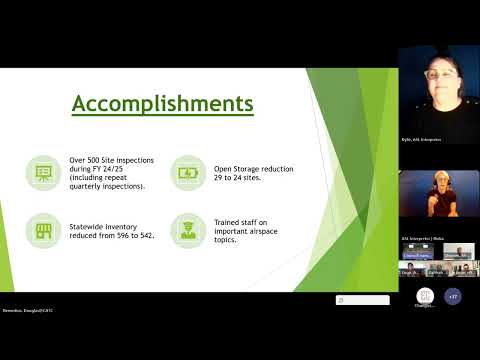
The presentation reported 24 sites remain classified as open storage across multiple districts; staff listed counts of one site in North Region Sacramento, 13 in District 4 (Oakland), nine in District 7 (Los Angeles) and one in District 11 (San Diego). Headquarters, working with districts, identified seven sites to be reclassified because the open‑storage component has been removed or is no longer in use; most of those are being converted to parking‑only uses. Caltrans said it reduced open storage from 29 to 24 since the prior report.
Caltrans recommended termination of 11 open‑storage agreements that no longer align with updated policies and said six remaining sites with active agreements are under review. Staff said termination timelines will be consistent with existing lease language (typically 30–90 days), and that districts will work with tenants before removing structures where feasible. The department reported 119 active holdover sites (month‑to‑month occupancies after lease expiration), concentrated in Districts 4 and 7, and said districts have been trained on auction procedures and preparing packages for California Transportation Commission (CTC) approval when direct negotiation is used.
On safety enforcement, Caltrans said the State Fire Marshal continues to inspect sites and identify violations, including ingress/egress problems, unpermitted structures, prohibited storage and unauthorized tenant systems (lighting, sprinklers and other equipment). The department said some violations are correctable and will be re‑inspected, while others may require demolition; Caltrans plans to identify demolition costs and consider lease buyouts for noncompliant long‑term tenants. Legal staff will document termination actions and liability issues, the presentation said.
Staff described administrative improvements, including an exception process that requires district submission to headquarters for cross‑stakeholder review, updated lease bid valuation procedures (headquarters appraisers mobilized to District 4 in Q4), and a revised Airspace Program Manual with clearer guidance. Caltrans reported inspections at more than 500 sites and said overall inventory of airspace leases has fallen from 596 to 542. The department also said it plans to auction approximately 25 sites in District 4 during the second quarter of fiscal year 2025–26 (December 2025).
Commissioners asked whether tenants would be engaged prior to demolition and about the fiscal effect of policy changes on revenue. Caltrans staff said districts will work directly with tenants before eviction and that staff would provide revenue figures later. Caltrans representative Stephen Keck said, “Most of the lease revenue that we receive ... fall under a section of law where those funds are transferred to the Transportation Debt Service Account to pay for debt service on past transportation bonds,” noting the department does not retain that revenue for general use.
Why it matters: the airspace program governs private use of property adjoining state transportation structures; changes affect tens to hundreds of leaseholds, local tenants and site safety. The department framed the updates as an effort to align with Federal Highway Administration guidance, reduce risk, and improve operational efficiency.
What’s next: Caltrans said districts will implement a standardized, time‑bound approach to reduce holdovers, complete valuations and auctions where appropriate, and post updates to future reports or presentations.