Get Full Government Meeting Transcripts, Videos, & Alerts Forever!
Get email alerts on the Land Use topic
No spam. Unsubscribe anytime.
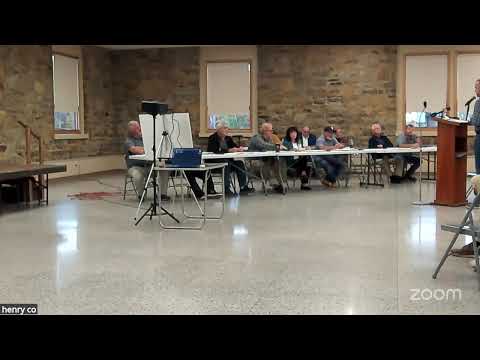
Commission hears hours of testimony on proposed Henry County technology park; PUD tabled for 30 days after extensive public comment
Summary
After hours of testimony from proponents and opponents, the Henry County Planning Commission voted 6–2 to table a proposed 580‑acre planned unit development for a technology park and data center near I‑70 and State Road 109 for 30 days.
The Henry County Planning Commission held an extended public hearing on Case B2285, a proposed planned unit development to create a large technology park and data‑center campus at the northwest corner of Interstate 70 and State Road 109. After hours of applicant presentation and public comment both for and against the plan, the commission voted to table the application for 30 days, 6–2.
Greg Barnes, representing the applicants, described the proposal and a set of voluntary restrictions he called “guardrails” intended to limit impacts. Barnes told the commission, “First, no outside water wells,” emphasizing the PUD language that would require municipal water service and thereby make open‑loop cooling systems impossible. He also described on‑site power generation using adjacent high‑pressure gas lines and said the project’s PUD would require strict adherence to the county noise ordinance plus an eight‑foot berm and large landscape buffers; the document also calls for at least 25% of the site to remain undeveloped and a 300‑foot building setback from the property boundary.
Supporters, including the mayor of New Castle and local economic‑development leaders, urged approval, saying the project could attract investment and long‑term jobs and would fund infrastructure improvements. “This project represents a transformational economic catalyst,” said Robert Hammer of the downtown council, describing potential water and sewer investments and a spillover benefit for local businesses.
Opponents raised multiple concerns in the public record. Several residents said the submitted PUD lacks explicit water‑use caps and asked for independent impact studies. Kyla Glayla, whose family owns farmland adjacent to the site, told commissioners: “The plan presented provides no parameters for water use, no caps, no detail on how much water will be required to build or operate the system.” She and others cited comparative estimates for traditional cooling systems and urged clarity on whether municipal systems would be sufficient and on long‑term operating costs.
Legal and planning questions were also raised. A commenter referenced the county’s comprehensive plan and cited an Indiana code provision when arguing the proposed heavy‑industrial intensity conflicts with the plan’s guidance for development near the exit; the speaker urged commissioners to evaluate plan consistency before approving the PUD. Commissioners and the applicant’s team discussed process next steps: the PUD certification is step one; a separate development‑plan submission will follow and must include detailed studies, permits and engineering, at which point environmental reviews (wetlands, air, stormwater) and state or federal permitting for on‑site power generation would be required if that element proceeds.
After the public comment period and applicant responses, Commissioner Dale Hall moved to table the item for 30 days; Commissioner Jason Roberts seconded. The commission conducted a roll‑call vote and the motion passed 6–2. The chair said the PUD will return at the commission’s next scheduled meeting after the 30‑day hold to allow time for additional information and for county staff and the public to review materials.