Get Full Government Meeting Transcripts, Videos, & Alerts Forever!
Get email alerts on the Zoning Rabbinical College topic
No spam. Unsubscribe anytime.
Baltimore County appeals panel signals limited approval for rabbinical college at Park Heights site
Summary
After a day of deliberations, the three-member Baltimore County Board of Appeals signaled a consensus to grant a special exception for a rabbinical college at 10729 Park Heights Avenue with conditions: initial occupancy capped at 48 students and two faculty, no on-site kitchen or laundry without further review, and ingress/egress restrictions; the
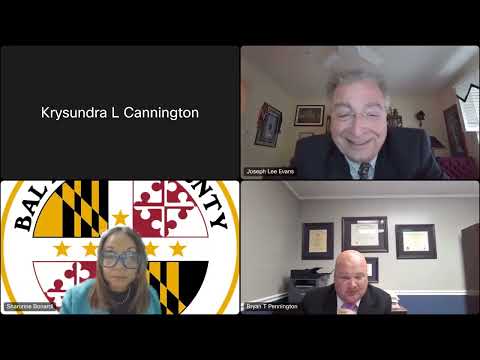
The Baltimore County Board of Appeals on Oct. 8 deliberated a petition (case 24-029-SPHX) seeking a special exception to permit a rabbinical college, including dormitories, at 10729 Park Heights Avenue in Council District 2. Chair Sharron Bernardi and board members Joseph Evans and Brian Pennington discussed zoning definitions, traffic access, parking, and sizable uncertainties about the site’s septic and water capacity.
The panel agreed in principle to a constrained pathway for the use: limit initial occupancy to 48 students and two faculty; designate the northern driveway as ingress only and the southern driveway as egress only; and require that no kitchen or laundry be installed without further authorization. Board members said any expansion in the number of residents or conversion to a full kitchen/laundry would require a new application and further review.
Bernardi opened the session by summarizing the petition and the requested relief, which included confirmation that 45 parking spaces would be sufficient and continued use of three existing single-family homes as nonconforming uses. She told the record the matter raises many issues that were addressed at length during earlier hearings.
Board debate turned first to whether a dormitory is encompassed by the zoning term “college” or is a separate use under the Baltimore County Zoning Regulations (BCZR). Evans, Pennington and Bernardi all agreed this is a close interpretive question; two members said they were prepared to treat dormitories as an accessory use for purposes of deciding the petition. Pennington said, “I am of the belief that a dormitory is an accessory use to a college.” Bernardi cautioned the board not to deny the project solely on definitional grounds without addressing other substantive issues.
Traffic and site access were also central. The panel relied on prior testimony and safety analysis in concluding the northern access should be for ingress only and the southern access should be egress only. Bernardi explained that the board’s review under BCZR standards includes whether a use will be detrimental to the health, safety and general welfare of the surrounding area, and she emphasized site-distance and ingress/egress safety as part of that evaluation.
Most contentious was the board’s review of wastewater and water capacity. The record included an exhibit (referred to as Exhibit 27) with usage data from a New Jersey yeshiva that several experts relied on in different ways. Evans described that exhibit as problematic: “This exhibit is the most hearsay-laden thing I think I’ve ever seen,” and he said the data’s provenance and meaning were unclear. The panel noted conflicting expert interpretations of septic-field capacity and expressed mistrust of county monitoring and the limited testimony offered on county processes for inspecting and approving septic upgrades.
Because of those evidentiary gaps, the board coalesced around a conditional approach: allow an initial, modest level of occupancy subject to strict limits and require that any expansion be the subject of a new review and independent data. Bernardi stated the board was not willing to cede unconstrained future growth to county administrative review alone and recommended that future expansion present sound data on actual water use and septic flow.
The panel acknowledged federal religious land-use protections in its analysis (the transcript refers to this consideration as “our lupa”), and members said that accommodation for a religious institution influenced their willingness to grant relief they otherwise might scrutinize more strictly.
Board members agreed that parking and continued use of the three rental houses were not contested by the protestants and were not dispositive. The hearing concluded with members thanking counsel and each other; Bernardi said a written decision will be issued to set forth the final findings and any formal conditions.
The board’s stated directions at the close of deliberations indicate a conditional approval pathway: 48 students and two faculty initially; no on-site kitchen or laundry without subsequent approval; ingress/egress limited as described; and a requirement that any expansion or change (additional students, kitchen, laundry) return for further review. The panel did not issue a final signed order during the session, and the transcript records no roll-call vote. The board said a formal written decision will follow that will memorialize the conditions and the process for any future expansions.