Get Full Government Meeting Transcripts, Videos, & Alerts Forever!
Get email alerts on the School Improvement topic
No spam. Unsubscribe anytime.
PGCPS launches Innovation and Performance Zone to accelerate improvement at 24 CSI schools
Summary
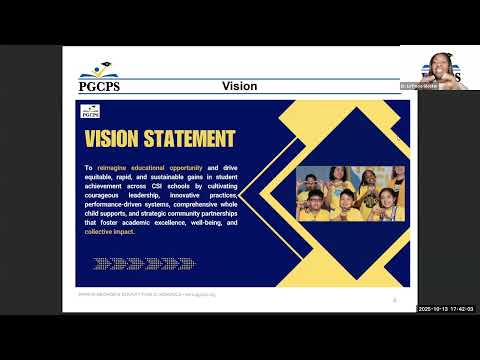
Prince George’s County Public Schools leaders presented the new Innovation and Performance Zone at the Academic Achievement Committee meeting on Oct. 13, 2025, saying the effort is designed to accelerate equitable gains in 24 state‑identified Comprehensive Support and Improvement (CSI) schools and to proactively support nine schools at risk of CSI designation (ATSI).
Prince George’s County Public Schools leaders presented the new Innovation and Performance Zone at the Academic Achievement Committee meeting on Oct. 13, 2025, saying the effort is designed to accelerate equitable gains in 24 state‑identified Comprehensive Support and Improvement (CSI) schools and to proactively support nine schools at risk of CSI designation (ATSI).
"Every system is perfectly designed to get the results that it receives," said Dr. Deanne Collins, chief of staff, summarizing the zone’s organizing idea and the district’s goal to redesign systems so CSI schools can produce faster, sustainable gains. Dr. Latricia Gloucester, associate superintendent of innovation and performance, said the zone will focus concentrated supports — leadership coaching, targeted instructional specialists, professional learning communities and whole‑child services — rather than creating separate curricula for zone schools.
The district said the 24 CSI schools include a mix of elementary, middle and three high schools and are grouped into three clusters of eight schools each; a fourth cluster of nine schools was labeled ATSI (at‑risk of CSI) and identified to allow proactive intervention. Gloucester summarized the state criteria the district is using: elementary and middle schools are designated CSI when one or more student groups perform below the lowest 5% of Title I schools statewide; high schools can be designated CSI when a four‑year adjusted‑cohort graduation rate is below approximately 67% across at least two years.
District leaders described changes to staffing and coaching: instructional directors assigned to the Innovation Zone will manage about eight schools each to allow more frequent coaching and oversight. Presenters cited research and a University of Virginia/Darden partnership framework that emphasizes four levers — systems leadership; support and accountability; talent management; and instructional infrastructure — and said the zone will emphasize tighter coaching feedback, model lessons and stronger professional learning communities.
Leaders also described the zone’s funding approach. Dr. Collins and Dr. Gloucester said resources will be ‘‘braided’’ from existing buckets — Title I, community schools funding, CSI allocations and the schools’ basic budgets — while avoiding supplanting rules. "It's called braiding of the funds and not getting in trouble with supplanting," Collins said, noting the district has no large unrestricted pot of new money and will seek partner funding for priority work where feasible. The district confirmed ATSI identifications occur on a three‑year cadence and said it will plan for sustainability if a school’s designation changes.
Board members pressed district leaders on how families will notice the difference. Gloucester said the district will run cluster‑level ‘‘listen and learn’’ sessions and co‑construct parent engagement strategies with community‑schools partners so parents can see and shape supports in their schools. Dr. Collins said the district will ask principals to analyze existing family‑engagement practice and co‑create plans with families and partners.
Board members and staff discussed early warning metrics the district watches before schools reach CSI status: MCAP and course assessments (including Algebra I and biology at high school), graduation‑rate trends for high schools, and chronic absenteeism. "If students are not present, they aren't receiving the high‑quality education we know they deserve," Gloucester said, naming chronic absenteeism a ‘‘big rock’’ of the work.
Special education needs were discussed separately. District staff said a systemwide special education funding request (discussed by the district as approximately $26 million in recent reporting) is driven by the systemwide cost to provide required services and compensatory interventions when services were missed; staff said those requests are separate from Innovation Zone allocations but are necessary to ensure legally required services are provided.
On implementation, district leaders described a hybrid model: some elements will be tightly prescribed (coaching feedback cycles, PLC expectations and talent‑management practices) while specific interventions (for example, high‑dosage tutoring) will be locally determined and tied to each school’s data and school performance plan. The district said it will return to the committee with field reports and updates (presenters flagged a February follow‑up visit) and that principals’ school performance plans and any CSI plans are submitted to the state and are typically posted on school websites.
No registered public commenters addressed the committee during the meeting, and no formal votes were taken at this session. The Academic Achievement Committee scheduled its next meeting for Nov. 10, 2025.