Get email alerts on the Design Review topic
No spam. Unsubscribe anytime.
Pleasanton planning commission backs streamlined design‑review process, cuts notice radius
Summary
On Oct. 22 the Planning Commission voted unanimously to recommend City Council adopt staff‑proposed amendments to Pleasanton Municipal Code Title 18 that narrow public‑notice radii, shorten appeal periods and exempt many minor projects from design review to reduce staff workload and applicant costs.
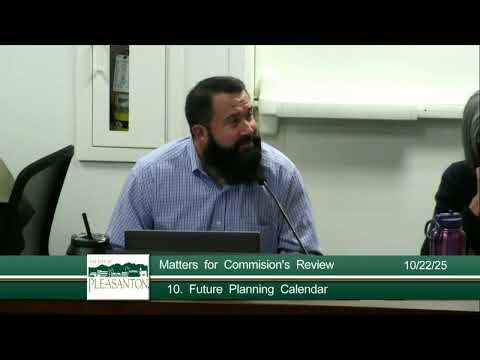
The Pleasanton Planning Commission unanimously voted Oct. 22 to recommend that City Council approve amendments to Pleasanton Municipal Code Title 18 intended to streamline design review, align public‑notice requirements with state law and shorten appeal windows.
Planners Megan Campbell and Emily Carroll of the City of Pleasanton presented the package, telling commissioners that "these codes have not been updated since the early nineties" and that staff spends substantial time processing small projects with limited community impact. The amendments would exempt a range of minor projects from discretionary design review — for example, single‑story home additions under 15 feet, accessory structures, fence work and minor exterior commercial changes — while retaining design review for projects with likely privacy or massing impacts, such as two‑story additions, new balconies and new multifamily units.
Staff cited local workload data: over the past decade the planning division processed an average of about 110 single‑family projects per year, a caseload Campbell said consumes "between 20 to 40% of a community and economic development full time staff member." Residential design review applications typically took several weeks; staff estimated the planning portion for a typical commercial applicant at about 10 weeks plus a multi‑week appeal window.
The package would also align the city’s public‑notice radius with the Government Code requirement cited by staff (300 feet), replace an extended city policy tied to City Council Resolution No. 91132, and narrow the appeal period. Emily Carroll explained staff’s appeals proposal: instead of frequent council call‑ups that can delay effective dates, the city would publish a weekly approval memo listing appealable discretionary planning actions; all appeals and council call‑ups would be required within a 10‑day window.
Campbell told the commission that the changes are not intended to eliminate code enforcement for standards such as height and setbacks — projects exempted from design review would still be reviewed for code conformance through building permits.
Commissioners asked technical questions about appeals frequency, notification processes and fences. Staff said appeals were rare — on the order of "two in five years" for formal appeals — and that the city currently mails notices to both property owners and tenants for some projects even though Government Code notice obligations apply to owners. Staff confirmed that fence permits up to 6 feet are processed over the counter and that overheight fence and building‑department requirements would remain in effect; the proposal would move fence review to the building permit process rather than require a separate planning step.
Commissioner Pace moved to recommend the amendments as presented; the motion was seconded and carried on a unanimous roll call (Commissioners Jagel, Jane, Mohan, Pace and Chair Morgan all voted aye). The action was recorded as a recommendation to City Council on case P253052.
Staff recommended the commission find the project exempt from CEQA pursuant to CEQA Guidelines §15061(b)(3) and told the commission the item will go to City Council in December with a target effective date in early 2026. Implementation tasks cited by staff include creation of the weekly discretionary approvals memo, internal process changes across departments, and outreach to the business community about the revisions.
Supporters on the commission said the changes would free staff time to focus on larger, more consequential projects while reducing unnecessary delays for small, objective work; some commissioners urged additional future rounds of process improvements and faster resubmittal handling for applicants.
Next steps: staff will forward the Planning Commission recommendation and the draft PMC amendments to City Council for consideration in December; if Council approves the changes, staff will implement the updated procedures and the weekly approval memo.
AI generated
The text on this page is AI generated. Summaries, highlights, analysis, and video transcripts are all produced from the original source material.
AI can make mistakes, so if you spot one, and we will fix it for everyone.
Note: the source content is unaltered by us. Any content source we link to, be it a video, an audio recording, or a document, is presented exactly as its publisher released it. That publisher is usually a government body, sometimes an individual official or another organisation.