Get Full Government Meeting Transcripts, Videos, & Alerts Forever!
Get email alerts on the Public Safety topic
No spam. Unsubscribe anytime.
Half Moon Bay Council accepts FY2024–25 law enforcement report as sheriff’s office highlights technology, staffing and e‑bike concerns
Summary
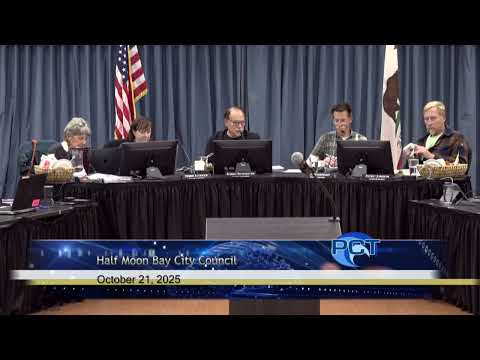
The Half Moon Bay City Council on Oct. 21 accepted the San Mateo County Sheriff’s Office FY2024–25 annual report after a presentation that emphasized continuity of operations, technology upgrades and traffic‑safety work along the coast.
The Half Moon Bay City Council on Oct. 21 accepted the San Mateo County Sheriff’s Office FY2024–25 annual report after a presentation that emphasized continuity of operations, technology upgrades and traffic‑safety work along the coast.
Miss Weiss of the sheriff’s office told the council that "the office of sheriff is now vacant" and that "the under sheriff is discharging the duties of the sheriff," adding there is an established chain of succession so daily service should not be disrupted (01:15:18). She also said the department’s statistical reporting changed from UCR to NIBRS, which complicates year‑to‑year comparisons.
The report detailed the office’s patrol staffing on the coast, data‑cleaning work on response‑time records, and modest fluctuations in crime categories. The sheriff’s office described equipment and technology investments including Axon Body 4 and Fleet 3 cameras (with GPS and transcription), the StarChase pursuit‑avoidance tracker, and pilot use of secure mobile devices to let deputies access local and state records in the field. The presentation also described multiple cases in which license‑plate‑reader (LPR/ALPR) data helped detect or recover stolen property and led to arrests.
Traffic safety remained a focus. The sheriff’s office showed mapped collision data and reiterated the ‘‘three E’s’’ approach — education, engineering and enforcement. The presenter said collisions and citation totals showed only modest year‑to‑year movement, but cited rising concerns about high‑speed e‑bicycles in downtown and on trails. "It is a problem," the presenter said of e‑bikes and described plans for school outreach, public education and a proposed e‑bike rodeo to teach safe operation (01:37:76).
Council members pressed the sheriff’s office on enforcement tactics and community outreach. The presenter and council discussed the limits on pursuing riders and options to improve response and evidence gathering, including potential drone or community‑sourced solutions to identify repeat offenders.
After questions, the council approved a motion to accept the FY2024–25 law enforcement report.
The report and presentation noted several operational items for future oversight: the sheriff’s office’s continued transition to NIBRS data, ongoing cleaning of call coding in the records system, monitoring whether changes in arrest counts reflect real trends or small sample fluctuations, and evaluation of the county’s new mobile crisis response services for mental‑health calls.