Get Full Government Meeting Transcripts, Videos, & Alerts Forever!
Get email alerts on the Transportation topic
No spam. Unsubscribe anytime.
Yukon council approves two curb cuts on NW 10th Street contingent on development agreement
Summary
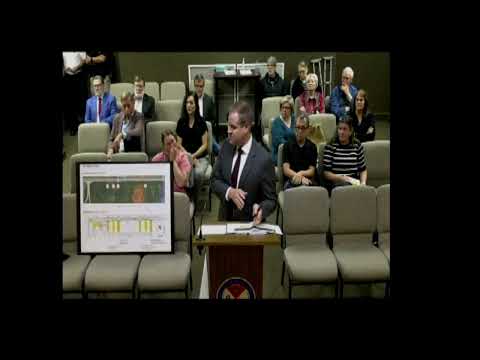
After an extended public hearing on traffic, notice and safety, the Yukon City Council approved two curb cuts for a commercial development on Northwest 10th Street, conditioned on a development agreement assigning impact fees and traffic improvement costs to the applicant.
The Yukon City Council on Oct. 21 approved two curb cuts for a commercial project on Northwest 10th Street, contingent on a development agreement that will enumerate impact fees and responsibility for future traffic-control improvements.
The vote follows more than an hour of public comment and testimony from city staff, residents, the applicant’s attorney and traffic consultants about safety, notice and driveway spacing. The council’s motion authorized two curb cuts with full ingress and egress, required acceleration and deceleration lanes and said the approval is contingent on a development agreement acceptable to the city manager and city attorney.
Applicant representative (Mr.) Box told the council the developer does not intend to leave Yukon with the bill for improvements and said his client would negotiate financing, but asked the council to avoid obligating the developer to undefined future fees. David Bock, a nearby resident, said, “The function of notice is never that of an applicant. It's always that of the government,” objecting that some neighbors did not receive mailed notice for the application.
Todd Butler, a traffic engineer with Traffic Engineering Consultants, summarized the firm’s study and recommended a configuration emphasizing right-in/right-out drives to reduce conflict points. He told the council that converting four access points to two would concentrate traffic at remaining drives and that right-in/right-out drives “are far more safe than the full access drives” because they eliminate left-turn conflicts, especially near the highway ramps.
The developer’s team said the site’s frontage and geometry make more than two drives desirable; the applicant’s civil engineer and traffic engineer argued the proposed plan would meet or exceed separation standards. The applicant said the developers hired a licensed abstract company to compile the notice list provided to Oklahoma City for the application and offered to share that list with the city.
Council members repeatedly framed the debate as a public-safety and traffic-flow issue on a busy arterial corridor. Council members indicated support for requiring acceleration/deceleration lanes, signalization at key intersections and a development agreement that spells out funding responsibility. The council voted to approve the two curb cuts contingent on that agreement.
Next steps include finalizing the development agreement between the city and the applicant; if the parties cannot reach terms, the matter will return to the council. Council members said they expect the agreement to specify which traffic improvements the developer must fund and to require plans for dedicated acceleration and deceleration lanes and other traffic-control devices.