Get Full Government Meeting Transcripts, Videos, & Alerts Forever!
Get email alerts on the Airport Noise topic
No spam. Unsubscribe anytime.
Residents urge Harris County to pursue FAA noise‑abatement steps after spike in training flights
Summary
Several Pine Mountain residents and pilots told the Harris County Board of Commissioners that training flights and aerobatic practice at Harris County Airport have increased markedly over the past year and asked the county to pursue FAA Part 150 noise‑abatement planning and other operational changes to reduce low approaches over homes.
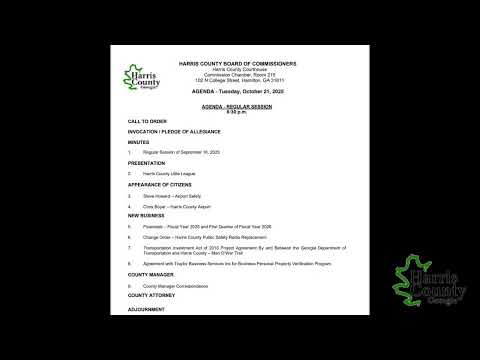
Residents living near Harris County Airport told the Board of Commissioners on Oct. 21 that pilot training activity has increased substantially in the past year and asked county officials to pursue changes aimed at improving safety and reducing noise.
Steve Howard, a Pine Mountain resident and former military pilot, told the board the rise in repeated training approaches from flight schools has created both safety concerns and a marked rise in noise for neighborhoods 1–2 miles from the runway. "We are requesting that the airport administration become part of the FAA part 150 noise abatement program," Howard said, adding that the FAA will assist and may provide funding for portions of the effort (00:15:31). He read a list of specific, FAA‑compatible steps he said the county could implement, including designating Runway 27 as the preferred runway when conditions allow, repairing the inoperative Precision Approach Path Indicator (PAPI) lights, listing nearby residences in pilot information sources, raising downwind pattern altitude from 800 feet to 1,000 feet, and establishing a base‑leg minimum of 500 feet in compliance with FAA guidance.
Chris Boyer, another Pine Mountain resident, said the closure of Columbus Airport and low avgas prices have attracted more transient traffic to Harris County Airport and identified two flight schools—one he called the Newton school and another he said is run by Auburn University—as frequent users of the field (00:22:21). "The airport is an asset to the county," Boyer said, but he suggested county staff try informal outreach to flight schools about schedule adjustments or operational guidance to reduce neighborhood impact.
John Willis, a pilot who keeps a plane hangared at the field for more than 30 years, echoed the increase in movements but cautioned that once aircraft are airborne federal rules govern the airspace. He urged the board to weigh the cost of a formal Part 150 study before committing county funds: "Before the county jumps up and starts writing checks like that as a tax paying citizen, I would say, you might wanna take a look at the cost and the benefit" (00:25:53).
The chair asked the county manager to collect the speakers' materials and to consult with the airport administrator and the county's airport consultant, then report back to the board (00:29:37). No formal action or ordinance was adopted at the meeting.
Why it matters: Residents described an identifiable change in flight‑pattern frequency and asked the county to use available FAA tools and airport administrative steps to reduce low approaches and neighborhood noise. County staff and commissioners framed the issue as a mix of local operational measures and federal airspace authority, and asked staff to pursue follow‑up with the airport administration, consultant and, where appropriate, the FAA.