
Working group weighs public right-of-way uses, parking and business activation
Get AI-powered insights, summaries, and transcripts
Subscribe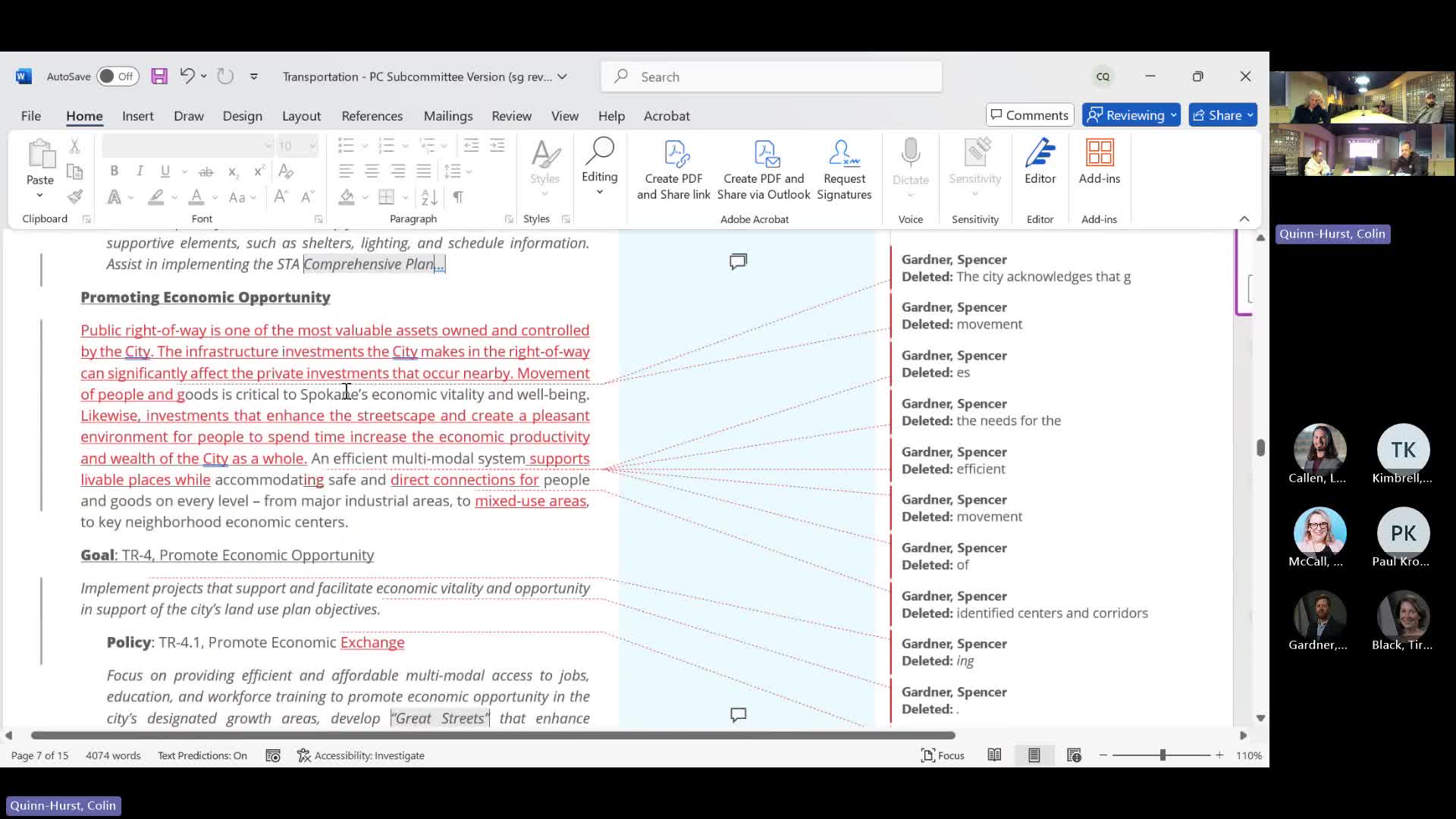
Summary
Members debated treating public right-of-way as a city asset to support economic opportunity through measures such as on-street parking, parklets and streeteries, and recommended clearer policy language (provide vs. increase) and examples for future-proofing.
Participant 4 emphasized that public right-of-way is ‘‘one of the most valuable assets owned and controlled by the city’’ and described policy language to support economic opportunity through street activation, business access, parklets and on-street parking. "Public right of way is one of the most valuable assets owned and controlled by the city," Participant 4 said.
Participants debated phrasing: several warned that wording such as "increase on-street parking" could be misread as prioritizing parking. Participant 6 and others suggested wording that highlights supporting business activation (examples: parklets, streeteries, temporary activation) and providing parking where appropriate rather than a blanket increase. Participant 6 suggested including examples so future readers understand how right-of-way might be used for businesses.
The group discussed coordination with development services, parks and other city departments when access or right-of-way changes are proposed, and recommended placing specific implementation strategies in separate documents to avoid frequent chapter amendments. No formal action was taken; staff will draft revised language that replaces ambiguous verbs like "increase" with clearer options ("provide," "facilitate" or "support opportunities for business activation").
The working group did not adopt final wording at the meeting and left final edits to staff for a future draft.