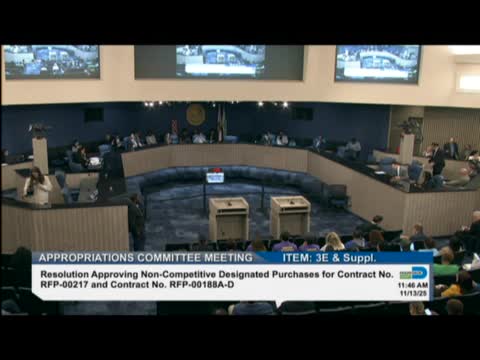
Appropriations committee defers proposed Miami‑Dade CBO trust after fiscal and procurement questions
Loading...
Summary
A proposal to create a Miami‑Dade CBO trust funded by a 2% deduction on eligible county contracts drew widespread public support but also administrative caution and fiscal questions; the committee voted to defer the ordinance for 60 days for further analysis.
The Miami‑Dade County Appropriations Committee deferred for 60 days a proposed ordinance that would create a Community‑Based Organization (CBO) trust fund financed by a 2% deduction on eligible county vendor contracts.
Sponsor Commissioner Keon McGee framed the measure as a permanent vehicle to stabilize funding for human and social services nonprofits, saying the trust would be "a permanent renewable source of legal and local funding for human services programs." He and several CBO leaders told the committee the proposal would protect organizations that provide critical services to children, seniors and vulnerable residents.
Administration officials cautioned that the ordinance’s projected revenue is smaller than some advocates suggested. Procurement director Namrata Upal noted exclusions—contracts funded by proprietary or fee‑based revenues (for example, aviation) likely would not be eligible—and said vendors could either absorb the fee or pass it on to the county. David Klockfelter of the Office of Management and Budget summarized the fiscal tradeoffs: because proprietary fees would be ineligible, he estimated the realistic annual yield at "30% of what we collect today, which is 4 to $5,000,000," not the roughly $16 million total cited for the broader UAP (user access program).
Commissioners debated multiple issues: whether the 2% will be absorbed by vendors or passed to taxpayers; the proposal’s effect on piggybacking by other jurisdictions; the adequacy of the estimated revenue in addressing a larger shortfall in nonprofit funding; and whether the measure should be vetted by the procurement reform STRIP committee or placed on a public ballot as a dedicated trust. Commissioner Cohen Higgins warned that businesses typically pass added costs along and said "the 2% will inevitably be passed along, not absorbed." Commissioners asked for more precise fiscal modeling, clarification of which contracts would be eligible, and options that would reduce impacts on small and local businesses.
After extended discussion and requests for additional data and STRIP committee review, the committee voted to defer the ordinance for 60 days to allow staff and commissioners to refine the item and supply more detailed fiscal and procurement analyses before it returns to committee.
Next steps: Staff will prepare more granular estimates of eligible contract revenue, impacts on piggybacking and small businesses, and an implementing order or draft language that clarifies eligibility and safeguards; commissioners suggested a sunshine meeting and STRIP review before the item returns.