Get Full Government Meeting Transcripts, Videos, & Alerts Forever!
Get email alerts on the Rezoning topic
No spam. Unsubscribe anytime.
Clute council denies rezoning request for 907 Lewis Street after residents press safety concerns
Summary
After a joint public hearing with the Planning & Zoning Commission, Clute council voted unanimously Nov. 13 to deny a request to change 907 Lewis Street from C‑1 to C‑2, citing unresolved traffic and access concerns raised by nearby residents.
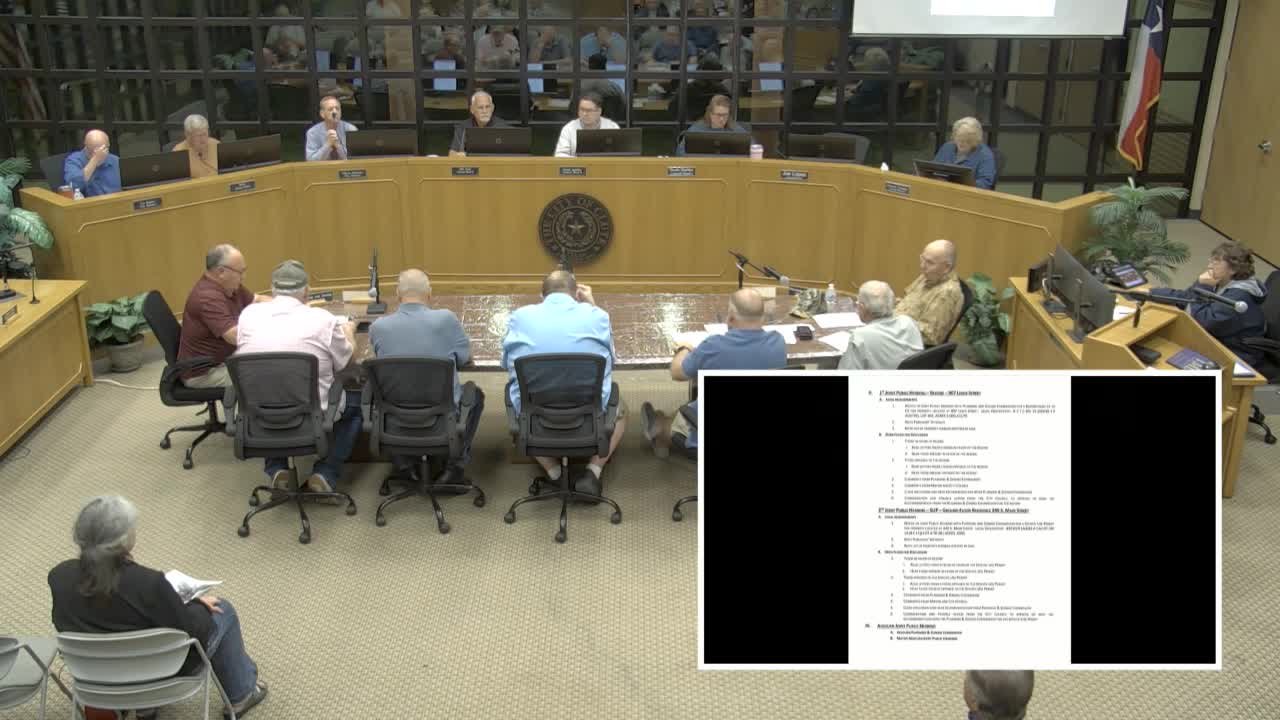
Clute — The Clute City Council jointly with the Planning & Zoning Commission denied a rezoning request for 907 Lewis Street on Nov. 13 after neighbors raised traffic and safety concerns.
The request would have changed the parcel’s zoning from C‑1 (neighborhood commercial) to C‑2 (broader commercial) to allow expansion of an adjacent business and to make frontage zoning uniform along Highway 332. Bobby Brown, a real‑estate broker representing the applicant, said the owner seeks the change to expand an existing automotive repair business and to enable potential future sales of subdivided lots fronting 332.
Neighbors said the primary issue was traffic and pedestrian safety on narrow Lewis Street, which dead‑ends at the property. “My main concern is just the traffic on the road, on Lewis Street specifically,” said resident Kieran Russell, who noted children playing and a family member with autism. Several residents asked whether large trucks would be routed through Lewis and whether the city could prevent that by requiring access from Highway 332 only.
City planning staff and the city attorney described options but warned of legal and procedural limits. Staff said the property already contains commercial zoning in part, explained the difference between a rezoning and a Specific Use Permit (SUP), and noted that a rezoning is a straight zone change that cannot be conditioned. Staff suggested potential mitigations — a Knox gate for emergency access, a cross‑access agreement to ensure primary ingress from 332, or a traffic‑commission action that could designate Lewis Street as a dead end or a “no trucks” street — but said those measures would require separate processes and, in some cases, property‑owner cooperation.
Council members said they were not comfortable approving a broad rezoning without guarantees that Lewis Street would be protected from through traffic. After deliberation, a motion to deny the rezoning was made and the council voted unanimously to deny the request.
The denial stops the replatting and sale process tied to the rezoning unless the applicant returns with a revised plan (for example, an SUP or documented cross‑access agreement). Planning staff recommended follow‑up with the traffic commission and recommended that the property owner be present at any further hearing to clarify access plans.
The planning and zoning commission had initially recommended approval before additional access and neighborhood concerns surfaced at the joint hearing. The council’s action does not change the status of adjacent properties that are already zoned C‑2; it rejects this applicant’s request to reclassify the rear tract at this time.