
Fairfax schools present early fiscal 2027 forecast as board presses for clearer funding story
Get AI-powered insights, summaries, and transcripts
Subscribe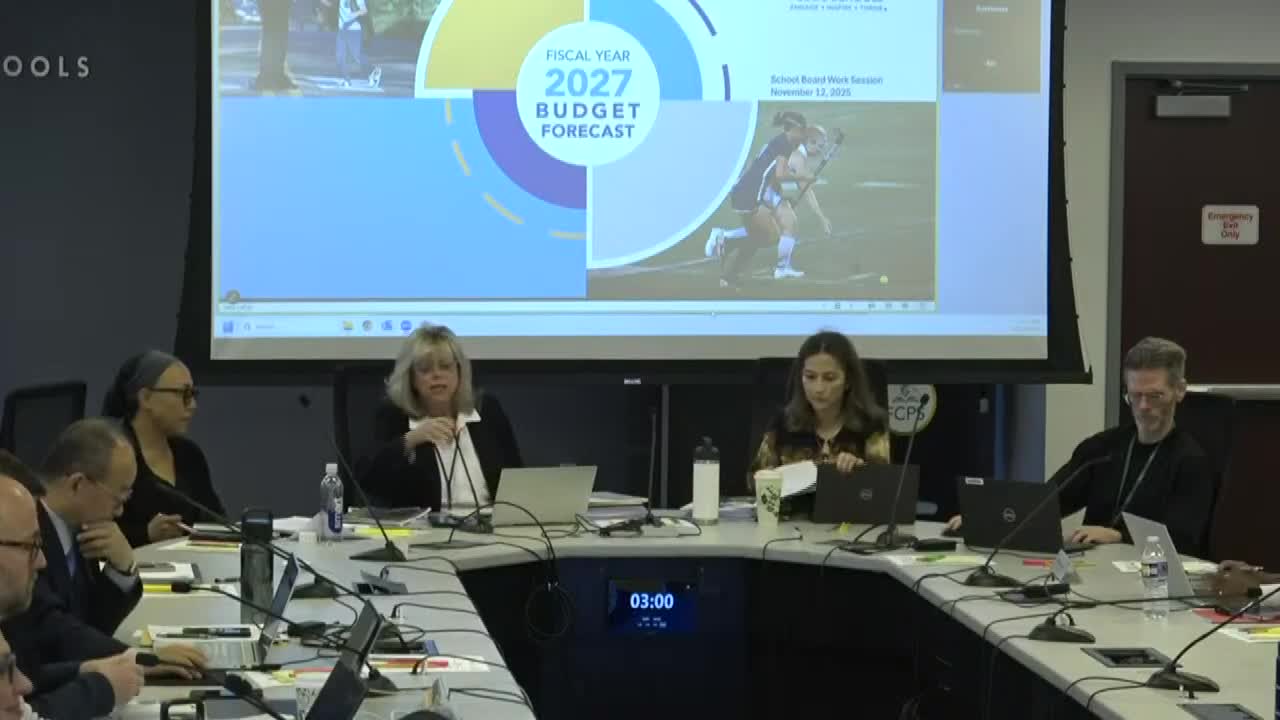
Summary
FCPS staff delivered a preliminary fiscal forecast for fiscal 2027 showing a base shortfall driven largely by compensation and benefit costs; board members pushed for clearer county-transfer visuals, JLARC context and program-by-program costs as they prepare advocacy and priority-setting.
Fairfax County Public Schools officials on Nov. 13 presented a preliminary fiscal forecast for the 2027 school operating fund, warning that the division faces a narrow set of options unless state or local revenues change.
The budget team, led by Superintendent Dr. Reed and Chief Financial Officer Lee Burden, described the forecast as an early, base-level projection rather than a superintendent's proposed budget. "The budget is a foundation of everything we're going to be able to do as a school division," Dr. Reed said, introducing the forecast and the board's role in setting priorities.
Burden outlined the revenue assumptions driving the forecast: the county transfer was assumed level for planning purposes, state revenues include an estimated $17.3 million increase tied to sales tax and local composite index (LCI) changes, and federal operating fund revenue was projected to remain flat. On the expenditure side, staff emphasized mandatory cost pressure from step increases, a 3% market scale adjustment (each 1% approximated at about $31.6 million), benefit rate changes and contract escalations. Burden said the forecasted required expenditures for the base budget totaled roughly $193.8 million.
Board members pressed for clearer presentation of how county transfers are shown (percent of county budget vs. dollar change), and asked staff to add JLARC context showing the statewide funding gap so members can advocate more effectively. "If a member of the public looks at this, it does not look like we are being underfunded," said one board member, urging the communications team to rework slides and talking points.
Several trustees requested more granular numbers for the items listed as "above SOQ" (programs funded beyond the Commonwealth Standards of Quality), including dollar amounts for college-and-career specialists, counseling, special education supports and transportation. Staff acknowledged those requests and said they would provide cost breakout and impact details in coming weeks to support board priority-setting and outreach to the Board of Supervisors and the Northern Virginia delegation.
What happens next: staff will refine the forecast as state and county budget signals emerge (the governor's introduced budget is due in mid-December and a joint county meeting is on Dec. 2). The superintendent will use this forecast as the groundwork for the proposed budget due Jan. 22; the board will collect member priorities via a Google form due Dec. 5.
Quotes in context: Burden cautioned that the forecast is preliminary: "These potential expenditures should not be interpreted as a recommended budget change or what the superintendent's proposed budget might include," and he noted the long-standing gap identified by JLARC and the limits of state funding formulas.
The work session concluded with board members asking staff for clearer visuals, per-item cost figures and analyses of program impacts and returns, and with staff committing to deliver additional datasets to support the board's advocacy and public communications.