
Wellington adopts updated building codes; trustees hear heated public comment over townhome sprinkler requirement
Get AI-powered insights, summaries, and transcripts
Sign Up Free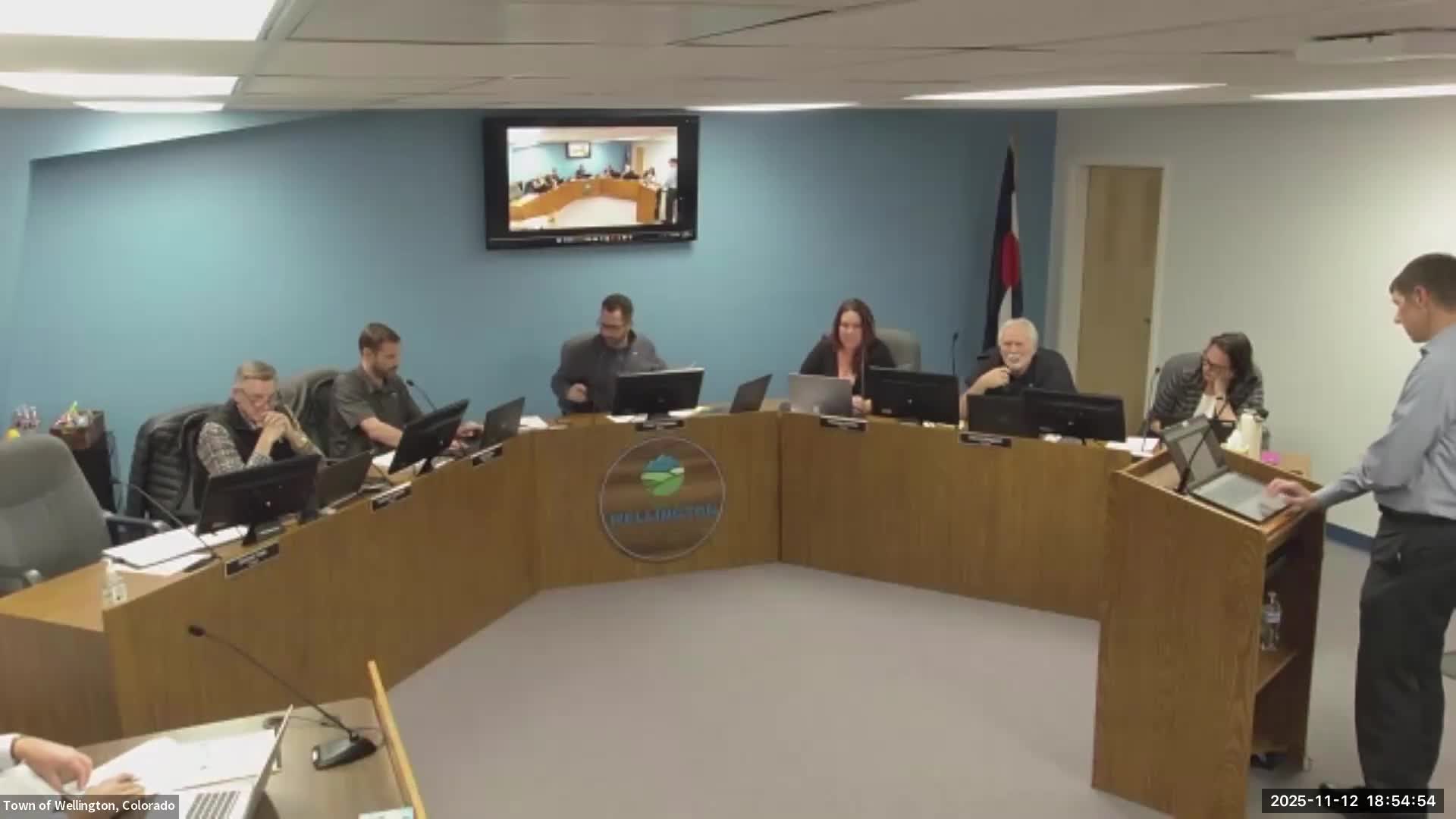
Summary
After public comment from local builders and in-depth board deliberation about townhome sprinkler requirements and housing affordability, the board adopted Ordinance 15-2025 to adopt the 2024 International Building Codes with local amendments, Colorado model electric/solar ready code and the 2025 wildfire resiliency code.
The Wellington Town Board adopted Ordinance 15-2025 on Nov. 12 to update the town’s building-code suite by reference: the 2024 International Building Codes with local amendments, the Colorado model electric-ready and solar-ready code, and the 2025 Colorado wildfire resiliency code. Planning Director Cody Byrd said the multi-jurisdictional effort aligns Wellington with regional partners and satisfies applicable state code requirements.
The public hearing produced a focused debate over a provision in the International Residential Code (IRC) affecting automatic sprinklers in attached residential units (townhomes). Local builders — including Jamie Bessler of Bessler Homes and Hank McDougall of Tesla Homes — told trustees that IRC changes and the Colorado model requirements could add substantially to construction costs. Bessler told the board that six items in the electric/solar requirements would add roughly $4,500 to the cost of a home and that, if the IRC sprinkler requirement stands, an additional $5,000 could be added for sprinklers — a combined figure Bessler said would price some buyers out of the market. “$9,500 is nearly a thousand families that will be removed from that affordability window,” Bessler said.
Builders asked the board to consider amending out IRC section 309 (as some jurisdictions have done) or otherwise allow an option in product types so buyers can choose to include sprinklers. They argued that properly engineered 2‑hour fire separations for single‑family attached townhomes already provide fire‑spread protection and that requiring sprinklers can lead to narrower firewall designs, acoustical issues, and long‑term maintenance burdens for homeowners.
Staff and trustees pushed back on amending the code without more study. Byrd and staff emphasized the requirement for automatic suppression on structures with three or more residential units is already part of the town’s adopted 2018 codes and is what the Wellington Fire Protection District has recommended; Byrd explained the distinction between firewall ratings (limit spread) and sprinkler systems (protect occupants to allow safe egress). Staff recommended further technical review with the fire district and SafeBuilt before making substantive amendments.
Trustees requested additional input from the Wellington Fire Protection District and signaled willingness to consider targeted amendments after a robust technical review, but they voted that night to adopt the code suite as presented. Trustee Daly moved to adopt Ordinance 15-2025; a second was recorded and the board approved the ordinance by roll call.