Get Full Government Meeting Transcripts, Videos, & Alerts Forever!
Get email alerts on the Economic Development Brownfield topic
No spam. Unsubscribe anytime.
Commission adopts Porter Street NEZ as part of transformational Brownfield package; public hearing on full plan set for Oct. 20
Summary
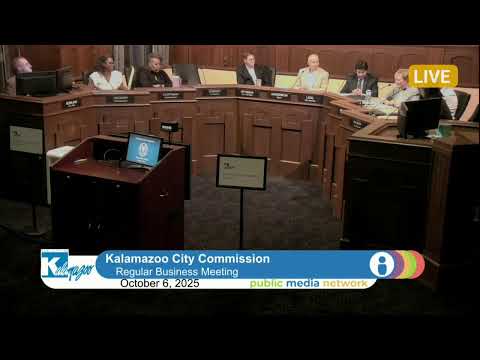
The Kalamazoo City Commission on Oct. 6 adopted a Neighborhood Enterprise Zone for Porter Street and advanced a three-site transformational Brownfield package that would pair local and state tax incentives to support housing, a boutique hotel and other downtown redevelopment.
The Kalamazoo City Commission on Oct. 6 adopted a resolution establishing a Neighborhood Enterprise Zone (NEZ) covering the block anchored by 619 Porter Street and advanced a three-site transformational Brownfield plan that the city will ask the State of Michigan to review. The NEZ vote clears a local step needed for the larger Brownfield plan, which the city plans to take up for action at its Oct. 20 meeting along with public hearings on related tax-exemption certificates.
City staff and the project team described the package as three linked redevelopment sites: the former Spearflex building on East Kalamazoo Avenue to be converted to 57 residential units; 619 Porter Street, a new-construction mixed-use workforce rental project with 58 apartments; and the Michigan Avenue Courthouse (the MAC), proposed for historic renovation into a 127-room boutique hotel. Jamie McCarthy, the city’s Development Manager, told commissioners the three projects together are seeking roughly $54 million in public incentives and financing supports, with about 20% of that coming from local property tax increment and the remainder from state-level taxes the transformational program can capture.
Logan Mulholland, the Brownfield consultant, and the developer team detailed the projected benefits: about 552 construction jobs across the three sites, an estimated 93 permanent retail and hotel jobs, and roughly 115 new residential units that staff expect will accommodate about 172 residents. Mulholland said the transformational Brownfield pathway is a highly competitive state program that allows certain state-collected tax streams to be used to support redevelopment projects that otherwise would be difficult to finance locally.
Mark Cioka of Plaza Corp., the developer, confirmed local hiring intentions when Commissioner Pamela Hoffman asked whether workforce-training graduates would be included in construction hiring. “We do plan on… each of these would want to work with that program and draw from that program,” Cioka said, adding that several local contractors the developer expects to use already have mentoring relationships with workforce programs.
The presentation also explained the mix of local and state incentives requested: the Porter Street element is pursuing a Neighborhood Enterprise Zone abatement potentially up to 15 years; the MAC hotel would seek a Commercial Redevelopment Act abatement (presented as a 12-year freeze of millage at prior taxable values); and the Spearflex portion would seek a Commercial Rehabilitation Act abatement (presented as a 10-year abatement). Estimated local abatement values presented were about $1.2 million for 619 Porter, $2.1 million for the MAC, and $462,000 for Spearflex (totaling roughly $3.0 million in local abatement estimates).
The city staff and consultants emphasized additional fiscal details: some taxes and debt millages (for example school debt and a juvenile home debt millage) remain payable by the development and are not capturable by the Brownfield authority; staff said the developments will continue to pay roughly $3.4 million in school debt over the plan period and nearly $50,000 toward juvenile home debt. Staff also noted a $700,000 community-benefits payment negotiated with the Northside Cultural Business District (NCBDA) to compensate that taxing authority for stepping aside on future increment capture.
Public commenters split on the project’s priorities. Jess Thompson, a Vine neighborhood resident and candidate for commission, offered direct support: “I am in full support of the proposed Porter Street NEZ,” Thompson said, noting the project’s potential to advance residential development. Jane Gosh, president and CEO of Discover Kalamazoo, said visitor-economy data show demand for a boutique hotel downtown and urged the commission to support the Courthouse renovation.
Other speakers urged caution on affordability. A community member who identified herself as Kaye questioned whether wages and housing being created would meet local affordability needs, citing the city’s consolidated plans and HUD data and urging broader affordable housing action beyond downtown-focused incentives. Maddie Jordan Woods, chair of the Northside Cultural Business District, said the executive committee reviewed the proposal and that the board voted to support the project in part because the developer agreed to a one-time $700,000 payment to the NCBDA to support district priorities.
Assistant City Planner Bobby Durkee explained the NEZ mechanics and the district’s geographic limits: the adopted NEZ covers a single block bounded by North Street, Porter Street, Ransom, and Pitcher, and staff emphasized that the district’s creation does not itself start abatement; tax-exemption certificates are applied for after construction and the city must approve those certificates before abatements begin. Durkee said the city currently uses roughly 1.5% of its allowable NEZ allocation under state rules, well below statutory caps.
The commission voted in favor of the Porter Street NEZ (roll call recorded as: Commissioner Prado — yes; Commissioner Wilson — yes; Vice Mayor Hess — yes; Mayor Anderson — yes; Commissioner Decker — yes; Commissioner Hoffman — yes). The broader transformational Brownfield plan will return to the commission on Oct. 20 with public hearings scheduled for consideration of the city’s tax-exemption certificates for individual projects.
If approved at the local and state levels, project supporters said the plan aims to increase downtown daytime and evening activity, generate new hotel and retail activity, and, after the Brownfield capture period ends, increase the city’s operating property-tax revenue from these parcels as they come back onto the tax rolls. Questions remaining on the record include final contract and construction schedules, exact community-benefit spending plans tied to the $700,000 payment, and final details about local hiring commitments and any targeted affordability levels for the rental units.
Commissioners did not take a vote on the full transformational Brownfield plan on Oct. 6; that action and associated public hearings are scheduled for Oct. 20.