Castellian outlines Project Ranger operations; residents press city on water, plume and emergency-response plans
Loading...
Summary
Castellian told Rio Rancho officials Project Ranger would assemble and test solid rocket motors on a site about 2–3 miles from nearby neighborhoods, said static-fire tests are horizontal and limited to daytime, and pledged safety controls. Residents and councilors raised groundwater, plume, trucking-route and first-responder concerns and demanded written MOUs and more community meetings.
Castellian Corporation presenters described Project Ranger as a scale production and final-assembly site for solid rocket motors and "all up rounds," emphasizing the company’s aerospace experience and a committed safety and regulatory approach.
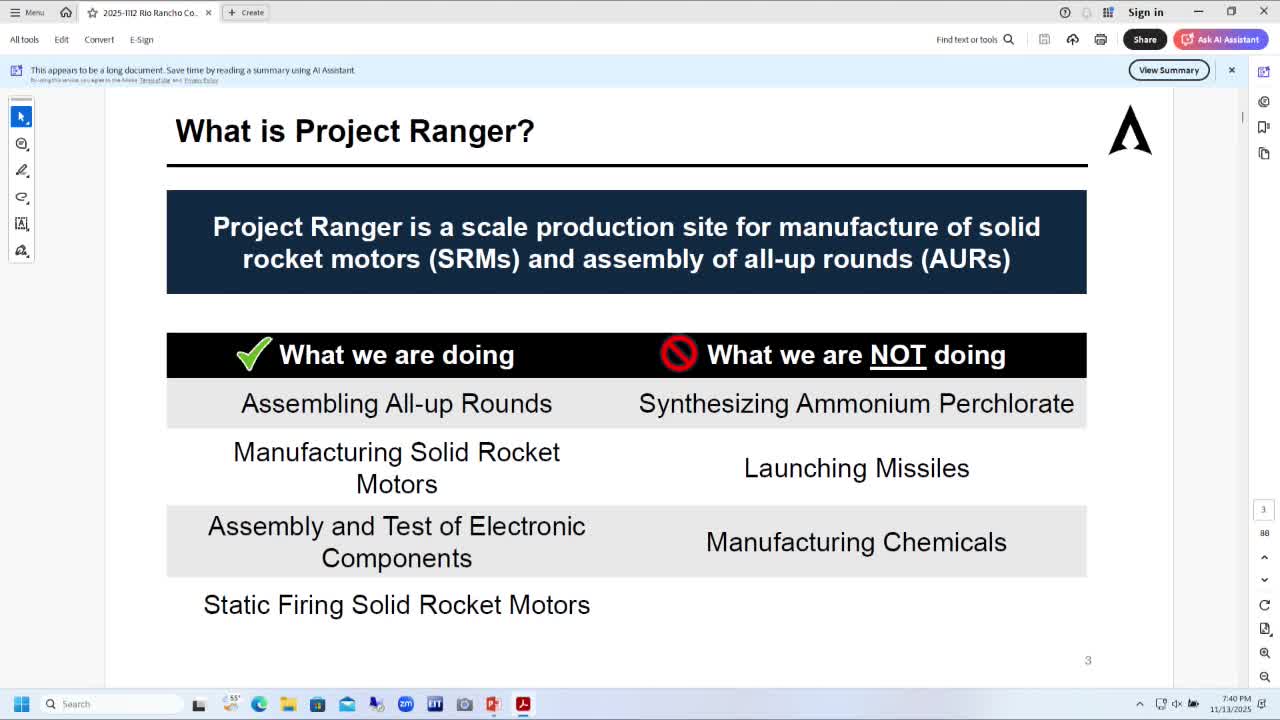
"Project Ranger is a scale production site for solid rocket motors," Andrew Crites told the Rio Rancho City Council, adding the facility will perform mixing, casting and curing of solid propellant, integrate electronics and conduct static-fire tests while explicitly saying the site will not synthesize ammonium perchlorate or launch missiles. "We will not be doing flight testing. We're not going to be launching missiles," Crites said.
The company described the propellant mix (ammonium perchlorate oxidizer, powdered aluminum and polymer binders), the casting process, separation distances among buildings, DCMA certification requirements and ongoing plume modeling with Sandia National Laboratories. Crites said the company is coordinating with the New Mexico Environment Department on emissions and hazardous-waste management and that the state land office’s lease contains additional lease conditions and required mitigations.
Castellian projected local economic benefits — more than $100 million in year-1 investment and creation of at least 300 high-quality jobs by year five, plus roughly 440 construction jobs — and described commitments to local hiring and partnerships with schools and trade programs.
Residents and councilors repeatedly raised concerns during public comment and the council’s question-and-answer period. Speakers asked how the project would affect local wells, how plume and particulate deposition would be measured, whether static-fire testing could produce toxic byproducts and whether Rio Rancho had been sufficiently included in prior county-led decision-making. One resident cited a recent news report and said: "This plant is gonna be near 3 of our wells... I hope that you don't end up making a decision that comes down to what it usually comes down to. It's all about the money." (public commenter)
Councilors and the Rio Rancho fire chief pressed for specifics on emergency response, mutual-aid agreements and authority having jurisdiction. Chief Jimmy Wenzel described a complex response footprint that would likely involve county, city and state resources and emphasized that certain high-hazard operations would require long on-scene commitment and specialized tactics that differ from standard structure-fire responses. He said those details — who enforces plan review, who conducts annual inspections and how incident action plans will operate — needed to be spelled out in writing.
The company and county staff responded that the plume study was underway, that transportation studies had been completed, that some site design details (blast deflectors, static-fire noise mitigation) were under development, and that non-energetic buildings would be sprinklered. The county and company committed to continued public outreach; council members asked for additional meetings in directly affected districts.
Castellian and county staff noted that federal DOD rules (DOD Manual 4145) and DCMA certification govern energetic-material production and that energetic operations cannot begin without required inspections and approvals. Company leaders said energetics would not be onsite until at earliest 2026 and that they would continue community engagement in the meantime.
Next procedural steps identified in the meeting: company follow-up on the plume study and NMED comments, development of the emergency-response MOUs requested by the council, additional community meetings in impacted districts and a Dec. 18 council update on outreach and MOU status.