Pompano delays zoning change to allow hospital‑affiliated off‑campus emergency rooms after residents raise access and noise concerns
Loading...
Summary
Commissioners tabled a private‑sector request to add a new 'hospital‑affiliated off‑campus emergency room' use in B‑3 after a long public hearing that included residents, ER doctors and hospital representatives debating traffic, ambulance noise and local review rights; staff and the applicant will refine buffer and access language for Dec. 9.
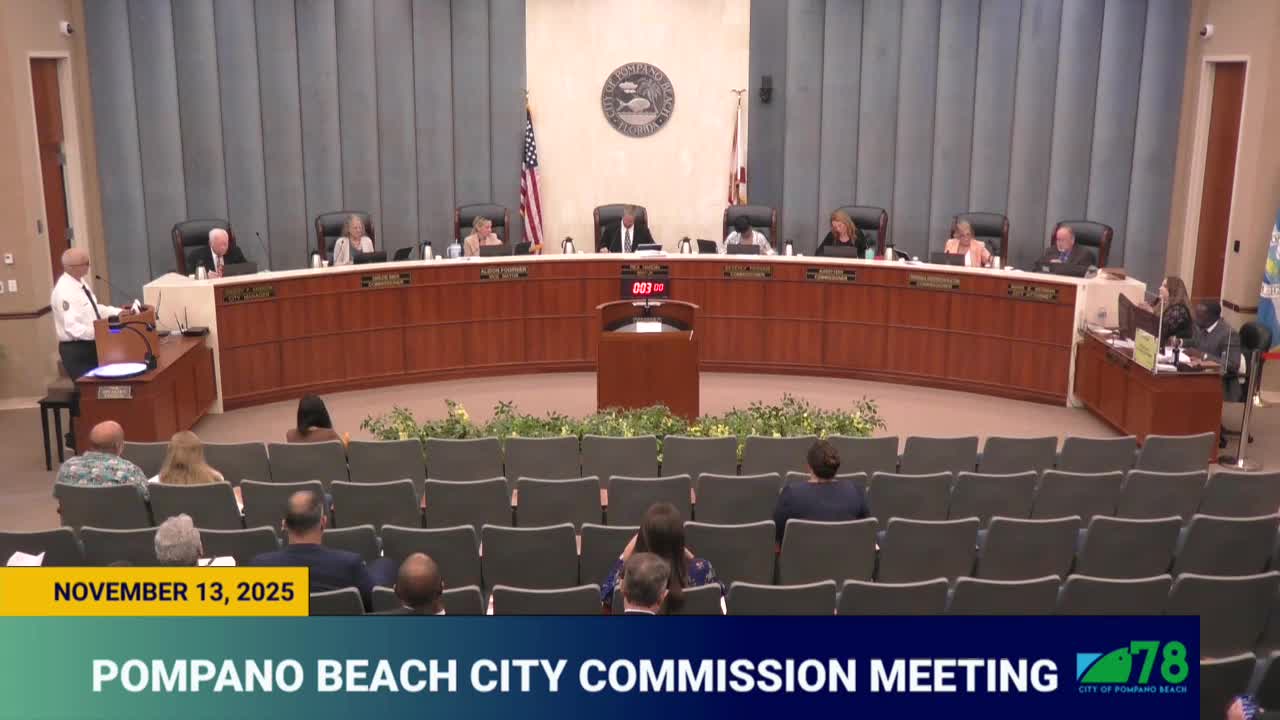
The Pompano Beach City Commission on Nov. 13 tabled a proposed zoning text amendment to allow hospital‑affiliated off‑campus emergency rooms (often called freestanding emergency rooms) in the city’s B‑3 commercial district after residents, local hospitals and emergency physicians pressed competing views on access, noise and local oversight.
The zoning change — proposed by health‑care interests — would create an explicit definition for a hospital‑affiliated off‑campus emergency room, allow 24‑hour operation, and set new standards including a recommended minimum site size (1.5 acres), access from arterial or collector streets, and a 20‑foot landscape buffer plus an 8‑foot wall where the facility would be within 500 feet of single‑ or two‑family residential zoning.
Applicant counsel Dennis Meeley said the statute that created the freestanding ER category (Florida law amended in 2021) aims to improve access and provide patients faster care. “A freestanding emergency room… gives patients an opportunity to be seen more quickly,” Meeley said, citing faster physician contact and shorter overall visit times at comparable sites.
Opponents including nearby residents and hospital leaders (Broward Health) urged caution. Broward Health executives and emergency‑medicine doctors said they are not opposed to the use in principle but argued the local special‑exception review should remain in place to allow case‑by‑case traffic, noise and ambulance routing analysis. “We feel that if there is a defined need… the special exception process should be kept in place, specifically around the distance from residential, the 500 feet,” said Matthew Garner, Broward Health North CEO.
Emergency‑medicine clinicians warned that freestanding ERs need proper staffing and that proliferation without oversight could fragment care. Dr. Evan Boyer (Broward Health emergency physician) said the community should weigh quality‑of‑care and coordination implications before broad code changes.
After the planning and zoning board recommended denial (6–1) and the CRA/EDC recommended approval, staff and the applicant agreed to tighten language on access and buffering. Commissioners voted to table the text amendment to Dec. 9 to allow staff and the applicant to refine the draft so it addresses concerns about road access, ambulance routing and residential impacts.
Next steps: the applicant and staff will revise the ordinance text to tighten access and buffer standards and present updated language and analysis at the Dec. 9 meeting.