Get Full Government Meeting Transcripts, Videos, & Alerts Forever!
Get email alerts on the Design Policy Scope topic
No spam. Unsubscribe anytime.
UDC training emphasized limits of advisory role under city charter and how 17‑05/17‑07 shape reviews
Summary
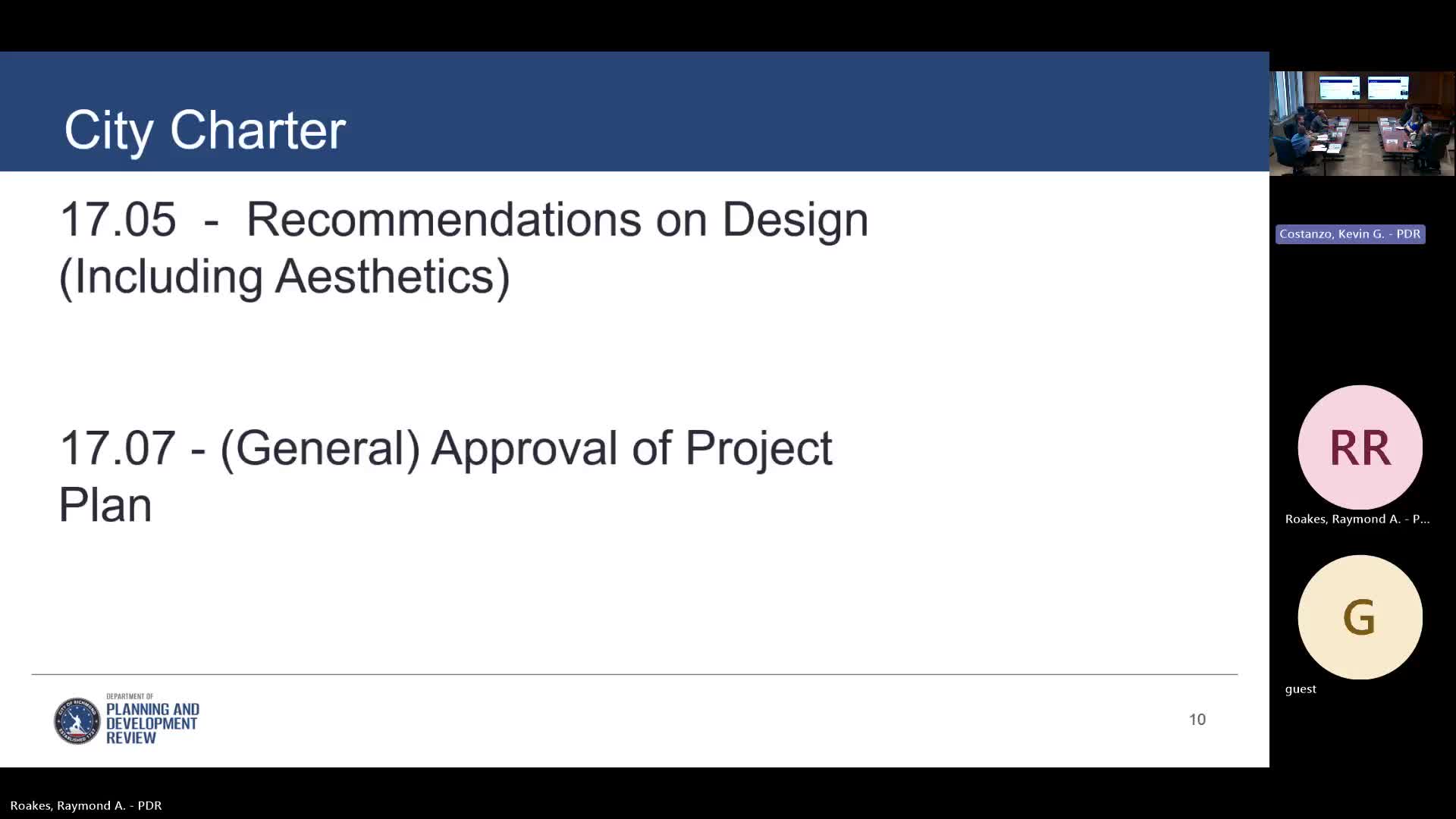
Staff walked members through how the master plan and charter sections (17‑05 recommendations vs 17‑07 approvals) constrain UDC action, describing appeals processes for design overlay decisions and urging members to focus recommendations on character while leaving specialist technical determinations to engineers and the Planning Commission.
At a training session, staff told the Urban Design Committee that the committee’s authority is bounded by the city charter and the master plan: "17 o 5" covers specific recommendations on design while "17 o 7" governs general approvals (location, character, extent). Staff explained that recommendations under 17‑05 are advisory and that approvals or disapprovals under 17‑07 deal with general features rather than technical specifics.
Staff described the administrative pathway for Design Overlay District decisions in the Museum District: staff issues an administrative determination on building permits and posts it for 30 days; "anybody" — the applicant, neighbors or citizens — may file an appeal to the UDC, which can then be appealed to the Planning Commission and Council, and ultimately to the state courts. Using case examples such as the downtown library and the Roundhouse ramp discussion, members explored the boundary between matters of design character (appropriate for UDC comment) and technical details (engineers/architects or Planning Commission responsibilities).
Several members raised transport‑related concerns, citing a recent smart‑scale/road project on Maury/Mari Street where the UDC lacked access to traffic counts and engineers’ analyses. Speaker 8 said the UDC sometimes "got way into the weeds" on lane width and intersection technicalities; staff advised that while the UDC can recommend pedestrian safety goals (for example, prioritizing crossings and safer intersections), detailed capacity and lane calculations are specialized and should normally be handled by traffic engineers and reported back through staff or the Planning Commission.
Staff also explained the Design Overlay District process and that some items are routinely delegated to staff (for example, small encroachments and banner display approvals), and that the committee’s guidelines were recently updated (2020) with another rewrite planned as part of the zoning code overhaul. The session concluded with staff asking members to identify high‑priority guideline edits and offering to circulate related materials.