Get Full Government Meeting Transcripts, Videos, & Alerts Forever!
Get email alerts on the Homelessness Warming Centers topic
No spam. Unsubscribe anytime.
Vigo County hears plan to fund winter warming centers; presenter proposes $1,200 daily activation rate
Summary
A warming‑center task‑force representative urged the Vigo County Council to adopt a predictable funding model this winter, proposing a $1,200 daily activation payment to Reach Services and four options for fiscal agents. The plan ties activation to weather triggers and to existing community partners.
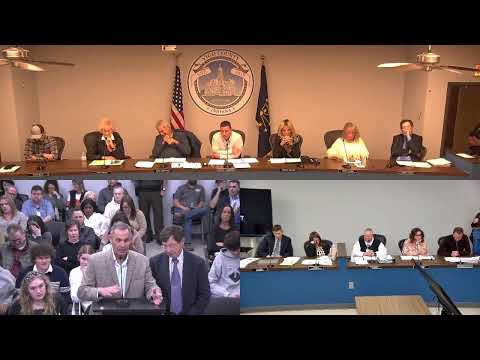
An unnamed warming‑center task‑force representative, speaking to the Vigo County Council on Nov. 10, presented a proposed county‑city funding model to ensure warming centers can reliably open during dangerously cold weather.
“A warming center is not your traditional homeless shelter,” the presenter said, explaining the centers are short‑term emergency operations where people can “come in from the cold, get warm, rest, have a meal, and stay safe until the severe weather passes.” He said Pathways Day Center (operated by Reach Services) has been the primary local warming center but that last‑minute, informal funding has created operational uncertainty.
The presenter cited the Homeless Coalition’s winter point‑in‑time (PIT) count of 194 people and a broader September count of 787 when including those doubled‑up, in hospitals or otherwise temporarily housed. Using existing partner capacity (Pathways ~70, Hamilton Center and Mental Health of America 25–50 combined, Bridge Church ~20), he said the county could have about 165 beds available when multiple sites are activated.
To pay for operations only when a warming center is active, the task force proposed a $1,200 daily activation rate to Reach Services to cover staffing, overtime and utilities; the presenter described the $1,200 as roughly 85% staffing, 10% utilities/maintenance and 5% cleaning and safety. He also laid out four fiscal‑agent options for city/county funds: the City of Terre Haute, Vigo County, a Wabash Valley Community Foundation account, or a community foundation account that rolls unused funds forward to the next year.
The plan would tie activation to specific weather thresholds rather than an absolute 0°F cutoff. The presenter described the proposed trigger as an apparent temperature or wind chill of 5°F or lower, or National Weather Service wind‑chill advisories for Vigo County, or wet conditions under 32°F with winds over 10 mph, or snow accumulation over 1 inch and temperature below 32°F, as well as emergency conditions such as power outages.
He said the model projects 21–49 activation days depending on winter severity and recommended that the county match the city’s initial contribution (the city planned to issue an initial $12,000). The presenter noted the Wabash Valley United Way and the Community Foundation indicated they could fill shortfalls beyond city and county contributions.
The presenter asked the council to adopt one of the fiscal‑agent options and a funding level (examples ranged from funds estimated to cover dozens of activation days up to $60,000 for roughly 50 days) and to approve an MOU among the city, county and Reach Services that would define activation, funding and communication roles.
Next steps: the presenter asked council members to discuss internally and indicate an amount the council would feel comfortable with; he said a December proposal could be acted on at that meeting if the council unanimously agreed to take action that night.
Why it matters: the proposal seeks to stabilize emergency winter operations for vulnerable residents — including people who are unhoused and residents whose heating fails — and to limit reliance on short‑term donations and last‑minute ad hoc support.