Get AI Briefings, Transcripts & Alerts on Local & National Government Meetings — Forever.
Johnsburg neighbors press McHenry County to deny Water Locust solar CUP, cite water, wildlife and battery-storage risks
Loading...
Summary
Neighbors and local experts urged the McHenry County Board Nov. 13 to deny a conditional-use permit for the proposed Water Locust/Cultivate Power solar installation, citing groundwater leachability, runoff and wildlife impacts and warning that battery storage could be added later despite an initial ZBA condition prohibiting it.
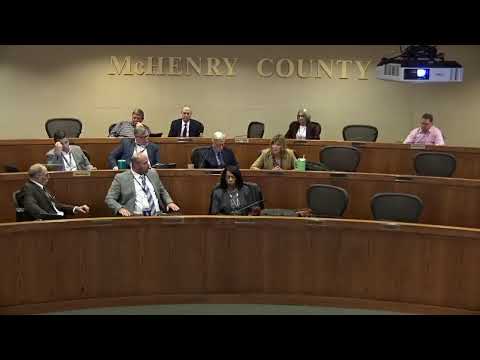
Residents from Country Oaks and other nearby neighborhoods addressed the board during the Nov. 13 public comment period to oppose the Water Locust Solar LLC / Cultivate Power proposal. Speakers described the site as a roughly 50–54 acre industrial solar installation sited near residential property lines and sensitive watershed features; objections focused on groundwater leachability, long-term herbicide use beneath solar panels, potential heavy-metal and plastic degradation runoff after panel end-of-life, visual and noise impacts, fire risk if batteries were added later, and potential property-value declines.
Key points raised by speakers:
- Renee Weigert urged the board to "vote no until long-term safety studies can be proved," raising electromagnetic-field (EMF) health concerns and arguing the community should not be used "as the experiment." (Renee Weigert)
- Jim Rollins, citing a McHenry County conservation review, said the site has high leachability and that steel pylons driven into permeable soils could create a pathway for contaminants to reach local wells and the Fox River watershed.
- John Wiermanski (Country Oaks resident) highlighted that the Zoning Board of Appeals added condition #10 prohibiting battery storage but warned that a future owner could return to amend the CUP; he asked the board whether converting a farm to a long-term utility facility satisfies the county's compatibility and future land-use findings.
- Joan Brum (pediatric nurse) and others urged fuller hydrogeologic and ecological assessments, suggested Army Corps consultation on impacts to waterways, and requested an enforceable decommissioning plan.
County staff and board follow-up: Several board members asked the State's Attorney's Office to provide a legal opinion on how pending state legislation (referred to in the meeting as "senate bill 25") affects local regulatory authority and the board's liability. Board members also discussed whether the items on the Nov. 18 agenda should be pulled for separate consideration; one member signaled intent to move to table to a January date certain if permitted.
Why it matters: The comments reflect concentrated neighborhood opposition and raise technical and regulatory questions (hydrogeology, wastewater/groundwater protection, long-term decommissioning, and battery-storage safety) that the board must consider in light of county UDO standards (e.g., UDO 16.20 references) and the zoning record. Several speakers urged denial based on incompatibility with future land-use designations, potential public-health and environmental risks, and uncertainty about enforcement if panels or batteries were decommissioned or abandoned.
Next steps: The board indicated it would request a legal opinion from the State's Attorney and may pull the related agenda items on Nov. 18 for separate discussion.