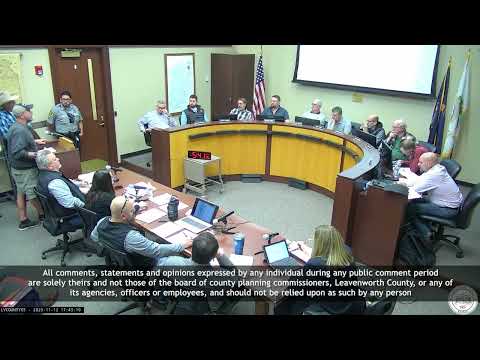
Planning commission recommends denial of Kaw Valley sand-excavation permit after hours-long hearing
Loading...
Summary
The Leavenworth County Planning Commission recommended denial, by a unanimous 9-0 roll-call vote, of a special use permit sought by Kaw Valley Companies to operate a sand excavation and stockpiling facility near 16201 Lenape Road.
The Leavenworth County Planning Commission recommended denial, by a unanimous 9-0 roll-call vote, of a special use permit sought by Kaw Valley Companies to operate a sand excavation and stockpiling facility near 16201 Lenape Road.
The vote followed more than two hours of staff presentations and consultant testimony, extended questioning by commissioners, and a public comment period in which residents and local emergency responders urged the commission to reject or delay the application. Planning staff had recommended approval subject to a long list of conditions and a time-limited permit (staff recommended a three‑year permit that would begin only after required conditions and public improvements are satisfied). The commission’s recommendation is advisory; the Board of County Commissioners will consider the SUP no earlier than Dec. 3, 2025, at 9 a.m. in the Leavenworth County Courthouse.
Why it matters: Kaw Valley asked permission to excavate sand from a roughly 430‑acre tract and to stockpile material on site, with a production model that the applicant and its consultants described as a wet‑dredge operation. The company told the commission it would use predominantly electric equipment on site, employ about five permanent on‑site staff, and rely on company trucks plus customers’ haulers to move material to a processing facility in Edwardsville. Commissioners, staff and many residents focused on the broader community impacts of truck traffic on narrow, curving county roads, and on potential noise, dust and enforcement challenges.
What the commission heard: Planning staff outlined proposed conditions including no truck traffic south on a county bridge into DeSoto, an 80‑foot buffer on the southern property line with tree screening, limits on hours for hauling, noise and lighting thresholds, and a requirement to provide copies of state permits (for example, Kansas Department of Health and Environment and Army Corps approvals) before local permits would issue. The staff report described the operation as a Type 4 industrial use that could create nuisance factors and recommended a time‑limited SUP to allow follow‑up oversight.
Kaw Valley’s counsel Aaron March and company consultants presented the operation and asked the commission to modify three recommended conditions. March emphasized the wet‑dredge method and reclamation plan and asked for a longer permit term to recover infrastructure investments; he said the company agreed with most conditions except three. In rebuttal the applicant stated, “Wet sand is wet. It does not promote dust,” and reiterated that the operation would be regulated by state and federal authorities and that reclamation bonds and KDHE permits would be provided as required.
Public safety and health concerns: Leavenworth County Fire District No. 2 (represented by Kirk Sowers and Assistant Chief Dylan Reeder) testified that crash‑prone intersections on the proposed haul routes already generate high‑speed accidents and that a large increase in truck traffic could increase emergency call volume; Reeder warned that increased heavy‑vehicle traffic would strain a largely volunteer fire district. Residents raised health concerns about airborne silica and long‑term dust exposure, potential declines in property values, and practical enforcement questions about keeping trucks on the designated haul routes. One speaker said, “Silica dust… cannot be completely controlled,” reflecting public anxiety about airborne particulate exposure and long‑term health risks.
Traffic and enforcement: Kaw Valley’s traffic consultant presented a conservative model that included up to 120 round trips as a high‑end scenario and said the real‑world average was expected to be closer to 50 round trips. Commissioners and many residents questioned whether county resources exist to monitor haul‑route compliance, enforce restrictions, and maintain or repair rural roads under heavy truck loading. Staff and county counsel explained the county’s haul‑route and road improvement agreement policy, which requires a third‑party road study paid for by the applicant and a development agreement that can specify improvements and who pays for them. Commissioners repeatedly emphasized that any public improvements or development agreement terms would need to be completed before operations could begin.
Permit term and conditions: A central point of dispute was permit duration. Staff recommended a three‑year SUP (the clock to start only after conditions and public improvements are met); Kaw Valley asked for a much longer term (the applicant requested 25 years in this hearing). Commissioners discussed intermediate terms (several suggested 5–10 years) and emphasized that any multi‑year authorization should be tied to enforceable development‑agreement commitments for infrastructure and enforcement.
Bottom line and next steps: The planning commission concluded that the SUP did not meet several of the county’s approval factors — specifically neighborhood character, zoning and nearby uses, detrimental impacts along haul routes, and relative economic gain for the county — and recommended denial to the Board of County Commissioners by a 9‑0 vote. The BOCC will receive the recommendation and the official record; the commission’s action is advisory and does not itself grant or bar a county SUP. The BOCC review is set no earlier than Dec. 3, 2025, at 9 a.m.
Speakers quoted in this report are drawn from the public record of the hearing. The planning commission’s recommendation does not represent a final county decision and may be subject to appeal or further proceedings at the Board of County Commissioners.