
Osteopathic Medical Board approves rulemaking to raise fees, adds $20,000 adjudication deposit for petition hearings
Get AI-powered insights, summaries, and transcripts
Subscribe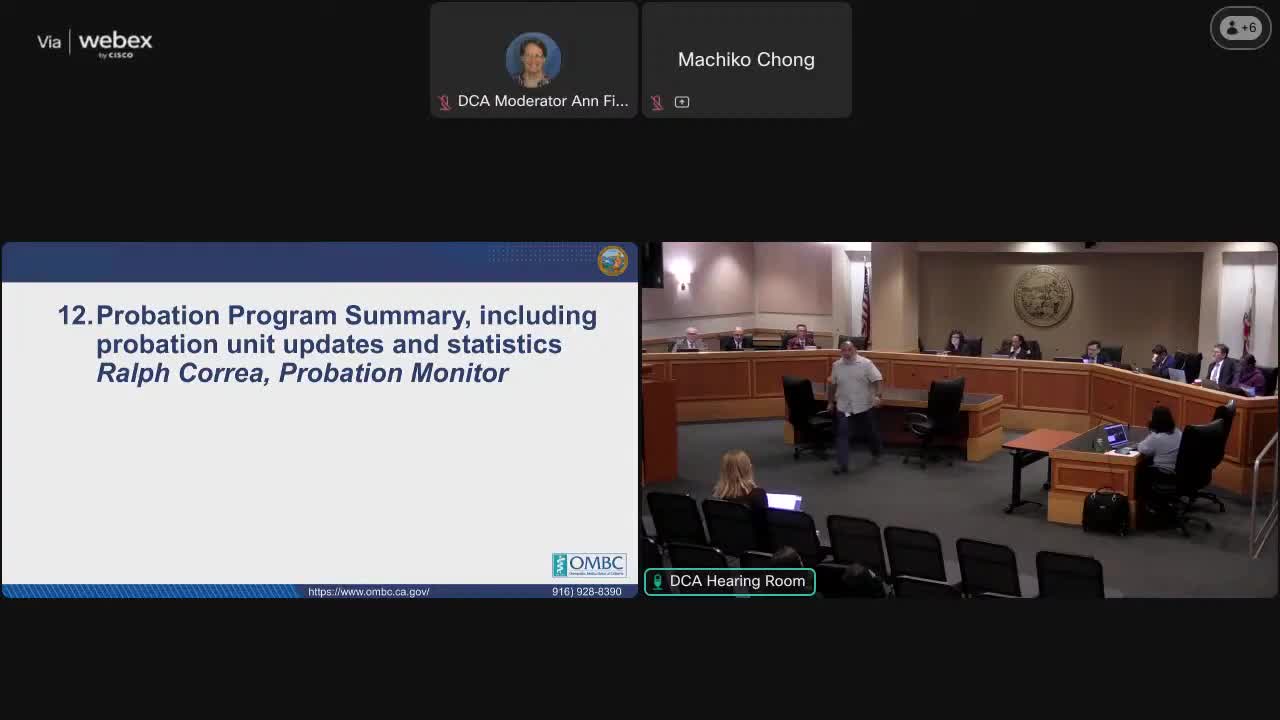
Summary
The Osteopathic Medical Board of California on Nov. 14 voted to begin rulemaking that would raise and reorganize certain license and petition fees and require petitioners seeking reinstatement or penalty modification to pay an upfront adjudication deposit intended to cover hearing costs.
The Osteopathic Medical Board of California on Nov. 14 authorized staff to begin rulemaking to update license renewal forms, create a retired‑license status and fee structure, and require petitioners seeking reinstatement or penalty modification to pay application fees and an adjudication deposit to cover hearing costs.
The board approved a trimmed regulatory package after a staff presentation outlining workload and fiscal justification. Terri Thorfinson, the board’s legislative and regulatory specialist, and Christie (regulatory counsel) described two nonrefundable petition application fees already proposed—$2,800 for reinstatement and $1,500 for modification of penalty—and a separate adjudication deposit the board would require to set a petition hearing. “On average, it’s $20,000 for you to do a petition hearing,” Christie said, explaining that the deposit would cover costs charged by the Attorney General’s Office, the Office of Administrative Hearings and court reporters and that petitioners would receive an itemized invoice and refund if actual costs are lower.
Board members asked for clarifications about timing, refund mechanisms and hardship considerations. Terri Thorfinson said the draft would require the adjudication payment to clear the board’s account before OAH schedules the matter; if actual adjudication costs are less than the deposit, the petitioner will receive a refund. Christie said the package includes a refund mechanism and workload attachments showing how the $20,000 average was calculated.
The decision to move forward followed staff warnings about the board’s finances. Kayla Van Lint, a DCA budget analyst, told the board that the OMBC entered the year with a beginning balance near $4.7 million and projected to spend about $4.54 million this fiscal year, leaving a small reversion; longer‑term projections showed revenue pressures and possible structural imbalance that could reduce months in reserve to near one by 2027. Staff said raising available statutory fees and recovering petition costs are part of a stepwise approach to stabilize funding before seeking any further legislative changes.
Public commenters pressed the board for stronger enforcement transparency and questioned whether fee increases would address enforcement backlogs. Michelle Montserrat Ramos of Consumer Watchdog thanked staff for recent changes but asked why relatively few complaints reach the Attorney General’s Office, and urged that the enforcement committee meet in public. Maria Ibarra Navarette and Tracy Dominguez described families’ experiences with delayed investigations and asked the board to reconsider language the public found offensive. “The process doesn’t appear to focus on their deaths as much as it focuses on whether or not a provider can be held accountable,” Maria Ibarra Navarette said, urging more transparent processes.
Enforcement staff responded with current performance measures: Christie Livramento reported 320 complaints received year‑to‑date, a 33% increase over last year, an average of 5 days to acknowledge complaints (target 10), 221 days average for desk investigations (target 360) and 804 days for cases transmitted to the Attorney General (target 540). Probation monitor Ralph Correa said the board has 648 pending enforcement cases overall, with each analyst averaging about 164 cases and a staff goal to reduce that to roughly 80 cases per analyst.
After discussion, Matthew Swain moved to approve the proposed regulatory text and send it to the Department of Consumer Affairs and Business, Consumer Services and Housing Agency for review; John Cummins seconded. The board conducted a roll‑call vote and the motion carried (6–0). The motion authorizes the executive director to take steps to initiate the rulemaking, make nonsubstantive edits as needed, and set the matter for hearing if requested.
What happens next: staff will submit the proposed package for agency review and, if accepted, post it for a 45‑day public comment period and a possible public hearing. The package includes revisions to renewal/retired‑status language, creation of OMB forms for retired status (OMB‑31/32) and a petition form (OMB‑7) that lists the application and adjudication fees and explains the refund mechanism.
The board also discussed next‑year procedural items including continued work on disciplinary guidelines, planned enforcement committee meetings to review those guidelines, and a January 2026 Hill Day to brief legislators on osteopathic licensure and potential future statutory changes.
The board adjourned for the year and will reconvene in January.