Get Full Government Meeting Transcripts, Videos, & Alerts Forever!
Get email alerts on the Rv Ordinance topic
No spam. Unsubscribe anytime.
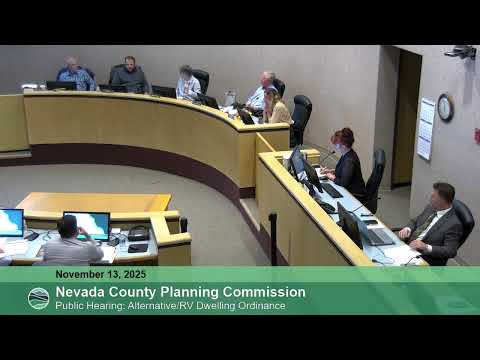
Nevada County planning panel backs ordinance to allow RVs as dwellings amid safety and cost concerns
Summary
The Nevada County Planning Commission voted on Nov. 14 to recommend that the Board of Supervisors adopt a draft ordinance allowing a single recreational vehicle to be used as a permanent dwelling on qualifying rural parcels, after hours of testimony and a split vote on the commission’s final recommendation.
The Nevada County Planning Commission voted on Nov. 14 to recommend that the Board of Supervisors adopt an ordinance allowing a single recreational vehicle to be used as a permanent dwelling on qualifying rural parcels, after a daylong staff presentation, commissioner questioning and a lengthy public‑comment period.
Brian Foss, director of planning, told the commission the draft ordinance is intended to create a permitting path and health‑and‑safety standards for RVs used as homes, not to promote short‑term rentals. "This ordinance creates a path to compliance," Foss said, summarizing the proposal’s core elements: a site permit, an initial two‑year approval with two‑year renewals, a minimum parcel size of three acres in specified rural zoning districts, and requirements for water, sewer, electrical hookups, screening, tie‑downs and a fire protection plan.
The ordinance would allow one permitted RV per parcel, require hookups verified by building and environmental health staff, and impose inspection and renewal checks. Environmental Health staff said a draft policy recommends that an RV not necessarily count as an extra septic bedroom if the existing system is functional and a 100% repair area is available; Claire Chappell said a qualified septic professional would evaluate capacity and note that some RV chemicals can affect septic systems.
Public commenters were sharply divided. Housing advocates and nonprofit leaders urged legalization as a tool to increase affordable housing and bring existing occupants into safe, regulated status. "We are trying to house local residents," Tom Durkin of the No Place To Go project said, arguing that legalization and amnesty could help low‑income workers and families and could qualify the county for state pro‑housing designations and funds.
Opponents and nearby residents raised repeated concerns about wildfire risk, infrastructure, insurance and enforcement capacity. "We currently have 351 open code violation cases," Matt Kelly, director of code compliance, told the commission, noting the department has four field officers and that enforcement remains complaint driven. Several residents said the estimated cost of making a site compliant — electrical connections, hard‑piped septic ties, gravel pads, water storage and defensible‑space work — could run into thousands or tens of thousands of dollars, creating a risk that many RVs would remain unpermitted.
Commissioners pressed staff on technical details and tradeoffs: why a two‑year renewal was chosen, why three acres is a minimum, how hookups would be met when parcels lack public utilities, and whether homeowners who host an RV would be able to obtain insurance or face new liabilities. Tyler Barrington, housing director, said many site‑specific hookup questions will be resolved at the building‑permit stage and that the draft borrows habitability standards used elsewhere, including from the City of Oakland for vehicle residences.
After public comment and follow‑up discussion, the commission first voted unanimously to find the draft ordinance categorically exempt from CEQA under sections 15303 and 15305. The commission then voted on a recommendation that the Board adopt the ordinance; an amended recommendation — asking the county to provide more detailed information to the Board about insurance impacts, enforcement capacity and costs before final action — passed 3–2 (Commissioners Foley, Garst and Chair Millman in favor; Commissioners French and McAteer opposed).
The commission’s recommendation now goes to the Board of Supervisors for consideration and final action. Staff said the Board will hold a later hearing, likely in early 2026; the planning department stressed that many site‑level technical issues (metering, hard‑piping, septic verification, and detailed fee schedules) will be addressed through permit review and interdepartmental checks.
What’s next: the Board of Supervisors will review the commission’s recommendation and the draft ordinance; staff told commissioners they will continue outreach to fire, environmental health, building and code enforcement divisions and update the record with additional analyses on costs, insurance and enforcement capacity if requested by the Board.