Get Full Government Meeting Transcripts, Videos, & Alerts Forever!
Get email alerts on the Water Supply And Development Moratorium topic
No spam. Unsubscribe anytime.
Conroe holds public hearing on citywide development moratorium; approves emergency repair to Well 21
Summary
At a May 22 Conroe City Council meeting, staff presented a proposed 120‑day moratorium on new subdivision and site‑development approvals tied to water‑system capacity; the council held a public hearing but did not adopt the ordinance that day. Council did approve an emergency repair for water well No. 21, authorizing up to $600,000 to Weisinger Inc
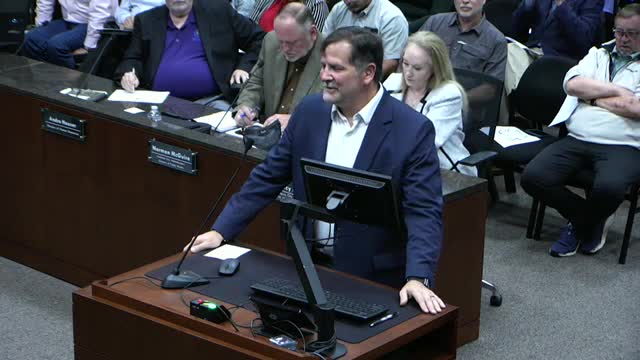
The Conroe City Council on May 22 held a public hearing on a proposed temporary moratorium that would pause acceptance and approval of subdivision, site‑planning and construction permits for property served by city water plants, and separately approved an emergency expenditure of up to $600,000 to repair water well No. 21.
City public works staff told the council the moratorium is a time‑limited measure intended to protect current customers while the city evaluates infrastructure and funding needs. City staff member Michael McGuire (public works/engineering staff) said the packet includes a stamped report from a third‑party registered professional engineering firm and supporting exhibits from the Texas Commission on Environmental Quality (TCEQ) and the Texas Water Development Board (TWDB) that, in staff’s view, justify invoking the city’s police power. McGuire described a 0.6 gallons‑per‑minute requirement per connection and said the packet includes multiple water models and connection counts from the city’s utility billing and GIS records.
"All the information is indeed included and laced up," McGuire said while summarizing the exhibits and the technical memorandum addressed to council.
Why it matters: the ordinance the city read into the record would, if enacted, impose an initial 120‑day moratorium on new development permits for areas served by city water plants, with limited exceptions and a waiver process adopted verbatim from Texas Local Government Code (chapter 212, subchapter E). The proposed ordinance lists public health and safety, conservation of water (Article 16, Section 59 of the Texas Constitution), and preventing a public nuisance as the city’s stated reasons. The ordinance as drafted makes exceptions for projects that are "no impact," projects with valid permits filed prior to 05/23/2025, and development agreements or grandfathered projects under state law. The ordinance text included an explicit adoption of waiver procedures in Local Government Code section 212.137 and referenced 212.139 for limits on moratoriums.
Public comments at the hearing were extensive and sharply divided. Dozens of builders, developers, business representatives and residents addressed the council. Several speakers urged caution or alternatives to a citywide halt: Mike Stecker (resident/home‑builder) urged the council "Don't rush this" and recommended bringing in a neutral outside engineering firm and pursuing an Alternative Capacity Requirement (ACR) process with TCEQ. Daniel Gillum (Traphome Homes) and other developers presented site‑specific pressure and fire‑flow numbers and argued the system should be evaluated by pressure plane rather than treated as a single, citywide system.
Industry groups and builders, including Lauren Fuller (Greater Houston Builders Association), Cody Miller (Greater Houston Builders Association) and Zach Wickens (Kendall Homes/Forest Creek Ventures LLC), warned of economic and legal consequences. Wickens said his project of roughly 85 lots at FM 830 and I‑45 would create about $12.0 million in new property value and is stalled by the moratorium. Several speakers noted that a recent ACR application could address compliance with TCEQ and that a moratorium alone does not guarantee protection from state action or fines.
Other commenters asked for specific exceptions: Trent Perez (civil engineer, Dunaway), speaking for Kelsey‑Seybold, asked the council to consider an explicit exception or variance for critical medical facilities, saying the clinic could serve thousands of patients and estimated connection demand roughly equivalent to two single‑family equivalents. Nicholas Roth (Rooms To Go/retail developer) said his group closed on a 5.8‑acre tract and asked that exceptions or waivers be available to allow projects already in late permitting stages to proceed.
Resident and community speakers raised operational and data questions. Betty Born Avery asked why the city appears to have received only about 27% of its San Jacinto River Authority (SJRA) surface‑water allocation and mentioned groundwater numbers she found; she asked for clarification about the relationship between SJRA deliveries, groundwater supplies and the city’s counting of connections. Several speakers cited state guidance and recent legislative attention (House Bill 2559 was cited in comments) urging the city to "prove up" capacity before taking a moratorium.
Council action on well repair: before the moratorium hearing, the council declared an emergency supplemental agenda item under Texas Local Government Code section 551.045 and, following a short executive discussion, voted to "declare an urgent public necessity for the critical and immediate repair of water well No. 21" and approved an expenditure to Weisinger Inc. "in an amount not to exceed $600,000." The vote was by voice; the motion carried. The mayor opened the motion, asked for a first and a second, and the council approved by voice vote.
What the council did not do: the council read the proposed ordinance and held the public hearing but did not vote to adopt the moratorium ordinance at the May 22 meeting. Staff indicated the moratorium had been discussed previously at a workshop and that additional hearings and a vote could be scheduled within an available Tuesday‑to‑Tuesday window; council members discussed scheduling follow‑up but did not set a final adoption date during the meeting.
Next steps and context: staff said the moratorium — if adopted — could be extended beyond 120 days by majority vote to allow code and policy updates and for the city to seek funds for infrastructure improvements. The ordinance text contemplates a process for exceptions and waivers, administrative determinations by the director of public works and appeal to council, and specifically contemplates grandfathering and development agreement exceptions. Multiple speakers urged the council to pursue an ACR with TCEQ and additional third‑party review of the modeling and assumptions before a citywide moratorium is enacted.
Speakers
- Mayor (unnamed in transcript), Mayor — government - Mayor Pro Tem Hardman — government - Councilman Wood — government - Councilwoman Arthur — government - Councilman David Harrell — government - Councilwoman Porter — government - Michael McGuire — City staff, public works/engineering — government - Jim Fredericks — Realtor / resident — citizen (first public comment on moratorium) - Betty Born Avery — Resident / commenter — citizen - Mike Stecker — Builder / resident — business - Zach Wickens — Builder, Kendall Homes / Forest Creek Ventures LLC — business - Aaron Alford — Developer / consultant — business - Lauren Fuller — Representative, Greater Houston Builders Association — business - Nicholas Roth — Rooms To Go, vice president real estate — business - Trent Perez — Dunaway (civil engineer) — business - Daniel Gillum — Traphome Homes / developer — business - Zach Graves — Keepsake Custom Homes / Droplet Resources — business - Cody Miller — Greater Houston Builders Association — business
Authorities
- Texas Local Government Code, chapter 212 (subchapter E) — cited in the ordinance text and waiver procedures (referenced by staff and in the drafted ordinance) - Texas Constitution, Article 16, Section 59 — referenced in the ordinance preamble about water conservation - Texas Commission on Environmental Quality (TCEQ) guidance — referenced by staff and commenters regarding capacity rules and the ACR process - Texas Water Development Board (TWDB) reports and water system data — cited by staff as part of packet exhibits - House Bill 2559 (referred to by public commenters) — mentioned by multiple speakers in the public hearing as recent state legislative context
Actions
- Emergency repair of water well No. 21: motion to declare an urgent public necessity and to expend up to $600,000 to Weisinger Inc. (mover/second not recorded in transcript). Outcome: approved by voice vote. Notes: authorized as emergency supplemental agenda item under Tex. Loc. Gov. Code §551.045. - Moratorium ordinance: reading and public hearing conducted; no final vote to adopt at this meeting. Outcome: discussion only / public hearing closed.
Clarifying details
- Emergency repair: repair to "water well Number 21"; vendor Weisinger Inc.; authorization "not to exceed $600,000"; item was added to the agenda as an emergency supplemental under Tex. Loc. Gov. Code §551.045 and discussed in executive session before the vote. - Draft moratorium: initial duration in ordinance text is 120 days from enactment; explicit waiver/exception process adopts Local Government Code §212.137 procedures; exceptions listed include "no impact projects," projects with permits filed prior to 05/23/2025, grandfathered projects under state law, and development agreements; staff cites a 0.6 GPM per connection requirement in exhibits. - Data disputes: several builders and engineers said the modeling relied on an August 2023 snapshot; others said the city recently filed an ACR application (commenters said "last Friday"). Speakers recommended independent third‑party verification of the city's modeling assumptions and pressure‑plane analysis rather than an across‑the‑board moratorium.
Community relevance
- Geographies affected: City of Conroe; specific developments cited along FM 830, I‑45, Woodland Hills, Pines at 7 Coves; projects adjacent to Willis High School were discussed. - Impact groups: home builders and developers, prospective home buyers, businesses and retailers with pending permits (e.g., Rooms To Go), medical facilities (Kelsey‑Seybold, Houston Methodist expansion referenced), current residential customers of Conroe water system.
Meeting context
- Engagement level: high public turnout on the moratorium item, multiple speakers from builders, developers and residents; item was discussed at a prior workshop. - Implementation risk: medium‑high if the moratorium is adopted without additional technical review (commenters warned of lawsuits, potential economic impacts and TCEQ process requirements). - History: staff said the topic was discussed in a recent workshop and referenced prior internal analysis and modeling; commenters noted prior awareness of capacity concerns and a recently filed ACR application.
Searchable_tags:["water","development moratorium","well repair","Conroe","TCEQ","ACR","builders","MUD"]
provenance:{"transcript_segments":[{"block_id":"block_9","local_start":0,"local_end":176,"evidence_excerpt":"So as public servants, you know, you you have very difficult jobs. I'm speaking on the moratorium on development. I I would oppose that.","reason_code":"topicintro"},{"block_id":"block_283","local_start":0,"local_end":71,"evidence_excerpt":"Alright miss Betty, thank you. Alright, it is now 11:05, we're going to, close our, public hearing and we're gonna move right back into our agenda","reason_code":"topicfinish"}]},"sections":{"lede":"The Conroe City Council on May 22 held a public hearing on a proposed temporary moratorium that would pause acceptance and approval of subdivision, site‑planning and construction permits for property served by city water plants, and separately approved an emergency expenditure of up to $600,000 to repair water well No. 21.","nut_graf":"City staff presented a technical packet and a third‑party engineering memorandum the council said supports temporary limits on new water connections while the city evaluates infrastructure capacity, but builders, developers and some residents urged alternatives such as a TCEQ Alternative Capacity Requirement (ACR) or targeted pressure‑plane reviews and warned of legal and economic consequences if a citywide moratorium is enacted without further verification.","ending":"The council closed the public hearing and did not adopt the moratorium ordinance at the May 22 meeting; staff told council the matter could return for vote within a week‑long scheduling window and emphasized the draft ordinance contains waiver and exception procedures for projects already in the pipeline."}},{