Committee forwards Richmond juvenile crime-control services plan after gun-violence prevention briefing
Loading...
Summary
After a presentation by Greg Hopkins on Richmond—s Office of Gun Violence Prevention and a city crime analysis, the Education and Human Services Standing Committee voted 3-0 to forward Resolution 2025-R-041 endorsing the city—s planned services under the Virginia Juvenile Community Crime Control Act to full council.
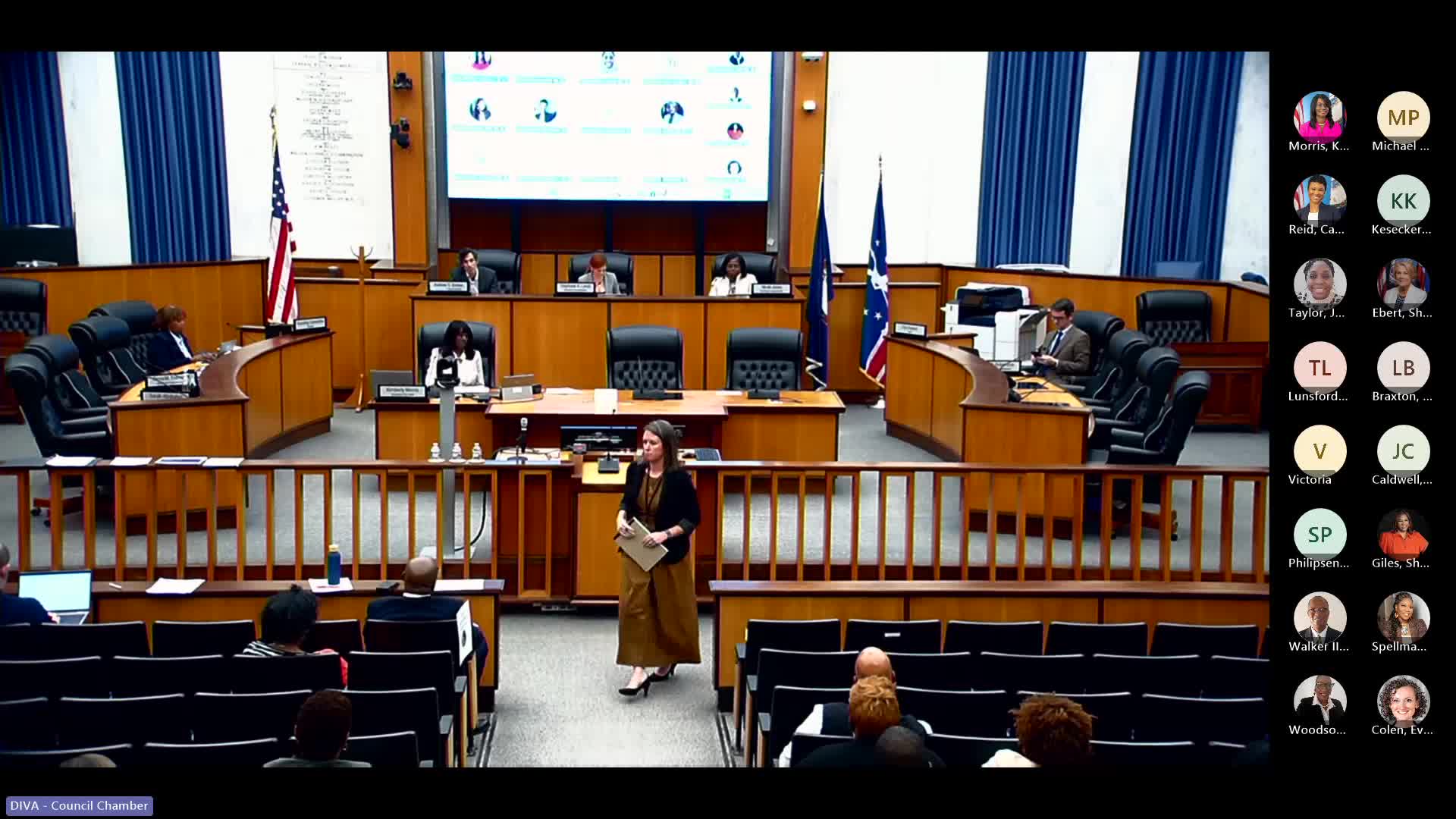
The City of Richmond—s Education and Human Services Standing Committee voted unanimously to forward Resolution 2025-R-041, the city—s planned services under the Virginia Juvenile Community Crime Control Act, to the full council after a briefing from Greg Hopkins, interim director of the Department of Justice Services and director of the Office of Gun Violence Prevention.
Hopkins told the committee the office is "a citywide leadership initiative to unify and coordinate the city—s violence reduction strategies," including prevention, healing and opportunity creation across city agencies and community partners. He said the office will use monthly crime analysis and a steering committee made up of representatives from Richmond Public Schools, Richmond Police Department, VCU, MCV, RBHA, RRHA, DSS, the Richmond Sheriff—s Department, the Commonwealth Attorney—s Office and community organizations to guide programming and track outcomes.
Why it matters: the plan commits the city to a set of locally administered programs and allows the city to make adjustments of up to 50% of the state-approved plan without returning to the Department of Juvenile Justice board, Hopkins said. The committee—s endorsement is a required local step before the plan is implemented.
Hopkins summarized the city—s crime-analysis findings: the average age of homicide victims and offenders has shifted upward (Hopkins said recent figures show offender averages around 30 and victims around 35), and many firearm homicides involve arguments, followed by robbery, retaliation and domestic assaults. He said juvenile cases reaching the court have tended to be more violent than in the pre-COVID period, prompting a focus on high-risk, high-need youth and better use of assessment tools such as the Youth Assessment Screening Instrument.
Council members pressed Hopkins for more transparency and evidence of program effectiveness. Councilmember (Chair) Lynch said the committee needs "robust evidence-based practices" and gave an example: "If we go put out a $250,000 contract, we want services that are delivered by licensed clinical social workers." Members asked for a public dashboard listing program names, funding sources (city vs. grant), stated goals and measured outcomes; Hopkins said a gun-violence data dashboard is under development.
Hopkins and members also discussed a gap in adult-focused programming. "We have a lot on the juvenile end, and there may be fewer programs for adults who are driving recent trends," Hopkins said, and described pilots aimed at adults and community-based violence intervention efforts.
Public comment included an unrelated allegation about police and juvenile court personnel. Craig Jones, a member of the public, alleged misconduct by a named detective and by juvenile court processes; the committee did not act on the allegations during the meeting.
The motion to forward Resolution 2025-R-041 was made by Councilmember Nicole Jones, seconded by Councilmember Bridal, and passed by roll call (Aye: Bridal; Aye: Vice Chair Jones; Aye: Chair Lynch). The committee recorded no opposing votes. Staff said Hopkins will follow up with requested crossover-youth data from DSS and DJJ and will provide further information about program inventories and the planned dashboard.
Next steps: the endorsement moves the VJCCCA plan to full council consideration; Hopkins can implement allowable local changes within the 50% adjustment limit or return to the DJJ board for larger changes.