Pleasanton planning panel approves 59‑unit Black Avenue townhome project amid traffic concerns
Loading...
Summary
The Pleasanton Planning Commission on Nov. 12 unanimously approved a 59‑unit, three‑story townhome development with seven ADUs and nine affordable units at 4400 Black Avenue under SB 330 and AB 130 provisions, despite neighborhood warnings about traffic, school safety and neighborhood character.
The Pleasanton Planning Commission voted unanimously on Nov. 12 to approve a 59‑unit, three‑story townhome project at 4400 Black Avenue, accepting the developer’s tentative map, affordable‑housing agreement and the CEQA infill exemption allowed under Assembly Bill 130.
The project, submitted under Senate Bill 330’s streamlined housing‑site process, would replace an existing commercial building on a 2.59‑acre site with 59 for‑sale townhomes, seven accessory dwelling units and about 13,636 square feet of shared open space. The proposal includes 127 total parking stalls and nine deed‑restricted affordable units, meeting the city’s 15% inclusionary requirement.
City planner Diego told the commission the application proposes a density of roughly 22.78 dwelling units per acre, conforms to the city’s housing‑element site overlay and relies on objective design standards adopted Jan. 26, 2023. The applicant requested 27 waivers from objective design standards — including a waiver to exceed the ODS maximum height (36 feet) for a maximum building height of roughly 42 feet 10 inches — which SB 330 allows if the project otherwise meets objective criteria.
Neighbors filled the hearing to oppose the plan, citing traffic, parking and safety near seven nearby schools, the Dolores Bengtson Aquatic Center and a nearby post office. A Loganberry Way resident, speaking for nearby neighbors, said the area already experiences "daily gridlock" during school and event hours and warned, "Adding more vehicles without a comprehensive traffic plan would only make things worse." Several speakers also asked whether the single entrance and proximity to the high school could pose egress or safety problems.
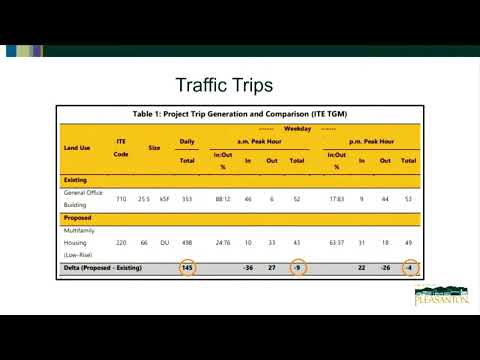
Mike Tassana, the city’s traffic engineer, told the commission the project’s traffic analysis estimates about 145 more weekday trips overall compared with the current commercial use but projects slightly fewer AM and PM peak‑hour trips (about nine fewer AM and four fewer PM). "If you separate that 145 through the busiest 14 hours of the day, that's an extra 10 cars an hour — about one more car every five or six minutes," Tassana said, arguing the change would not worsen peak‑hour level of service on nearby intersections.
Kelly Rachina, representing True Life Companies, told the commission the developer cannot provide underground parking because it is "cost prohibitive," and that a three‑story product is necessary to achieve the density the city identified for the site. "We will continue to collaborate with the city and try to incorporate your feedback," Rachina said.
Commissioners acknowledged the neighborhood’s safety and traffic concerns but repeatedly noted state housing laws and the city’s adopted housing element limit local discretion. Several commissioners urged the city’s traffic engineering staff to continue monitoring conditions and to pursue traffic‑calming, crosswalk or signage improvements if post‑construction data show safety problems. The city’s traffic engineer said many mitigation options exist but some — such as ADA‑compliant crosswalk ramps — carry additional costs and design requirements.
Commissioner Pace moved to approve staff recommendations — including adoption of the AB 130 CEQA exemption, approval of the housing site compliance review under SB 330, the tentative map and the affordable housing agreement — and to remove conditions 42 and 43 as verbally amended by staff. Commissioner Mohan seconded; the motion passed unanimously.
What’s next: the developer may proceed with final map and building‑permit applications consistent with the approved tentative map and conditions of approval. City staff said it will continue to field resident concerns and that traffic‑calming or other safety improvements may be pursued at the city’s discretion if future monitoring shows a problem.