Get Full Government Meeting Transcripts, Videos, & Alerts Forever!
Get email alerts on the Transportation Traffic topic
No spam. Unsubscribe anytime.
South Pasadena staff launch comprehensive study, propose quick safety fixes for Orange Grove Avenue
Summary
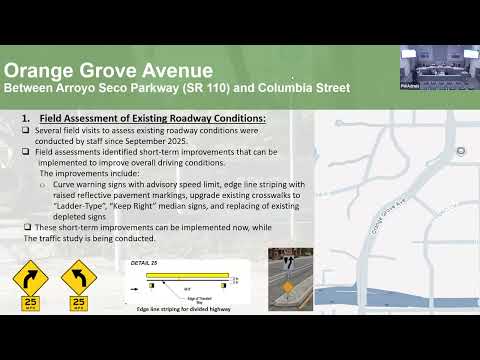
City staff told the Public Works & Infrastructure Commission they hired Gibson Transportation for a comprehensive Orange Grove Avenue study and will deploy short-term safety measures—curve-warning signs, restriping, raised markers—while the study (estimated 3–4 months) develops longer-term options.
City of South Pasadena Public Works staff updated the Public Works & Infrastructure Commission on Wednesday on safety work planned for Orange Grove Avenue, a high-volume corridor running north–south between Columbia Street and the I‑110 freeway.
Bassam, a Public Works staff member, said the corridor carries "approximately 30,000 vehicles per day" and has a posted speed limit of 30 mph. He told commissioners staff has identified hazardous horizontal curvature, fading edge and median striping, and median nose locations that make the route less legible to drivers. "We initiated a comprehensive traffic study along Orange Grove," Bassam said, adding that the city "hired the Gibson Transportation consultant to conduct a comprehensive study on Orange Grove." He said the study will collect speed and volume data and analyze accident history.
Why it matters: Commissioners have flagged a string of serious crashes on the corridor, including recent fatal collisions, and residents submitted written comments about safety at Orange Grove intersections such as El Centro and the area near the I‑110. Staff framed short-term measures as ways to raise driver awareness while the consultant develops alternatives that could include lane‑configuration changes or a continuous raised median.
Short-term measures and timeline: Bassam said staff plans to deploy several quick-build elements in the coming weeks that can be done in-house—adding curve-warning signs with advisory speed plates, refreshing edge lines on medians, installing raised pavement markers, and adding median nose markings. "Some of these quick mitigation measures ... we can implement hopefully in the next few weeks," he said. He estimated the consultant study will take about three to four months to prepare recommendations and community meeting materials.
Commissioner suggestions and next steps: Commissioners suggested additional quick-build items—vertical reflective delineators, chevrons, curb-line edge striping on the wide southbound travel lane to narrow the driving lane, and reinstalling a removed speed-feedback sign. Bassam said staff would ask Gibson to evaluate these options and to include the full Orange Grove corridor from Columbia to Mission in the study so impacts north and south of the freeway are considered. He also said staff will coordinate with Pasadena where the roadway merge originates in the adjacent jurisdiction.
What remains unresolved: Staff said it has not yet received a copy of the most recent collision report; the record of causation for the latest crash remains outstanding. Commissioners and staff agreed to return with Gibson’s study alternatives and corresponding community engagement plans once the consultant completes initial analysis.
The commission did not take a formal vote on the study at the meeting; staff will present draft alternatives and outreach plans when Gibson’s work is ready.